




They called him ‘the Man with the Golden Ear’.
Clive Davis was a figure so powerful that when CDs first appeared in the 1980s, one industry in-joke pretended the discs were so-called after his initials.
The roster of talent he discovered or nurtured was unparalleled. Across a 60-year career, he helped make stars of Bruce Springsteen, Alicia Keys, Christina Aguilera, Neil Diamond, Billy Joel, Rod Stewart, Jermaine Jackson, Luther Vandross and Harry Connick Jr, among dozens of others. Former President Barack Obama said earlier this year: ‘Most people don’t realize how much the music they love was shaped by one man.’
But beneath the gold was a layer of darkness that saw him accused of manipulation, racism, tax evasion and greed. While he lived, many people regarded him as too powerful and controlling to be challenged.
That control was evident when he chose to carry on with his legendary annual pre-Grammy party at the Beverly Hilton hotel, the same location where his most beloved protege Whitney Houston had died that very day in 2012.
An insider told the Daily Mail that even up until his death on Monday at age 94, Davis ‘remained thinking that it was the right decision’ not to cancel the party that night.
Even more disturbing allegations surfaced after the downfall of his other protege, Sean ‘Diddy’ Combs, whose career he launched.
Despite Davis’s claim that he never liked or understood hip-hop, he funneled huge sums of cash to Combs in the mid-1990s, when the star was still known as Puff Daddy – including one payment of $15 million to help him set up Bad Boy Records when Combs was in his early 20s, and another of $50 million.
The two became close friends (even lovers, according to Combs’ rival, former Death Row Records CEO Suge Knight) and at the 2020 Grammys, Davis paid an opulent tribute to Combs. Less than three years later, R&B singer Cassie Ventura launched a high-profile lawsuit against Combs, accusing him of physical abuse, rape and sex trafficking.
Davis funneled huge sums of cash to his protege Sean ‘Diddy’ Combs, whose career he launched, in the mid-1990s
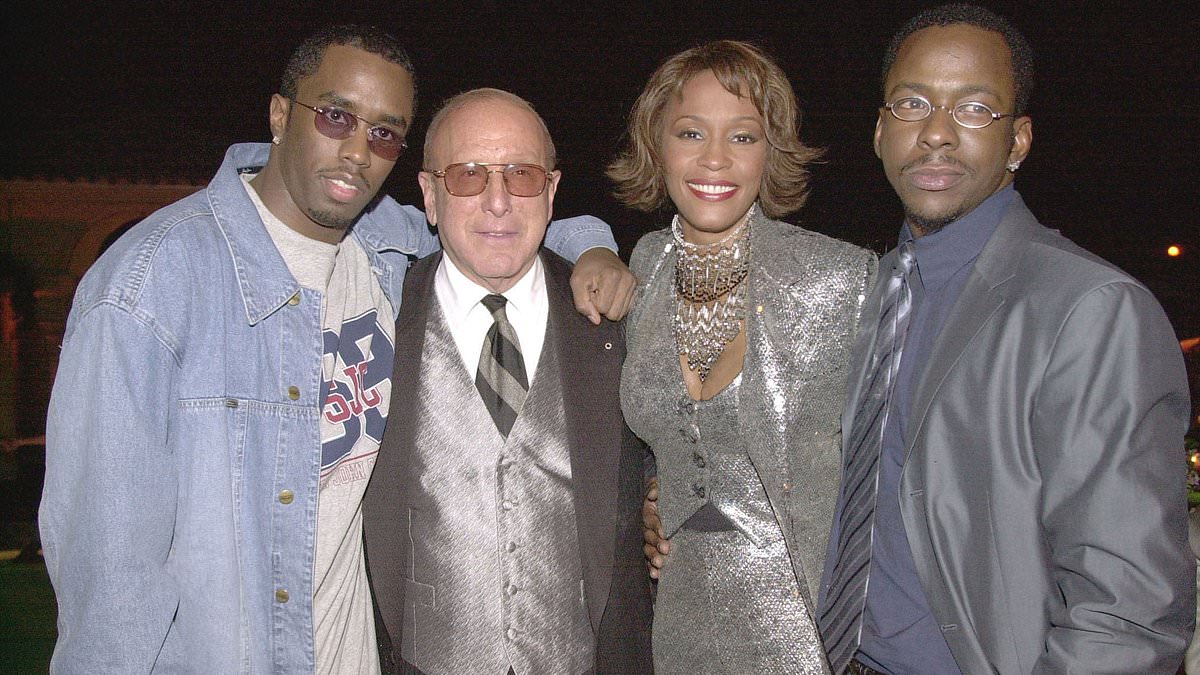
Beneath the gold was a layer of darkness, especially with fallout from Combs’s crimes and the death of Whitney Houston. Pictured: Sean ‘Diddy’ Combs, Clive Davis, Whitney Houston and Bobby Brown
Across a 60-year career, he helped make stars of dozens of artists, including Jermaine Jackson
After Combs was jailed for four years in 2025, an unnamed source told Hollywood reporters: ‘Clive is freaking out. He’s not sleeping well, haunted by the memories of what he and Diddy got up to together. Now he’s terrified that the truth might come out.’
Davis emphatically denied all claims of nefarious association with Combs.
Of course, he helped launch the careers of less problematic artists, though not without controversy: Janis Joplin was so grateful for the way he forced Columbia Records to sign her before she was famous that she tried to urge him into bed – an offer he refused, to her chagrin (‘She volunteered, I declined, let’s just say that,’ he later said.)
At the time, his sexuality was a secret known to very few in the business and he did not come out as bisexual until his memoir, The Soundtrack Of My Life, was published in 2013. He was 82 at the time and had been living quietly with his longtime partner Greg Schriefer for years. While details of how they met are unknown, Schriefer, who works as a realtor and interior designer, is credited with redesigning one of his homes.
As perhaps his greatest protege, Whitney Houston became the biggest star of the 1990s with Davis at her side, after he famously discovered her in a New York City nightclub in the early ’80s. When he first heard her, he said, he felt ‘a tingle in the spine’.
However, critics accused Davis of sacrificing too much of Houston’s natural soul in a bid to win over white audiences with songs that he had handpicked, such as Saving All My Love For You and How Will I Know. Houston, however, often credited him the ‘father’ of her career.
Always obsessive about details, he demanded changes to all her recordings, even down to the slightest change in tempo.
When she was working on the soundtrack for The Bodyguard, he insisted that the first 40 seconds of I Will Always Love You had to be a cappella without a backing track, despite the received wisdom that this would deter radio DJs from playing it. The song went on to spend 14 weeks at No 1 in the US.
Despite their close working relationship, Davis came in for vocal criticism in February 2012 after deciding not to cancel his pre-Grammy party at the Beverly Hilton on the night Houston was found drowned in her bath – in the same hotel.
‘I am personally devastated by the loss of someone who has meant so much to me for so many years,’ he told guests at the party. ‘Whitney was so full of life. She was so looking forward to tonight even though she wasn’t scheduled to perform.
‘Whitney was a beautiful person and a talent beyond compare. She graced this stage with her regal presence and gave so many memorable performances here over the years. Simply put, Whitney would have wanted the music to go on and her family asked that we carry on.’
The decision left a bitter taste for many, even in the final years of his life. After his passing, a source told the Daily Mail that he ‘never listened to the people that said he should’ve canceled it, and it never became the big regret to him that it should have become.’
‘You’d think over the years that Clive would have pondered his thoughts on having his party still go on when Whitney had died in the room upstairs, while people were partying below,’ the source added.
‘Alas, he never changed his tune. His party had so many sponsors, so much money coming through, that when it came down to it, he convinced himself that Whitney would have wanted the show to go on. It is and was very naive.
‘Instead of honoring her, he took the money and rationalized it all.’
As perhaps his greatest protege, Whitney Houston became the biggest star of the 1990s with Davis at her side
Whitney Houston often credited him the ‘father’ of her career
‘Whitney was a beautiful person and a talent beyond compare,’ Davis said at a party the night of her death
Carly Simon was among his critics. ‘His energy, his testosterone, all his hormones were ignited by having the biggest No 1 records,’ she said. ‘He is on the side of the winner at all costs, and the cost can be very high. The cost can be somebody’s career or somebody’s innateness.’
Despite his apparently magical ability to recognize future megastars, Davis insisted his real talent was for simple hard work. To the end of his career, he would take home tape compilations of current hits, studying how the different genres of popular music were evolving in order to keep abreast of trends.
‘A lot of it is preparation,’ Davis said. ‘I study what people are listening to. I’ve always listened to every hit in the Top 40 – to every record that makes the chart, not just the Top 10.’
This was the secret of his ‘Golden Ear’, he insisted. Though he was an avid music fan as a teenager, with a passion for Sinatra and the Great American Songbook, he had no intention of going into the music business when he left school.
Born in Brooklyn, New York City, the son of Jewish parents, he lost his mother Florence when he was in his mid-teens, and his father Herman, an electrician, died a year later. Davis moved in with his married sister in Queens and earned a scholarship to Harvard Law School, graduating at age 24 in 1956.
The small New York law firm he joined happened to have CBS records as a client, and Davis was assigned as their attorney. He rose through the boardroom to become company president by 1967, but it wasn’t until he attended the Monterey Pop Festival the same year, seeing Jimi Hendrix and The Who, that he realized he possessed a gift unimaginable to most music execs.
‘I sensed a total social, cultural, musical revolution, and my peers in the music business had no idea,’ he said. ‘They didn’t see it; they just were not there. That’s probably the epiphany that changed my life.’
Within a few years, he was regarded by musicians as all-powerful, a business guru to everyone from the Grateful Dead to Barry Manilow.
Having risen to the top of CBS’s music division, a report from Vanity Fair describes the ‘freewheeling’ environment in which its ’emperor’ Davis – who had turned the once-slumping business around – had created.
Arthur Taylor, who was made president of CBS in 1972, told the magazine that one male recording artist would be presented with ten young women upon arriving in New York.
‘There were a lot of “whores” hanging around all the time. In the building, out of the building,’ Taylor said, noting there were also ‘aberrational sex shows’ for top customers.
An unnamed executive also noted: ‘We had hookers and sex parties in Columbia Records forever, forever. It was part of the record industry.’
Other celebrations were tamer. To toast to the sheer range of the acts he signed, in 1973 Davis hired the Ahmanson Theater in Los Angeles for seven consecutive nights, for an eclectic and ever-changing bill of his artists – Johnny Mathis, the Mahavishnu Orchestra, Loudon Wainwright and, fatefully, a young singer-songwriter called Bruce Springsteen, long before he became The Boss.
Davis loved Springsteen’s complex wordplay, so much that he once ordered all Columbia staff to gather round television sets and proceeded to read the songs aloud, like poetry.
But he was unimpressed by the rocker’s stage presence – or lack thereof. ‘Bruce, when you’re onstage like that, you can’t just stand there,’ Davis told him. ‘You’ve got to move.’
He also worried that Springsteen had no obvious singles in his repertoire. That was remedied immediately: the singer went away and wrote Spirit In The Night and Blinded By The Light.
Two years later, Davis went to see him perform at the Bottom Line and was mesmerized by the transformation: ‘He was jumping on tables, literally jumping off the stage. After the concert, I went backstage, and he looked up and said, “Did I move around enough for you?”‘
But Davis’s career took a blow in 1973 when Colombia accused him of misappropriating company funds for personal expenses, including the bar mitzvah of one of his sons. Davis denied the charge, claiming invoices totaling $94,000 (about $700,000 today) had been forged in his name by another employee, but he was nonetheless fired.
That same year, CBS reportedly ‘tried to leak all kinds of stuff – that Davis had huge gambling debts, that he was homosexual, or that he was a drug freak of some sort,’ according to Vanity Fair. CBS hit back, calling the claims false and ‘utterly ridiculous’.
Davis came out as bisexual in his 2013 memoir, having lived with his longtime partner Greg Schriefer for years
Davis signed Alicia Keys to Arista Records early on in her career
Setting up the Arista label in the mid-1970s gave a second wind to artists including Aretha Franklin
Worse, Davis was made the scapegoat in Colombia’s ‘drugola’ scandal, with unproven accusations that he approved the distribution of illegal narcotics to help promote his acts. Davis always insisted he was ‘green’ about drug use and had assumed that artists who slurred their words and passed out were drunk, not stoned.
In 1975, he pleaded guilty to filing a false income tax report and was fined $10,000.
He revived his own career by helping others to do the same – setting up the Arista label in the mid-1970s and giving a second wind to artists including Aretha Franklin, Dionne Warwick and Lou Reed. He also helped to launch critically acclaimed art rocker Patti Smith and jazz revolutionary Gil Scott-Heron.
But when artists tried to defy him, Davis could be ruthless. He told Barry Manilow to ditch any dreams of writing his own material and instead record the songs that were given to him. ‘If you were Irving Berlin,’ he said cuttingly, ‘we would know it by now.’ Their friendship never recovered.
Davis died on Monday at his Manhattan home following a spell in hospital with respiratory problems. Both his marriages, to Helen Cohen and Jenet Adelberg, ended in divorce, and he subsequently lived with his partner, Schriefer. He leaves four children, eight grandchildren and a fortune estimated at $850 million.
Read the full article here