






Watch enough biographical documentaries on film and television and it becomes difficult not to think that filmmakers are making a tacit judgment linking running time and a life’s merit.
Judd Apatow has new documentaries on Mel Brooks, at four hours, and Maria Bamford at 115 minutes, which seems longevity-based. Derek Jeter got a five-episode docuseries, while Yogi Berra’s recent documentary was only 98 minutes, which seems recency-based. The Beatles have had at least 15 hours of documentary time dedicated to them in the past few years, while Milli Vanilli’s documentary was only 106 minutes, which… is fine.
Troublemaker
The Bottom Line
Not much depth, but a solid primer.
Venue: Sundance Film Festival (Premieres)
Director: Antoine Fuqua
1 hour 34 minutes
So you wouldn’t be wrong to look at the 94-minute running time of Antoine Fuqua‘s Troublemaker and think that it will be nearly impossible to do justice to Nelson Mandela in an hour-and-a-half.
Your concern would not be unfounded.
Troublemaker, which takes its title from Mandela’s birth name, Rolihlahla, or Xhosa for “Troublemaker,” is definitely a cursory biography — one that feels narratively rushed at every turn and practically demands having a laptop handy for emergency Googling of underserved events or people.
You could tell the story of Nelson Mandela in proper depth with a quality eight-hour documentary — going deep on the origins of apartheid, acknowledging the impact of many of his contemporaries, probably examining some of the complexities of his ideology and celebrity in a way that makes him human and doesn’t feel like pure hagiography.
Using interviews conducted for Mandela’s autobiography as its spine, Troublemaker is pure hagiography. Still, having Mandela’s voice guide you through even a sanitized version of his life feels important and, in places, unnervingly timely. Needless to say, Mandela’s story still matters.
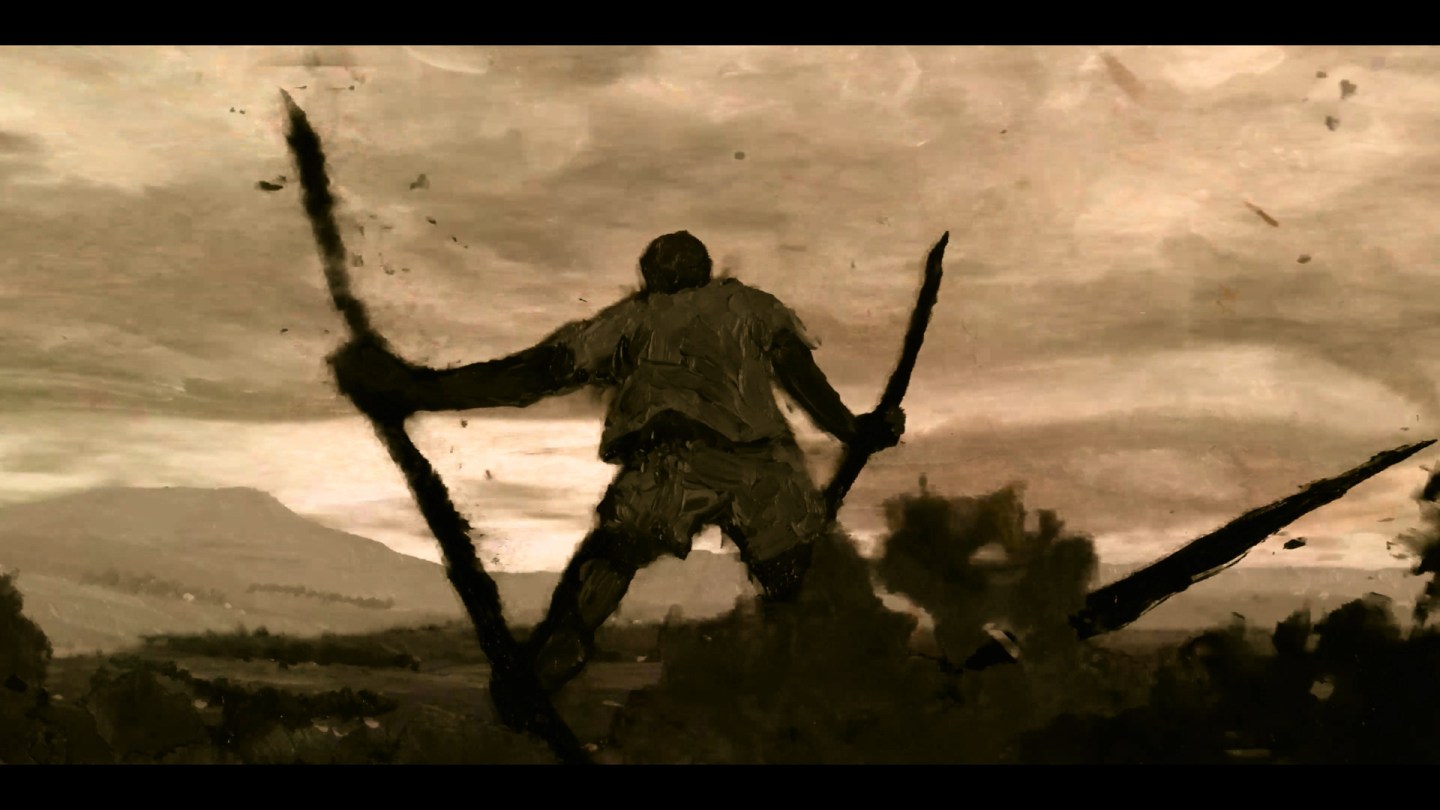
Plus, Fuqua finds smart ways to visualize that story, particularly through the animation by South African visual artist Thabang Lehobye, which is surely the thing I will come away from Troublemaker remembering.
The audio in Troublemaker comes from 1992 and 1993 interviews of Mandela by journalist Richard Stengel, interviews that contributed to Mandela’s 1994 memoir, Long Walk to Freedom, previously adapted as a 2013 film starring Idris Elba. (The film had a running time of 146 minutes. And felt too short.)
Mandela’s own words offer a bracing reminder that his path was not one of exclusively peaceful resistance. He was one of those figures whom the media turned into a teddy bear after he was old and less able to be a firebrand, but his fight against a fascistic regime was unyielding and uncompromising. It also wasn’t a fight he commanded alone, and Troublemaker is able to name many of his mentors and collaborators, but not give them anything resembling voices or personalities of their own. Add wives Evelyn and then Winnie to the long list of people it’s impossible to come close to understanding with the story zipping by in a manner this fast and this choppy.
Fuqua allows the doc to be governed by the structure and, largely, the limitations of the Mandela/Stengel interviews, which start by addressing Mandela’s childhood and stretch through his years as a revolutionary, his decades as a political prisoner and then his release and election as South Africa’s president.
Because Mandela was not writing a history of apartheid, Fuqua has to explain things with two or three lines of onscreen text to start the movie. Because the interviews ended in 1993, the documentary reaches a certain biographical point and just stops. Because Mandela had, over his years on Robben Island, written his own history of his incarceration, there was less reason to back-and-forth on it with Stengel, so his commentary becomes sparse.
It’s here that Troublemaker unveils the person who is both the documentary’s secret weapon and its source of greatest aesthetic confusion. For more than half of its running time, Troublemaker sticks semi-strictly to Mandela’s own perspective, expanding only with the inclusion of television news/archival footage. Then, as Troublemaker gets to what could be the most gripping part of its story, Fuqua turns things over to fellow activist and fellow Robben Island prisoner Mac Maharaj, who delivers what can only be described as a deus ex Mac-ina to push the story forward with his own memories, more harrowing and detailed than anything Mandela was feeding to Stengel at that point.
As valuable a figure as Maharaj is — his biography could easily sustain a feature-length documentary — it’s strange to treat him as a human who exists only in terms of Mandela’s plot. It’s even stranger to have a doc that, for an hour, is entirely without talking heads or ANY voices outside of Mandela, and then suddenly is like, “Oh, but now we’re changing our style and having exactly ONE talking head. Oh, and he’s an executive producer on the documentary!”
What Maharaj does to pick up the slack in the narrative, Lehobye does to pick up the slack in the visuals. The animation is bold and evocative, sometimes heavy on symbolism — illustrating, for example, why “Rolihlahla” can mean both “troublemaker” and “pulling the branch off of a tree” — and other times representing private conversations and moments, like the first meeting between Mandela and F.W. de Klerk, an event where no cameras were in the room where it happened. The editing by Jake Pushinsky relies heavily on dissolves to blur the line between old news and archival footage and newly shot depictions of the locations, usually treated in black and white. Lehobye’s animation slides right in and creates dreamlike transitions.
As every generation gets farther from Mandela’s life and death, as each generation — not so much in South Africa, probably, but much of the world — forgets what apartheid was and how it ended, it becomes more necessary to have a handy primer. I just wish Fuqua had tried to make Troublemaker longer than that Milli Vanilli documentary.
Read the full article here