




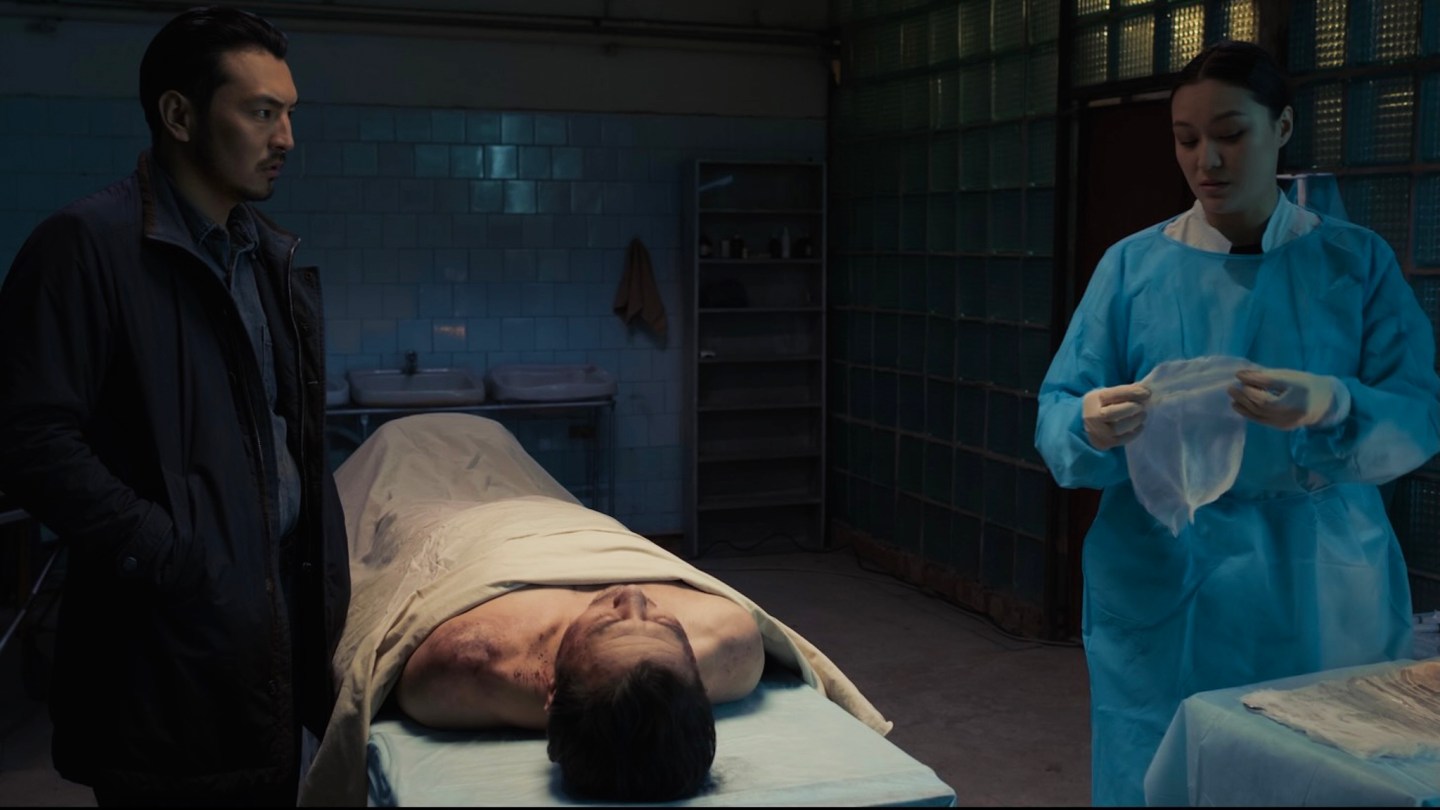


Ready for nature neo-noir from Kyrgyzstan?! If so, you may want to wrap up for Mergen, filmmaker and producer Chingiz Narynov’s second feature as a director, which will have its international premiere at the International Film Festival Rotterdam (IFFR) on Friday, Jan. 30. After all, it takes us into the snow-covered Tian Shan mountains of the Central Asian country, which used to be part of the Soviet Union. But don’t get too comfortable because personal and historic traumas and demons lurk beneath the gorgeous landscape.
They haunt police officer Nurtay, portrayed by Omurbek Izrailov, who is investigating a death after a vlogger accidentally comes across a body in the wilderness surrounding a former gold mining town. He soon looks into local crime boss and poacher Kerym, played by Nazym Mendebairov, in an effort to uncover what may be a vast conspiracy. Kalipa Tashtanova also stars in the film as Janyl, who Kreym guards stringently. Jo
The screenplay for Mergen was written by Aikyz Gaparova, cinematography was handled by Urmat Tendik, with Natalya Polyakova serving as editor. Aida Usonova and Narynov produced the movie from Citylab Films, in partnership with Kyrgyzfilm, the largest and oldest film studio in Kyrgyzstan. Citylab is handling sales duties on the film, which won the Grand Prix for best film in the Central Asian Competition at the Bishkek International Film Festival in Kyrgyzstan.
Narynov studied film in St. Petersburg, Russia, and did a three-month course in documentary filmmaking at George Washington University.
In his social issue-driven first feature, After the Rain, he explored the problem of bride kidnapping, meaning the abduction of a woman or girl by a man and accomplices for the purpose of forcing her into marriage, in his home country.
The social crime drama Mergen sees him using Kyrgyz mythology to explore mankind’s relationship with nature, power, and money, along with lingering colonial legacies.
The IFFR website promises audiences that the film, screening in the fest’s Harbour strand, which “offers a safe haven to the full range of contemporary cinema,” reveals “the deep undertow of violence beneath the placid exterior of this apparently peaceful rural community.” At the same time, the unfolding mystery also sparks a reckoning for Nurtay.
Narynov talked to THR about Mergen, filmmaking in Kyrgyzstan, and working across documentaries and fiction features.
In Mergen, you mix crime thriller and genre aspects with social and environmental issues. Can you talk a little bit about the inspirations for the film?
My screenwriter Aikyz Gaparova and I wanted to make a film about the problems of Kyrgyz society, the problems that we see now, that we witness, that we experience. And we decided to make it based on two very old Kyrgyz epics, one being called Kozhozhash [in which a greedy hunter kills more animals than he needs]. In the other, Karagul Botom, there is a father who accidentally kills his son because he thinks he is an animal.
So, the theme of ecology and preserving nature, and the importance of being in good relations with nature, is very deeply rooted in Kyrgyz myths and literature.
The problems that we are witnessing and showing in the film are very modern. It’s about ecology and our very predatory attitude towards nature and towards our resources. Also, there is a gender problem, with one of the female characters living in this patriarchy, hurt by the figure of the businessman. But he is not really a businessman. Since I made this film mostly for Kyrgyz people, in Kyrgyzstan society, this particular type of man is very recognizable. He knows the local authorities very well, and he is doing shady business. So, all of this comes together in this story.
We see a kind of fog or smoke in Mergen, which I interpreted as a personification of nature. Can you maybe explain that?
Yeah, this fog is indeed a personification of nature. In our story, gold mining happened during the Soviet era in this sacred valley. We actually have a lot of sacred places in Kyrgyzstan, places where you go to pray to ask for a new baby, for example, or a house or help with your problems. In this place, during the Soviet era, it was an era of socialism, communism. So, religion was oppressed.
[SPOILER WARNING. This paragraph includes story spoilers]
And there as these explosions [related to the mining efforts] that trigger the spirits of the mountains, represented in this fog that covers all the town. And the most sensitive people, like Nurtay and his father, feel them [and the father goes insane].
This town and its surrounding nature are beautiful, but you see and feel socio-economic problems and challenges behind the facade. You are based in the capital, Bishkek, but can you share some insight into the issues that smaller and more remote places in Kyrgyzstan face?
Bishkek, the capital, is doing pretty well right now. We have a lot of building construction and economic activity, but the smaller cities look very sad, and I hope that you can feel it in the film. During the time of the Soviet Union, these small cities were built around a main factory or plant that people there were servicing. After the collapse of the Soviet Union, these factories were abandoned, and the people were also abandoned.
In one of the places where we shot this film, there were 20,000 people during the Soviet era, and now only 3,000 people are living there, mostly working in tourism, like horse riding services. So, there are a lot of empty buildings, abandoned and without any windows. They look very, very sad. It’s one of the pain points that I wanted to include in this story.
That also feels like quite a universal theme, similar to your themes of humans’ relationship with nature. Have you received much feedback from abroad about the universality of the issues you portray in Mergen?
I haven’t really heard a lot of feedback yet, because we had our world premiere at the Bishkek Film Festival. There were a lot of local people, and we had a lot of conversations about the problems in Kyrgyzstan, in our society. I’m really curious how it will be received in other countries. So, it’s really exciting to bring the film to Rotterdam. I’m feeling really honored to be part of the Rotterdam Film Festival, and it will be my first time being there.
What can you share about the cast of Mergen and how you found your actors?
The casting process was pretty long. We had a lot of auditions. But when I did the audition with Omurbek, I immediately felt that he was the right option. For Kerym, the main antagonist, we had almost three months of nearly daily auditions with different people. But in the end, we settled on one of our very famous actors in Kyrgyzstan. Nazym Mendebairov is very well known and is very popular, and he has a reputation for playing bad guys. He plays them perfectly. And Kalipa is also a very famous actress in Kyrgyzstan. But the big discovery that we made is Tilektesh Usenakunov, who plays Turdukul, this big guy, who is not an actor. He just did some stunts and worked as a bodyguard previously. And the guy who plays the investor Jacob is Toon Cavens, a [Belgian math teacher] who is also not a professional actor. He’s a teacher in a school in Kyrgyzstan. We have these private schools with English-language teachers. So he’s teaching math in English.
You have worked on documentaries and fiction features. How is it to go between factual and fictional work?
I was originally thinking about myself more as a documentary filmmaker. Now I think I’m both. My first serious project was a [45-minute] documentary called Metal Bread [about a woman in an all-but ghost town in Kyrgyzstan].
Before I let you go, please tell me a bit about the production company Citylab.
This film was made in partnership with Kyrgyzfilm, our national film studio. Citylab started as a collective of young filmmakers when it was founded in 2010. Now, we are not so young anymore. (laughs)
So we started as a collective. Now it’s a production studio. We do a lot of video work, from documentaries and corporate stuff to production services for other companies that want to film here in Kyrgyzstan. But now, I think we will be making a pivot. We always wanted to make our own feature films, and now I feel that we have the capacity and experience to pivot to producing films.
Read the full article here