






We may often think of islands as places of refuge and peace. But that is not the case in young German writer-director Kai Stänicke’s feature film debut Trial of Hein (Der Heimatlose). But if you have had an experience of returning home to find that both this home and you yourself have changed, you will recognize the simmering tension and psychological undertones of this cinematic exploration of identity, memory, belonging, and the restrictions that communities can impose on us.
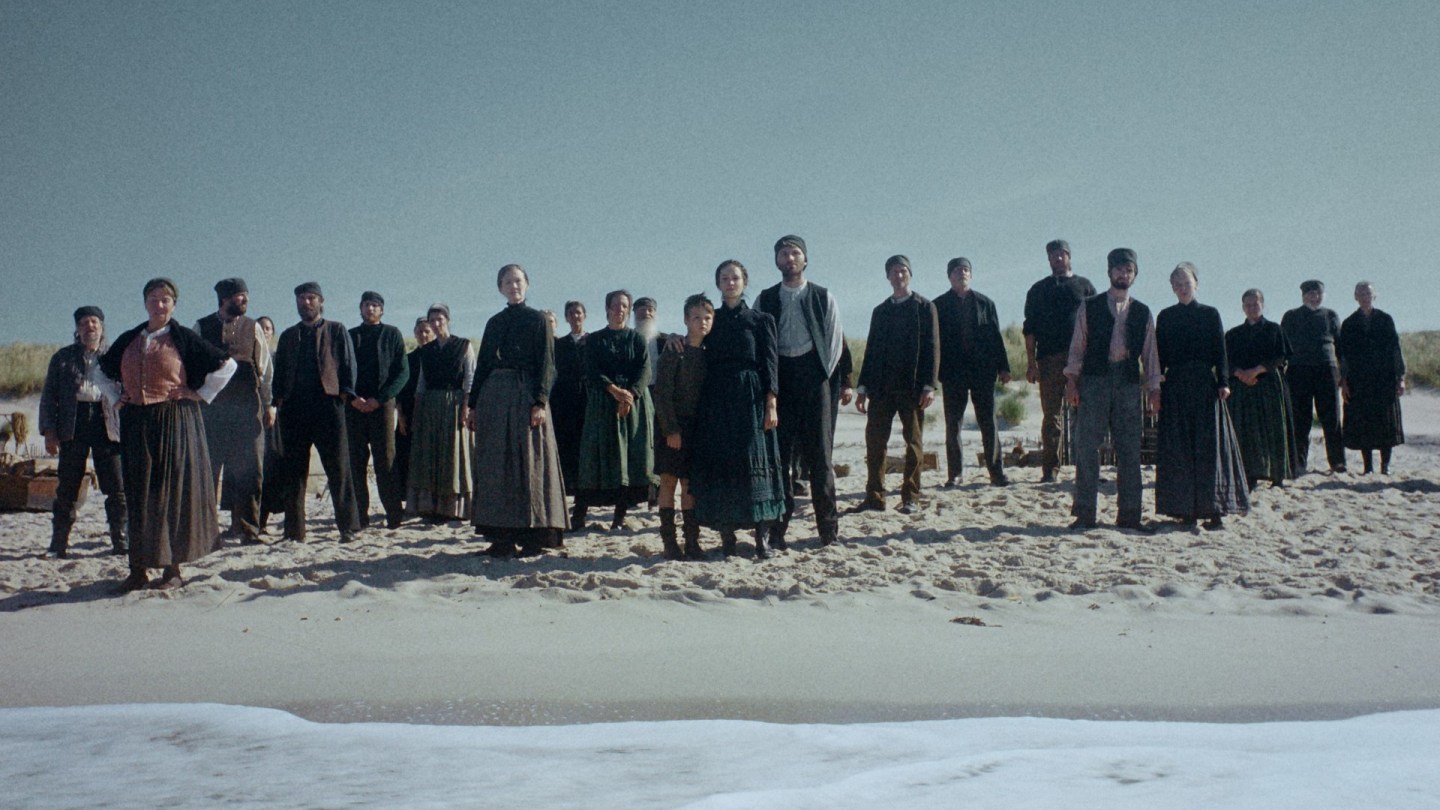
The film tells the story of Hein, who, after 14 years on the mainland, returns to the place he is from, the only village on a remote island in the North Sea. To his surprise, the close-knit community no longer recognizes him. That is even true for his childhood friend Friedemann, who distances himself from the visitor despite their once unbreakable bond. The island community even convenes a village court to determine whether Hein is who he claims to be. The court hearings make evident that Hein’s memories of his youth sharply differ from the recollections shared by witnesses. The mood in the village shifts from suspicion to open hostility as the locals become more and more convinced that Hein is an impostor.
“On the verge of losing everything, Hein desperately searches for proof to validate his memories – only to realize what he has long refused to see,” teases a synopsis. Indeed, Trial of Hein takes us onto the terrain of self-deception and self-acceptance.
The movie, world premiering at the Berlin Film Festival as the opening film of the Perspectives section of new voices on Feb. 13, stars Paul Boche, Philip Günsch, Philip Froissant, Emilia Schüle, Jeanette Hain, Sebastian Blomberg, and Stephanie Amarell. Written and directed by Stänicke, the film features cinematography courtesy of Florian Mag, with editing handled by Susanne Ocklitz. Heretic is handling world sales on the movie produced by Tamtam Film, and co-produced by Lupa Film.
The script for his debut feature film secured Stänicke, who has previously made live-action and animated shorts, such as Gay Goth Scene, Circle, and Pace, a place in the Berlinale Talents Script Station and a Wolfgang Kohlhaase scholarship.
Stänicke talked to THR about the inspiration for and themes explored in Trial of Hein, how his personal experience played into it, and what’s next for him.
What was the genesis of Trial of Hein?
The story is deeply personal to me. In some ways, it’s my story. And it’s based on my own experience. I grew up in a small rural town in Germany in the 1990s, and growing up there, I felt that I couldn’t truly be myself for much of my youth. As a kid and as a teenager, you don’t fully understand it, but when I moved to larger cities to study, I finally accepted parts of myself that I couldn’t before.
And when I came back to my hometown, I had so many emotions. Most of all, I felt that it was another life that I had lived there. It was a life that wasn’t really my own, or it wasn’t fully my own, and I could never go back to this life. This is where the core idea for the film came from.
I loved how Hein’s story also felt timely and like something I could relate to and probably a lot of other people can understand, even though it’s set on a non-specified German island in a past that isn’t fully defined…
I always wanted to make it a bit of a parable. I wanted it to have this universal quality. The historic setting and the island, and all of these decisions were made because I wanted it to feel like a universal fairy tale, in a sense. For me, it was important not to pinpoint an exact time and location.
The [COVID] pandemic actually helped a lot with the writing. During that time, I stayed at my parents’ place. They live in a small farmer’s village now. And while everyone was in lockdown, I wrote the first draft of the script. I think a lot of people could already relate to the story when reading the script, including people who don’t have a queer background like me. My experience with the script was that many people have ambivalent feelings about their home and where they come from, or about returning home.
Can you tell me a bit more about the island as the location for your fairy tale?
An island felt like the natural choice because it can be quite isolated. The island in the film is, in a way, at the end of the world. It’s somewhat otherworldly. I also wanted the community to be very reclusive and close-knit, so I introduced the island in the script very early on.
Did you actually shoot on an island?
Yes, we shot on actual islands, two different German islands, Sylt and Norderney. But when you see the island in a wide shot in the beginning, that is a VFX shot, because the islands themselves are much bigger.
Tell me a bit about your cast and how you found Hein and the other characters.
I had amazing casting directors, Liza Stutzky and Andrea Rodríguez. Paul Boche is fantastic as Hein and really gave his all to the role. Some of the cast members are also quite well known in Germany, including Emilia Schüle, Jeanette Hain, and Sebastian Blomberg. People loved the script from the start and could see the potential of the film, so we were very fortunate that everyone wanted to be part of it.
Was it just me, or did you write in old or at least old-sounding language?
Yes, the film features historic language and a theater-like setting, which is not easy for an actor to portray convincingly. They all did an amazing job, and with the language and setting, you can fully immerse yourself in the story and truly feel what the characters are feeling.
Since you mention the theater-type setting, I loved that you used houses, which have walls missing. How did you make that decision or how did that come about?
Actually, this idea came out of budgetary constraints. We didn’t have the money to build an entire village. The village court was always planned as an amphitheater, so I thought: since I wanted the story to be a parable, how could we push this even further? I was inspired by Dogville by Lars von Trier, one of the films I deeply admire. I took this theater-stage aesthetic and merged it with the island.
I felt at some point that this place doesn’t need buildings with walls because all the characters have such walls inside of them…
I think it worked really well for the themes of the story, such as performing roles. When are you yourself, and when are you not? It’s like you’re always on a stage, you’re always performing. But what was especially important for me in this approach was that we don’t lose the connection to Hein, so you can fully immerse yourself in the story. I tried to counter any sense of distance with the cinematography, staying really close to Hein using a handheld camera, in a kind of documentary style.
The people on the island play this card game called “Lügen” (Bullshit). Is that a real game?
It is an actual game, but it has different names in different regions. It is actually called Lügen where I come from.
Memories differ between the island inhabitants and Hein. Tell me a bit about this theme of different narratives in people’s heads!
When I talked to people about my experience growing up queer, even my family or close friends, and shared what I went through or struggled with in childhood, they were often surprised. They didn’t know. Then I realized that I had kept it all inside; I hadn’t really shown it on the outside. That tension fascinated me: what is the value of a memory if it’s only based on external observation? My experience was so different from what everyone else thought I had experienced, and for them, the memory would be completely different. That tension is what the idea of the court is based on. What is the true memory? Hein goes through this process of trying to figure out which parts are truly him and which are just a performance for others.
The whole theme of people excluding others who may, or in this case – may not, be different seems quite timely…
I had the first idea for this film 10 years ago. And very often, in the process of making this film, I felt like maybe I was a bit too late with this story. And then suddenly, now that the film is done, things in the world are kind of reversed, and it’s feeling so timely again. I was surprised by that.
I hope we will see more feature films from you. Any new ideas or plans?
I hope so too. Filmmaking has been my dream since I was 12 years old. I used to shoot homemade versions of my favorite films with my classmates. Some of them are even coming to the premiere at Berlinale. It’s a full-circle moment.
So yes, I hope to make more films, but I’m really grateful and happy that we have this opportunity now to show this film at the Berlinale in Perspectives. I’m really excited, and a little nervous, to share it with the world.
Read the full article here