





Greenland’s film community has spent years fighting to be seen on its own terms. In recent weeks, as U.S. rhetoric about taking control of the Arctic territory — “if necessary by military force” — has escalated, that struggle has taken on a sharper urgency.
“I think a lot of Greenlanders, myself included, are just tired. It’s so emotionally draining,” says Greenlandic film producer Inuk Jørgensen. “The recent rhetoric feels like it’s gone up a notch, and I think that really affects a lot of people. Even though people are very united, but people are drained. People are very tired of this.”
The past few weeks have seen tensions spike dramatically. After a high-stakes meeting in Washington this week between Greenlandic and Danish officials and senior U.S. figures failed to ease the standoff, European allies moved quickly to show support. Troops from France, Germany, the U.K., Norway and Sweden have been sent to Greenland as part of joint military exercises led by Denmark, under Operation Arctic Endurance. Danish Prime Minister Mette Frederiksen called Greenland’s defense a “common concern” for NATO, while reiterating that there remains a “fundamental disagreement” over Washington’s ambitions.
“The American ambition to take over Greenland is intact,” Frederiksen said in a statement on Thursday. “This is obviously serious and therefore we continue our efforts to prevent that scenario from becoming a reality.”
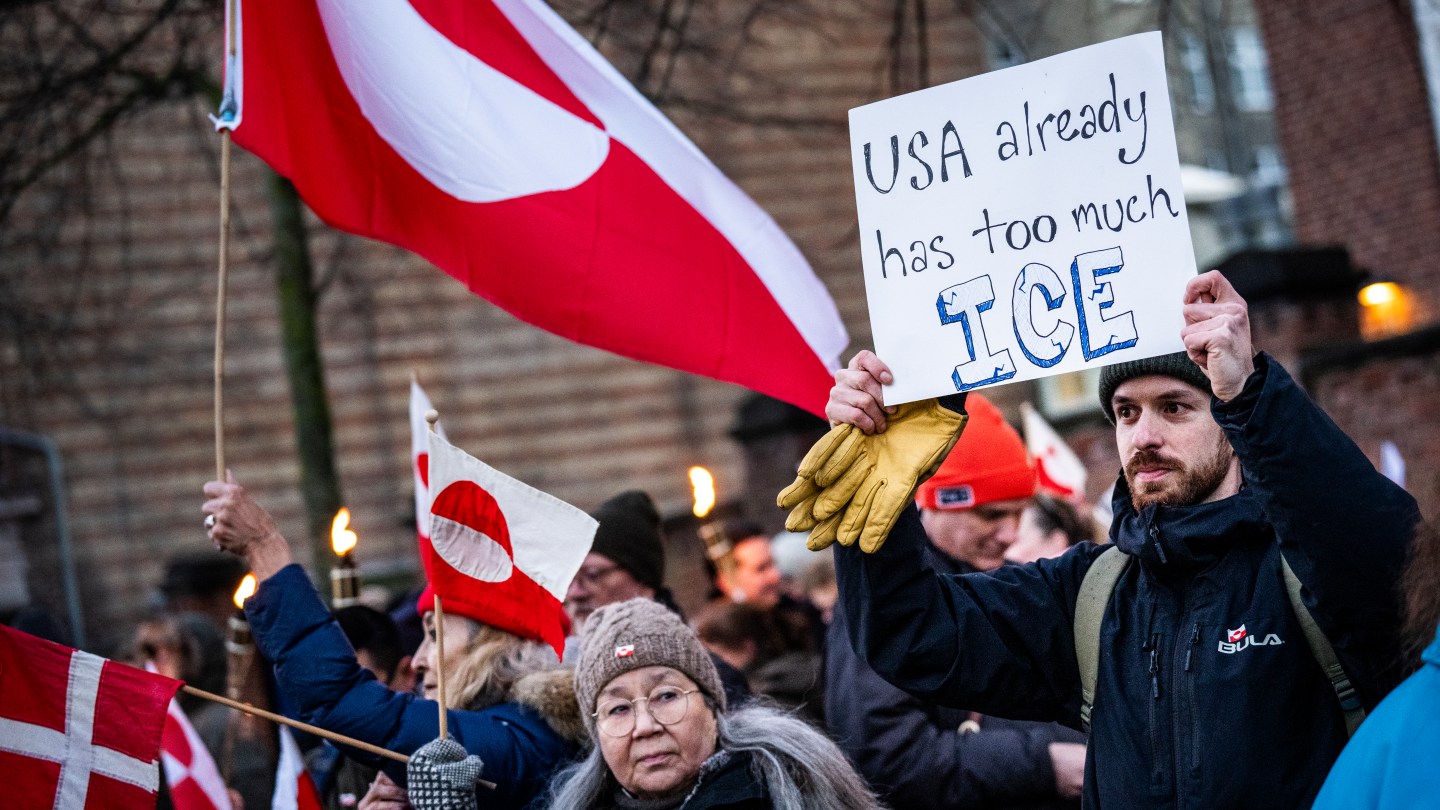
On the ground in Nuuk, the symbolism has been impossible to ignore. Inuk Silis Høegh, director of award-winning music documentary Sumé: The Sound of a Revolution and the TV history series History of Greenland and Denmark recalls a visible shift in public mood when the threat of force was raised again. “A few days ago, when [Trump] repeated this claim and that they might use military force, people here started hoisting the Greenlandic flag everywhere,” he says. “I think most people see it as a lack of respect: Trying to buy us, or take us by military control. Or speaking over the tops of our heads, straight to Denmark.”
That sense of being talked about, rather than listened to, cuts particularly deep for artists. “One of the things I think hurts a lot of Greenlandic filmmakers and artists at least, and Greenlandic people in general, is that a lot of international media talk about us like a commodity to be exchanged,” Jørgensen says. “The talk is all done over our heads … It underlines the value of what we in the Greenlandic art community have been fighting for for many years: To tell our own stories about us and our place in the world.”
Høegh says the latest claims coming out of Washington have been accompanied by what he calls a distorted narrative. “All the ‘facts’ they are putting out about us, most of it is not true,” he says. “They’re trying to make a story about us wanting to be a part of America, that we’re so fed up with Denmark.” He points to polling and public sentiment at home. “The vast majority, 85 percent, 90 percent of the population does not want to be American.”
If the pressure has sparked fear, it has also forced a reckoning around identity. “I feel that we were kind of under attack, and we’ve never been before,” Høegh says. “People who used to post pictures of their morning coffee are posting long posts about who they are as Greenlanders, what they want. It’s forcing people to think about their identity. So in that way, it’s healthy.”
Jørgensen describes a similar mix of anxiety and resolve. “Every day I wake up and I check the news, something new has been going on,” he says. “Because of the fact that this is going so quickly, the Greenland people can sometimes feel that they’re not part of the conversation about them.” The uncertainty is personal as well as political. “I do fear that the Greenland that will be here in a year won’t be the same Greenland that I know, that I love and where I do my work. I’m hopeful for the best, and I hope cooler heads will prevail, but, like a lot of Greenlandic people, I’m also afraid.”
At the same time, filmmakers say the moment has brought renewed attention to Greenlandic stories — and tangible support from abroad. “I wouldn’t say it’s been positive, but this has definitely put a spotlight on Greenland, on Greenlandic stories,” Jørgensen says. “Even when I travel internationally, to film festivals in Europe or to Toronto, people are showing really heartfelt support for Greenland, and for Greenlandic filmmakers.”
That support has been particularly strong from Europe’s film institutions. “Within the Nordic and European community, I feel there’s a strong sense of wanting to show that Greenland is included,” Jørgensen says. “Because of our Nordic and European partners, because of this whole crazy situation, we are maybe able to punch a little above our weight.” He singles out the European Film Academy, as being “very inclusive” of Greenlandic filmmakers. “They really want Greenland to have a seat at the table, which is fantastic. Growing up in Greenland, I never saw a Greenlandic person having a seat at the table.”
European Film Academy CEO Matthijs Wouter Knol says that connection long predates the current crisis. “Greenland is one of the countries where members of the European Film Academy live, so they’ve been for many years an active part of our community,” he tells THR. In recent years, that relationship has deepened through youth initiatives, training programs in Nuuk and support for building a stronger industry infrastructure. Just this year, Greenland set up its first national film agency, the Kalaallit Nunaanni Filminstitutti (Greenlandic Film Institute), to coordinate and promote local and visiting productions to the island.
Next week, the European Film Academy will host a spotlight on Greenlandic cinema on its VOD platform for Academy members. The event, scheduled before the latest political escalation, now feels pointedly timely. “We’ll focus on Greenlandic cinema and highlight basically the work of our members,” Knol says, “but also give a better view of what is Greenland and what is important in Greenland.”
For Høegh, the stakes are not abstract. Greenland has often been framed through an outsider’s lens, he says, and the current moment only sharpens the need to reclaim that narrative. “As a filmmaker, it just reaffirms that we want to tell our own stories,” he says. “It seems like for a lot of film history, it was mostly foreigners coming to tell the story of Greenland. We want to take that narrative back.”
The rhetoric has even begun to filter into how stories might be told on screen. “In the American movies, the bad guys are the Russians or the Chinese,” Høegh says. “But now, I think, you might see some stories coming out of Greenland where the Americans are the bad guys.”
Despite the troop deployments and diplomatic brinkmanship, Høegh does not believe Greenland will disappear under outside pressure. If anything, he sees a hardening of resolve. “We need to show we are here and we have a strong identity,” he says. “We’ve been here for 1,000 years. No one else has been able to survive here. This is our land and no one is going to tell us who we are or how we should live.”
Read the full article here