






From the penultimate floor of London’s luxe 45 Park Lane hotel, the capital’s skyline is betrayed by dreary, grayish clouds.
This is not only extremely typical weather for the sun-starved population here in the U.K., but provides us Brits with a much-needed small talk starter (it’s either that or the selection of fruit and pastries up for grabs on the coffee table).
So, the publicists, makeup team and fellow members of the press — all of us peering out of the floor-to-ceiling windows with a grimace — begin doing just that. We lament our seasonal woes and reminisce on brighter days, and while I’m led into a larger room with even grander windows, Jack O’Connell throws in his two cents: “I love winter.” He looks the part of a man having to get on with the movie press in a dull January, wearing a cream, knitted sweater and black trousers. He picks up an apple and bites into it.
“I love winter,” he says again, eyes fixed on the rainy horizon. An innocuous comment to most, but for a detail-obsessed entertainment journalist with a soft spot for flamboyant writing, it’s something else entirely. The actor’s statement is a telltale glimpse into the unpredictability of Jack O’Connell, a hint of the contrarians we’re accustomed to seeing him play onscreen, and a fabulous example of the off-the-wall energy with which our conversations are immediately fired up by.
The 35-year-old is having one hell of a year, catching his breath after starring in Ryan J. Coogler’s slick vampire film Sinners, which has gone on to dominate awards season. On Sunday, Coogler, Michael B. Jordan and crew took to the stage at the Golden Globes to accept the award for best box office achievement, having accrued a cool $368 million.
When The Hollywood Reporter last caught up with O’Connell, his charming, bloodsucking Remmick was just about to hit theaters. “It would have been audacious,” the Brit laughs about anticipating the kind of success Sinners would go on to chalk up. “It sort of fills me with the promise about cinema-going. I think we’re in quite a frightened era,” he says, “especially people involved in film [who] are really desperate to know what the future is going to hold. So for people to go and watch Sinners, it’s really, really reassuring. There’s a resilience there. And long may that continue.”
The actor’s signature roguishness dates back to the ’00s, when a Bristol-set teen drama called Skins was airing and, it would turn out, producing a young talent pool of superstars. A 17-year-old O’Connell played Cook — a boisterous Jack the Lad character, you won’t be surprised to find out — alongside Kaya Scodelario and Luke Pasqualino. They took over from the first generation led by Nicholas Hoult, Daniel Kaluuya, Dev Patel, Joe Dempsie, and Hannah Murray.
“It was university to us, do you know what I mean?” says O’Connell when asked about how formative his time on Skins was. “It taught us to turn up on time and deliver. At the age where everyone else was at university, we got to spend that period of our lives in Bristol making the coolest program ever.”
Since then, he’s constructed a résumé marked by variety. This includes David Mackenzie’s 2013 prison crime drama Starred Up, seductive 2022 historical romance Lady Chatterly’s Lover with Emma Corrin, Michael Mann’s racing drama Ferrari (2023) and Sam Taylor-Johnson’s Amy Winehouse biopic Back to Black (2024). If you’re more partial to watching us Englishmen on TV, maybe O’Connell’s most recognizable as British Army officer Paddy Mayne in Steven Knight’s ongoing BBC drama SAS: Rogue Heroes.
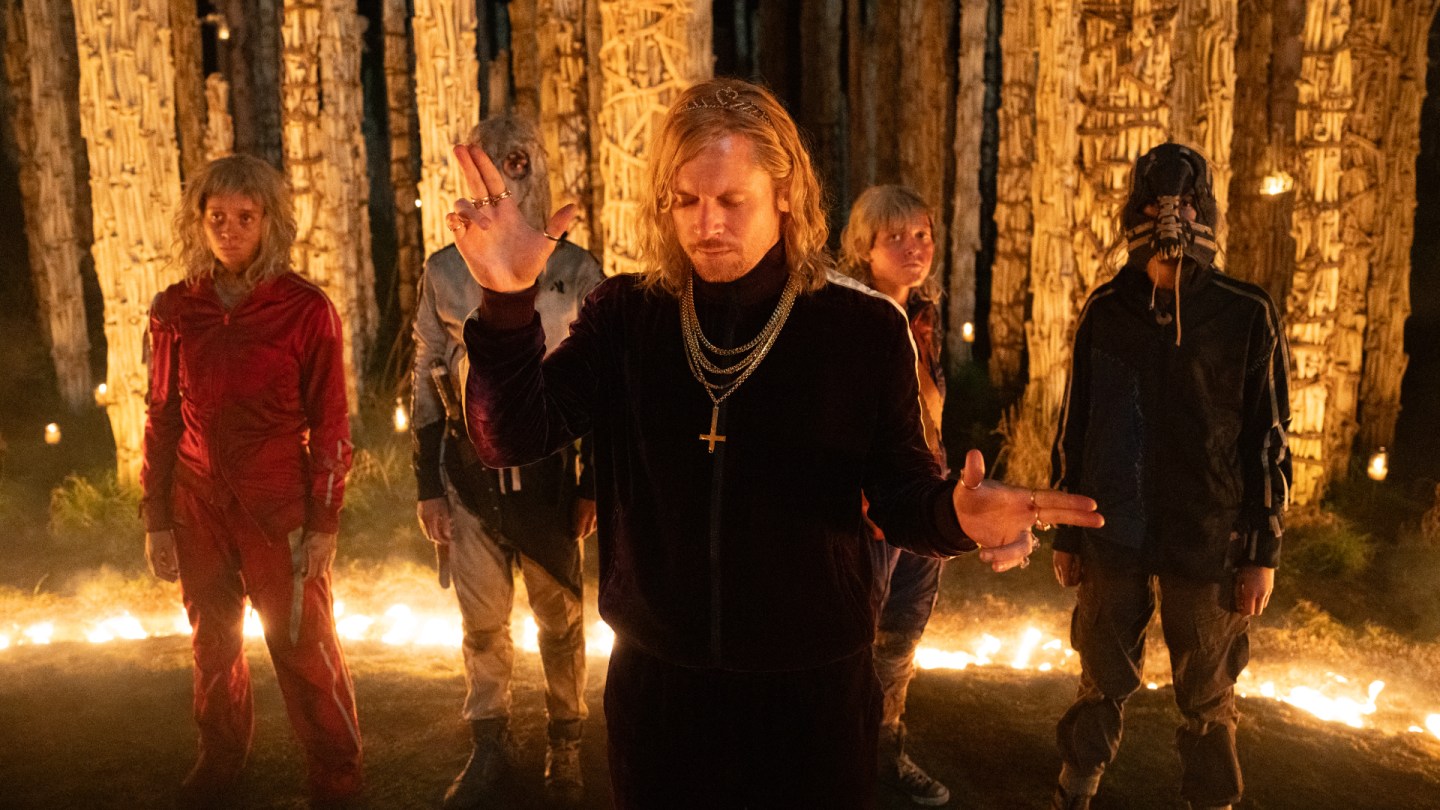
But we’re at the hotel to discuss what might be O’Connell’s most outrageous role to date. He’s about to blow minds as the bleach-blond cult leader Sir Jimmy Crystal in 28 Years Later: The Bone Temple, out Jan. 16 and again penned by Alex Garland. Nia DaCosta‘s wild ride of a zombie sequel picks up right where Danny Boyle left off in last year’s installment, spinning the hit horror franchise on its head and putting the psycho-social ramifications of the infection under a microscope.
Our teen protagonist Spike (Alfie Williams) has ditched the self-sufficient survivor community on an island off the coast of Northumberland, England, only to find himself at the behest of Sir Jimmy’s satanic appetite for torture. Ralph Fiennes returns as bone collector Dr. Kelson, who eventually crosses paths with Sir Jimmy’s twisted ideology and his “fingers” — the wig-wearing minions weaponized by their charismatic kingpin.
“I got sent a script, so I was left to kind of make up my own mind,” begins O’Connell about his introduction to the blinged-out Scot. “I was reading all of these characters on the page, and I think part of me was drawn the most to Sir Jimmy. Then it was a case of going to Danny’s house — Nia was there — and just discussing it. [I] gave my view on who the guy is and left and waited to hear. It was that infamous period just after an audition where you’re sort of on edge.” So he knew he wanted the part? “Oh, really badly.”
When asked about how he’d tease Sir Jimmy to audiences coming into this film, it’s a case of finding as many synonyms as possible for the word evil. “He is a vehicle through the uttermost darkest, depraved parts of us,” O’Connell says. “He exists in this post-apocalyptic landscape and he’s therefore allowed to be completely no-holds-barred. He survived, so we have to give him some credit. But in Alfie, in Spike, he sees a new recruit — and listen, these guys are lavishing in it. They’re having a really good fucking time.”
“We see what happens to him as a kid, how dreadful and corrupting that has been for him,” he adds, referencing the beginning of Boyle’s film. “And this is how he’s exercising it. This is the reality, according to Sir Jimmy, which is a very warped one.”
Upon the release of 28 Years Later, fans went bananas for the theory that O’Connell’s tracksuit-donning ringleader is inspired by British media personality and DJ Jimmy Savile, who, after his 2011 death, was accused of wielding his popularity to sexually abuse hundreds of people, including young children and the elderly. Does the hypothesis have legs? “Yeah,” says the actor. “I think he sort of models himself on the memory of this figure that was always on TV.”
In the 28 Years universe, the virus outbreak occurred in 2002, and thus Savile’s crimes ultimately remain buried. “I think what Alex [Garland] means behind that, and I can’t speak for him, but my take was unchecked power. I think it totally exists in the story to unsettle,” says O’Connell. “I love that it’s showing how popular culture just went kaput. And you see these people who were, in some way or another, just trying to latch on to what the messaging was in that era… And because me and Nia are the same age, we would constantly go back to that well: ‘What were people up to back in the day?’” he says about the infection’s freezing of time. “He uses lingo like ‘peeps.’ We don’t say peeps anymore!” Something about the delivery suggests O’Connell would love to still be throwing ‘peeps’ around.
Tiptoeing around spoilers, he talks about being encouraged by The Marvels helmer DaCosta to chip away at Sir Jimmy’s sensitivity in one particularly memorable scene. “Getting to bounce off Ralph Fiennes alone is a wonderful opportunity,” he tells THR. “But I think I remember Nia nudging me to be more vulnerable and not be sure-footed. It was very easy to just assume Jimmy’s in command all of the time, but I’m not sure how interesting that would be.”
O’Connell calls sharing a screen with Conclave star Fiennes “a career highlight.” He explains: “You’re never done learning, and when you’re working with someone like Ralph, it’s gonna come at you in buckets.” He recalls trying to be as attentive as possible, but much of what Fiennes taught him was in the tirelessness of his approach. “It doesn’t matter if it’s the start of the day or the end, there’s an investigation going on. Interrogating the work, the scene, and trying to find newness and more inroads, which is really reassuring to see — to work with an actor at the level Ralph is at and still finding that desire to find more.”
On the contrasting directorial styles of Boyle and DaCosta, O’Connell is only full of praise for the pair. “What they both have in common is [they’re] unflappable,” he says. “They never relent. They’re just in it with you, which is massively fucking rewarding.” Stylistically, he says, the camera was a lot more static on DaCosta’s shoot — Boyle’s frantic filmmaking process is slightly less traditional — but he’s confident The Bone Temple has its own voice. “Nia’s using her insights as a fan, but she’s completely put her own mark on it.” It’s clear O’Connell’s also just pretty damn chuffed for his friend.
And while a method approach wasn’t necessary for Sir Jimmy — “there was no requirement to be like, ‘Well, I’m a fucking satanist. Stay out of my way!’” — he does admit to having to remain a little intense. It’s not quite how the 15-year-old Williams remembers it, who told THR earlier this week that O’Connell would march into the tent on set and begin to serenade his cast and crew with a guitar. He smirks. “Night shoots can be long.”
Does O’Connell like playing the bad guy? “It’s been a lot of fun. There’s not been any conscious effort made,” he says. “I’ve been rolling with the punches a little bit.” Though he is trying “not to concentrate” on the fact that he keeps nailing these sinister roles. “Listen, I love my job. I’m excited for what might be next. The long and short of it is just to try and treat every role the same way I always do, with the same sort of curiosity.”
Thankfully, we do know what’s next. O’Connell has already shot Boyle’s upcoming biographical drama Ink, written by James Graham. This time around, he’s playing Larry Lamb: editor of The Sun and an early accomplice of Rupert Murdoch, who transformed the outlet into the notorious tabloid we know today. Guy Pearce co-stars as the Aussie media mogul.
“It’s great writing, James Graham, like fucking phenomenal writing, and a really fascinating period of British history and our culture. A lot has changed since then — an awful lot,” says O’Connell about portraying the mastermind behind page three glamor models. “Back then, [there was] an emphasis on newspapers to keep people up to speed, to keep people informed enough to be able to vote responsibly. Have we lost that? Does that exist now?” His questions hang in the air. “I’m not sure. It’s kind of niche now, isn’t it, to have responsible, non-biased information.”
For the next few months, though, O’Connell’s riding the high of Sir Jimmy Crystal’s disconcerting magnetism. “There’s the apprehension of never knowing,” he says about hoping for turnout from cinemagoers. “But there’s fun to be had in that. I really love this film. I’m so proud of what Nia has done, Ralph, having worked with him and my gang. I’m enormously proud. So, yes, I am biased. But I think people are going to lose their minds over it.”
There’s only one question left to answer. Remmick vs Sir Jimmy. Who comes out on top? “Are they alone or does Jimmy have his posse?” asks O’Connell. He’s taking this seriously.
“One on one?” No hesitation. “One winner. Remmick.”
Make of that what you will.
28 Years Later: The Bone Temple is in U.K. theaters Jan. 14, and U.S. theaters on Jan. 16.
Read the full article here