




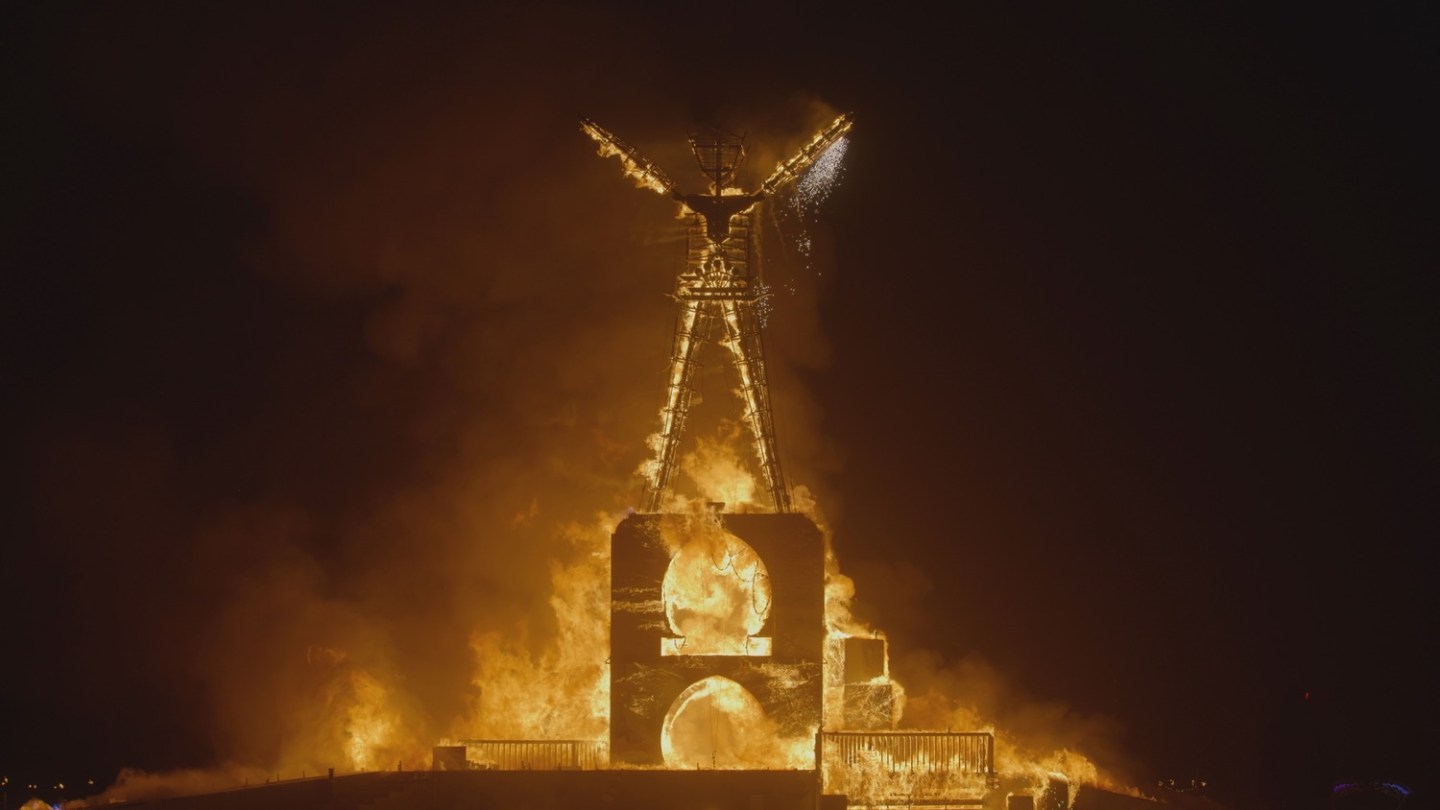


There is a bungee-strap battle that goes down inside a geodesic “Thunderdome” arena and, one year, revelers found a 23-foot-tall, 50-foot-long hedgehog temple erected on the playa in Nevada, where Black Rock City has risen nearly every Labor Day week for the past 40 years. And let’s not overlook the central wooden effigy itself, collapsing and engulfed in flames as steampunk Mad Max extras dance and laugh and cry.
Of all the dazzling visuals and surreal art that burst out of Burning Man, the large-scale, weeklong desert event that is now so vital that it has spawned its own subculture, it’s the images seen about seven minutes into HBO‘s The Man Will Burn that are truly surprising: Rather than “Burners” running wild in costumes and dancing in the dust, the four-part documentary opens on a boardroom, with charts indicating cash flow. And then there are the actual people who, all year long, schlep to the office and run the business of Burning Man. Here, they are arguing about how to pay for it.
If you were left wondering whether the series, which began streaming weekly on HBO Max on July 9 and concludes Thursday, was a deliberate provocation, the series’ directors, Jehane Noujaim and Vikram Gandhi, cleared that up while speaking with The Hollywood Reporter last week.
“We’re documentary filmmakers, so we’re interested in reality,” Gandhi said about the series, which premiered at the Tribeca Festival in June. “The whole point of Burning Man is to not think about the gifting economy and the decommodification part of it — that’s what happens out on the playa. But when you peel back the layer behind the event, that’s what’s going on. Everything has a cost.”
That tension — between a 40-year-old social experiment premised on resisting institutions and the institution it had to become to survive — is one of the many aspects of the phenomenon that The Man Will Burn interrogates. Noujaim and Gandhi spent five years filming with unprecedented access to the Burning Man Project’s leadership. They begin the journey just as the organization is faced with what Noujaim called “one of the greatest existential crises” in its history: the COVID-19 pandemic threatening the very premise the event is built upon, which is simply that people show up.
Noujaim, an Emmy winner known for The Square and The Vow, said she and Gandhi — who directed the biting and, as some argued, immoral 2011 documentary Kumaré — were drawn to the project precisely because the stakes were so undeniably real.
“Even though many of the people that put this together have very different concepts of what they want to create, they do share this belief that it should happen every year, and they feel very strongly about that,” she said. “The stakes for all of the characters that we were following were very high. And I think when that happens, the true human nature comes out — and that’s wonderful for a film.”
Producer Muriel Soenens, who came to the project as “the non-burner of the team,” as she explained to THR, said the pandemic demanded answers to questions the community had been letting linger for years.
“It basically had opened up a Pandora’s box of issues that had been plaguing them since the early days: Do we grow or not? Who does this belong to? Does this belong to anybody? And if it does, who should be leading this?” she said. “As anarchy grows in numbers, it can no longer be truly radical. It can’t be as free as it was.”
As the series barrels forward through crisis management and office politics to the chaos that rain on the playa can cause, we watch as an event built on the idea that no one is in charge is forced by circumstances to reveal who actually is.
Making The Man Will Burn land was always going to hinge on access, which took years to earn, scene by scene. The filmmakers say the Burning Man Project’s leadership — including CEO Marian Goodell, a central figure throughout the series — gave them startling latitude, including in a boardroom scene during the depths of the crisis.
“I don’t think anything was off limits from the organization,” Gandhi said. But the organization, he added, was “only a tiny part of the access” — every camp, every art-car crew, every individual required separate, often lengthy negotiation. “Sometimes we would have to talk to people for 45 minutes, or months, before shooting for five minutes,” he said.
That’s not to say Goodell herself was resistant at first, Noujaim said.
“Marian was very much like, ‘This film is not about me, it’s not about one person,’” Noujaim said. “But we really pushed forward with following her because she was at the center of any big decision that was going to be made.” The access deepened over successive years, a dynamic Gandhi described bluntly: “As you are stood up for the fifth interview, then they’ll give you the sixth, and maybe it’ll be nicer or more open than it would have been if they hadn’t stood you up five times.”
Consent, the filmmakers said, was unusually fraught for a documentary in 2026 — a rarity, Soenens noted, in the social media era, when people are eager, or at least used to being on camera.
“There is really the deep question of, do I want to be filmed,” she said, adding that some longtime attendees declined outright, believing no documentary could capture what the event actually feels like, or objecting on principle to it being filmed at all.
Of the many conundrums and debates about Burning Man, it may not be too surprising that the series’ most pointed material concerns money — specifically, the encroachment of wealthy tech figures, including Kimbal Musk, who have become entangled in Burning Man’s finances and, therefore, have a seat at the table in its governance. But Gandhi pushed back on the idea that tech wealth itself threatens the event’s spirit; tech money, he noted, has been present at Burning Man since the 1990s. The more interesting question, he said, is about participation versus consumption: “Are people going without participating and buying an experience, rather than working on the experience?”
Yet how money concentrates power is on full display here. Musk, Gandhi said, “was maybe the loudest voice in the room” during a boardroom debate over whether to cancel the event outright — a moment that crystallizes how an organization “running on debt” ends up dependent on its wealthiest members, above its founding ideals.
Noujaim framed it as an argument the film wants viewers to sit with rather than resolve.
“It’s not whether people have money or don’t have money. It’s more this question of: Are people coming in to build together, to give and to sacrifice — which enables human connection — rather than the connection we normally deal with, which is very transactional?” she said. The struggle, she adds, is real and ongoing inside the organization itself, which works to prevent “plug-and-play” camps, where wealth substitutes for participation as the wealthy parachute into Black Rock City.
Asked what they wished they could include, the filmmakers pointed to structural gaps rather than deliberate omissions. Because the series is character-driven, storylines that didn’t touch their core subjects largely fell away, even ones with some true dramatic weight. They also mention a widely reported and still-unsolved death at the event that happened the year after filming wrapped; Noujaim said she and Gandhi weren’t present for it and had only secondhand information, but it’s a thread in the story of Burning Man that shows how its growth is leading to the seeping in of chaos.
Two pursuits, they said, nearly made it into the final cut but didn’t: a ride-along with the event’s volunteer rangers, complicated by the fact that there’s no cell service on the playa to coordinate filming, and a stint at the event’s makeshift hospital, where the crew nearly captured a premature birth — HIPAA privacy rules shut the access down. Both, Gandhi said, spoke to an underappreciated reality — that Black Rock City is “a city running a city,” with real infrastructure and real emergencies behind the drugs and art and fun.
For all the institutional friction the series documents, both directors indicated that what caught them off guard wasn’t the conflict — it was the playful tone. “The humor,” Gandhi said, “the level of humor and self-deprecation that keeps it way less earnest than you would expect. They are the first to cut themselves down and question themselves and consider themselves flawed and imperfect. They don’t like calling it a utopia.”
Noujaim said she was struck by the scale and the sheer amount of volunteer labor required to build and dismantle an 80,000-person city in the desert, most of it unpaid.
“There’s nothing like it on Earth,” she said. “People put more effort into building something than most people put into their jobs — and more joy in working.” It’s a note the film leans into deliberately, she added, precisely because it pushes against what most people assume Burning Man is in reality — not a party bought and consumed, but one built, hour by unpaid hour, by those who simply show up.
Read the full article here