





The International Film Festival Rotterdam (IFFR) enjoys a reputation as a destination for those curious about and interested in discovering new and unusual cinematic voices.
So it comes as no surprise that the 55th edition of the fest, running Jan. 29-Feb. 8, is again chock-full of envelope-pushing arthouse movies that sounds anywhere from offbeat to outright outlandish.
Vanja Kaludjercic, festival director at IFFR, has promised “an array of titles that speak to our mission of audience discovery and championing filmmakers forging new paths in cinema.”
Here is THR‘s look at a small selection of Rotterdam films that sound experimental, out there and different, to say the least.
58th
Director: Carl Joseph E. Papa
IFFR section: Harbour
Sales/world rights holder: GMA Network Films, Inc.
After the 2009 Maguindanao massacre in the Philippines, most of the corpses of journalists and the wife of a progressive political candidate were found. Not so the 58th victim, a photojournalist nicknamed Bebot. His daughter Nenen has since fought to get his killing — by forces directed by an influential family allied with the then-government — officially acknowledged.
Papa (The Missing) mixes animation, TV news footage and Skype interviews for an envelope-pushing documentary following her tireless efforts. After all, “even though justice was partly served by the courts in 2020, Bebot’s absence from the historical record continues to haunt his family,” a synopsis of the film highlights.
The unusual approach allows even unrecorded events to be dramatized. “Most touchingly, this creative approach opens the door to lyrical imagining of times past, present and future,” points out the IFFR website.
Dead Souls
Director: Alex Cox
IFFR section: Harbour
Sales/world rights holder: Exterminating Angel
Legendary indie director Alex Cox — the man behind the 1984 cult classic Repo Man — returns to the screen as both director and star in this frontier fable of American greed, which is loosely based on Nikolai Gogol’s 19th-century Russian novel of the same name. Cox plays a mysterious drifter called Strindler who scours the West for the names of dead Mexican laborers and pays top dollar for them.
Other cast members include Zander Schloss, Dick Rude, Amariah Dionne and Edward Tudor-Pole, while spaghetti Western legend Gianni Garko has a co-writer credit with Cox on the project.
“Pistol duels and crooked officials abound,” IFFR promises. Don’t expect any by-the-numbers-type straight shooting. Instead, “Cox’s idiosyncrasy stands out as the film veers tonally through the picaresque, dark satire and genre curveballs you won’t expect.”
Unerasable!
Director: Socrates Saint-Wulfstan Drakos
IFFR section: Tiger Competition
Sales/world rights holder: Socrates Saint-Wulfstan Drakos
If you are thinking (like the writer of these lines), “What a cool name that director has!” – think again! Socrates Saint-Wulfstan Drakos is not the real name of the filmmaker behind this Rotterdam competition entry. “And when the film is over, everyone in the audience will understand why,” the IFFR website tells us. “The creator of such a politically outspoken work, one that confronts both the limits of civil liberties in an authoritarian Southeast Asian regime and the inner colonialism of a very neoliberal European country, would naturally prefer to take shelter behind an assumed name.”
The story the film tells is simple – and heavy. “An independent filmmaker, tortured for his participation in a pro-democracy movement, fled his home in 2018 and relocated to nearby Thailand, undocumented,” explains a synopsis. “After five years, he left the region for the West, hoping to build a new and finally dignified life for himself. Instead, he became caught in another struggle, this time with bureaucracy.”
IFFR festival director Vanja Kaludjercic has this to say about the film: “The story Drakos weaves from various kinds of images, some rough and nervous, others with a more professional sheen, and gradually develops a serene poetry that seems impossible to foresee in a work with such political urgency. It stands as a film shaped by pure heart and true dedication.”
The Passion According to G.H.B.
Directors: Gustavo Vinagre and Vinicius Couto
IFFR section: Harbour
Sales/world rights holder: Carneiro Verde Filmes
“A hookup becomes a threesome; the threesome becomes an orgy. In this magical realist gay bedroom odyssey, Matias reminisces about his past encounters and considers his future, while speaking to a fictional figure from Brazilian literature.” Alright, I’ll let you digest this for a moment…
Ready? This Brazilian movie features “Chemsex,” the use of psychoactive drugs to enhance sexual experiences. Vinicius Couto, Igor Mo and Christiane Tricerri star in the film, which IFFR calls “a conceptual deep-dive surfacing the risks and rewards of chasing perceptual and sexual expansion.” Adds the fest: “The film’s gay strangers attempt to dissolve the boundaries between each other and within themselves.”
But hold on — who or what is GHB?! We don’t know, but what we do know — after a bit of research — is that Matias speaks to the apparition of G.H., the fictional narrator in Brazilian writer Clarice Lispector’s 1964 mystical novel The Passion According to G.H. That should clear it up.
Wolfgang
Director: Filmsaaz
IFFR section: Bright Future
Sales/world rights holder: Saleh Kashefi
You decide whether the writer-director’s name, Filmsaaz (real name: Saleh Kashefi) — an audiovisual artist from Tehran — or this synopsis is more unusual: “In this acid trip opera, the life of 22-year-old Mozart is reimagined to tell the present-day story of an Iranian artist exiled in Paris” to escape censorship back home. In fact, in 1778, a young Wolfgang Amadeus Mozart was actually in exile in Paris. Reeling from his mother’s death, he spent his days writing music and engaging in hedonistic excess. Mozart’s experience thus becomes a parallel of sorts for Wolfgang, the Iranian artist living through similar extremes in Paris.
If you’re intrigued by this “audiovisual opera,” which is a debut film, here is more: Ghazal Shojaei, herself an exiled Iranian actress, plays the titular Wolfgang, with Kata and Saeed Mirzaei also part of the cast. “Navigating grief, destructive tendencies and creative expression, the artists’ lives swirl together in a time and gender-queering ode to self-transformation,” according to IFFR.
Rotterdam programmers promise a film “sliding between hallucinogenic, candy-colored fever dreams, and painterly black-and-white chiaroscuros,” with Filmsaaz’s “dub-laced reinterpretations of Mozart’s music reclaiming the perversity and latent queerness of one of the most revered composers in history.” Concludes the IFFR preview: “Gradually, every scene strips away another layer of artifice: revealing a moving journey towards self-discovery, and intricate reflections on making art in political exile.”
Art Is Dark and Full of Horrors
Director: Artemio Narro
IFFR section: Harbour
Sales/world rights holder: El Llanero Solitario
Star artist Chema rules the Mexico City art scene — but if he falls, every vulture of the art market will be ready to swoop in. This satire of the Mexican art world unfolds over the course of a week of preening, dealing and partying, full of posing and artspeak.
Director Artemio Narro, who has developed a reputation for his stylized and irreverent approach to filmmaking, has also brought his two previous features — ColOZio (2020) and Me quedo contigo (2015) — to IFFR. His latest movie uses “witty Brechtian distancing devices, including life-size cardboard cut-outs standing in for real people,” the fest programmers highlight. “And in this film about art, almost no art is ever actually glimpsed: the ‘white cube’ of the modern gallery has never looked emptier or more bereft of soul.”
Let Them Be Seen
Director: Nolitha Refilwe Mkulisi
IFFR section: Bright Future
Sales/world rights holder: Brown Flamingo Productions
In her directorial feature debut, which blurs the boundaries between documentary and fiction, Nolitha Refilwe Mkulisi looks to revive the energy of beloved 1990s South African musical game show, Jam Alley, to take a very different look at her hometown, the village of Tapoleng.
The region, once known for its high density of churches, has been “forgotten by the new order in the post-Apartheid era,” according to a synopsis. The film follows the village’s inhabitants, in their homes, at shops and in informal gatherings, as they “redefine their spiritual ties and forge new beliefs rooted in ancestral traditions.” The result is a series of funny, serious and at times bizarre scenes that take viewers to a world rarely seen onscreen.
The film invites a deeper curiosity about what unfolded beyond the frame — how the story was shaped by the people living it. As the IFFR website observes: “Assembling a strong female team, and letting her fellow community drive the narrative, Mkulisi places faith, ritual and memory at the forefront.”
The Misconceived
Director James N. Kienitz Wilkins
IFFR section: Harbour
Sales/world rights holder: Visit Films
Looking for an experimental 3D-rendered home renovation tragicomedy for millennials? Director James N. Kienitz Wilkins and his co-writer Robin Schavoir have got you covered. “A failed filmmaker turned single dad tries to make a living while retaining his sense of self,” reads a synopsis for the The Misconceived. So, what happens when he’s accidentally hired by an estranged college buddy, who has become a successful sculptor, to renovate the country vacation home of his dreams? The movie continues the journey of Tyler from the writing duo’s 2019 film The Plagiarists and is mostly set in a half-renovated farmhouse where a mystery of irresponsibility and theft unfolds.
The film, highlights the IFFR website, also “doubles as an acidic treatise on working conditions for the contemporary creative.” For example, it depicts only “working hours” to “explore the fragile, porous boundaries between employment and personal life.” Jesse Wakeman, John Magary, Callie Hernandez, Jess Barbagallo and Theodore Bouloukos are among the performers featured in the film.
The film is rendered entirely within the Unreal Engine video game engine, utilizing motion capture, facial recognition and voice performances, and it also uses a library of stock media.
“As a hybrid between 3D animation and ‘indie’ film, The Misconceived takes full advantage of the new ability to shoot in virtual worlds utilizing motion capture, facial capture, and a marketplace of 3D architectural and character models to create an uncanny mirror to contemporary society (notably, not using generative AI), and produce a truly independent, feature-length movie no traditional film companies were willing to support,” highlights Kienitz Wilkins in a director’s statement. “In many ways, the movie is an argument for and against its right to exist.”
Bowels of Hell (Privadas de suas vidas)
Directors Gustavo Vinagre and Gurcius Gewdner
IFFR section: Harbour
Sales/world rights holder: Blue Finch Films Releasing
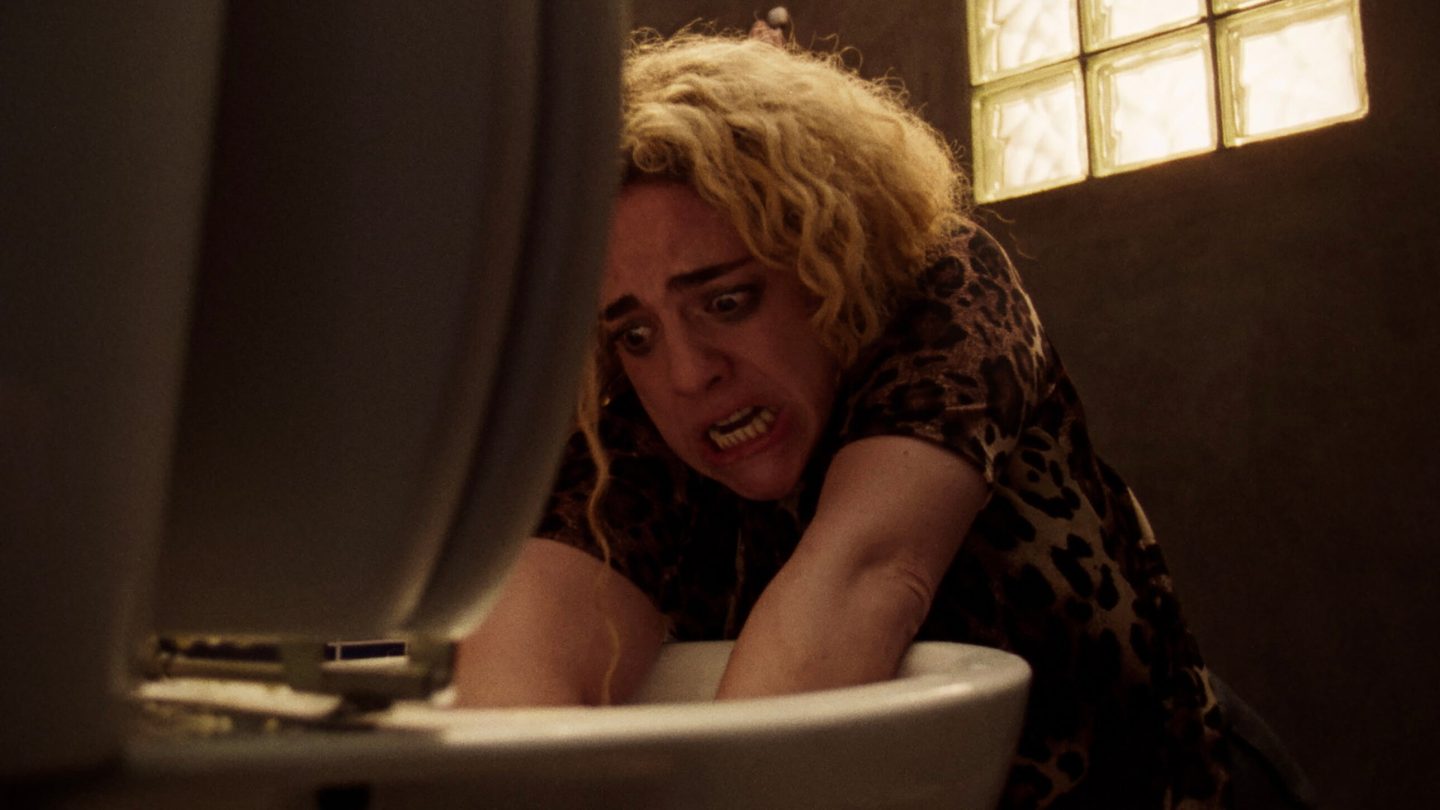
“Birth and death trauma, constipation and gassy poos, toilet curses and gender issues,” are just some of the elements that IFFR promises in this Brazilian horror comedy “with more than a touch of gore, exploring in excruciating detail the mysteries of the human organism.”
Martha Nowill, Otávio Muller, Chandelly Braz and Marco Pigossi star in the movie that seems designed to flush away any form of correctness, political or otherwise. The “very graphic” film makes “fun not of but with everything it touches — including spirituality, parenting, disability, ecology, trauma and gender-neutral language,” programmers emphasize. And did you notice? One of the directors is the same Gustavo Vinagre who also co-directed the earlier-mentioned The Passion According to G.H.B.
So, what is it actually about? The story follows Malu, who is “organizing a gender-reveal party for a pregnant influencer — while dealing with her own grief, her persistent constipation problems and her adolescent transgender child.” At the condominium where she lives, strange phenomena occur in — of course —the bathroom. You may want to take a deep breath before you enter the cinema for this one.
Sicko
Director Aitore Zholdaskali
IFFR section: Bright Future
Sales/world rights holder: Loco Films
If you only know Kazakhstan due to Borat, check out Sicko from Shulamah co-director Aitore Zholdaskali. “In Almaty, a cash-strapped couple hatch a plan to solve their money troubles, but soon become embroiled in a toxic web of social media, violent criminality and spiraling greed,” reads a summary for the film. Get ready for a Korean horror-influenced “blood-soaked satire on the indignities of late-stage capitalism,” IFFR warns.
Sicko stars Ayan Utepbergen and Dilnaz Kurmangali as an ambitious but broke couple who, after starting a crowdfunding campaign for a “life-saving” treatment for her, quickly go viral. Fame and fortune beckon, but soon their newfound celebrity status attracts attention from the criminal underworld.
Snake milkers and the Miserable Lady
Director Vahid Alvandifar
IFFR section: Harbour
Sales/world rights holder: Distorted Pictures
Eftekharzade, Yousef Yazdani, Majid Farhang, and Nahal Dashti star in the story of a snake catcher in the Iranian anti-venom department who dies on the job, only to miraculously return to the living and refuse to go back to his old life.
Vahid Alvandifar’s narrative feature debut, made on a shoestring budget, touches on big themes with gorgeous Iranian scenery as the backdrop. The movie is listed as a co-production between Iran and Sweden.
“Disguised as the titular miserable lady, the resurrected man and his colleagues try to sort his economic and legal affairs, while they contemplate what makes life worth living in the first place,” notes the IFFR website. “This macabre fable about dying becomes a poignant reflection on the conditions of life in contemporary Iran.”
The Hole, 309 Days to the Bloodiest Tragedy
Director Hanung Bramantyo
IFFR section: Harbour
Sales/world rights holder: EST N8
From Indonesia comes a supernatural mystery-horror thriller mixing history, folklore and myth. Its inspiration, according to the Rotterdam festival website, comes from “the swarm of theories surrounding the September 30 Movement of 1965, when six army generals were assassinated in Lubang Buaya preceding a failed military coup.”
Baskara Mahendra, Carissa Perusset, Khiva Iskak, and Anya Zen star in the film, in which a series of macabre murders sees a person killed on the 30th of each month, each time with a gaping hole in their bodies, and their faces inscribed with such words as “greedy” or “heartless.”
Tapped to solve the mystery, and dispel rumors about the military’s involvement, is army officer Soegeng, whose investigation eventually leads him to confront the realities as corruption. Prepare for what Rotterdam programmers promise to be “a chilling journey into the heart of darkness.”
2m²
Director: Volkan Üce
IFFR section: Big Screen Competition
Sales/world rights holder: CAT&Docs
How Much Land Does a Man Require? is the English title of an 1886 short story by Leo Tolstoy. The answer could be: 2m², the size of a grave, according to info about this Belgium, Germany, Turkey documentary by Volkan Üce, who has previously made two other docs: Displaced (2017) and All-In (2021).
It follows Tayfun Veli Arslan, “an undertaker for the Belgian-Turkish community,” who helps families decide where their loved ones should be buried, explains the Rotterdam website about the film, which is set in Genk, Belgium. “Through his wry humor and daily negotiations, 2m² reveals the mix of belonging, bureaucracy and small absurdities that shape life between two homelands. … Most of the people who require his services are immigrants or their descendants, and many families prefer to have their loved ones buried not in Belgian soil but back in the old country.”
Get ready for an intercultural documentary about a funeral parlour entrepreneur dedicated to his work and the grave decisions (literally!) that he helps people make.
Read the full article here