




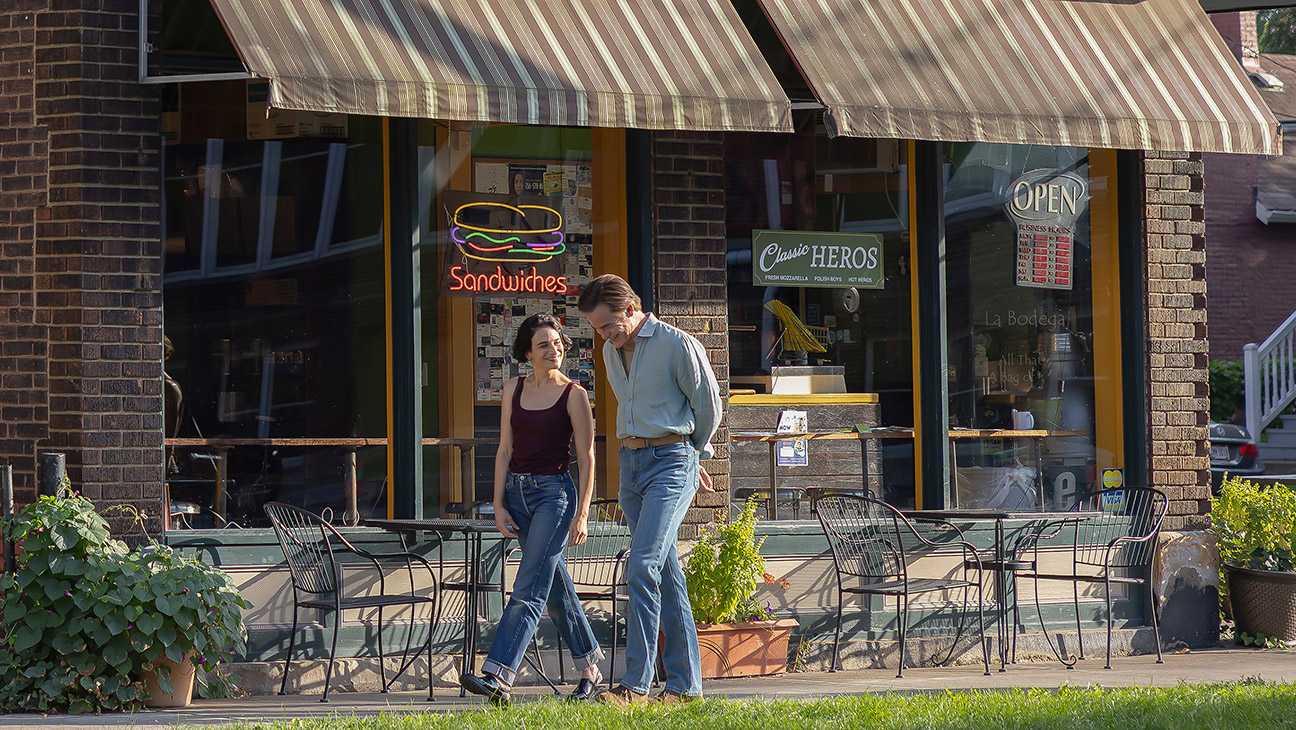


Whether playing sexy comedy or hostility, raw emotional agita or hollowness, Chris Pine and Jenny Slate are so damn fine in Carousel that you keep wondering why we seldom get to see these gifted actors bite into characters of such substance and complexity. Rachel Lambert’s latest is a strange and beguilingly lovely relationship drama. Eventually. But first, the writer-director needs to get out of her own way, peeling away the fussiness and frustration of her oblique approach and finally cutting back on her overbearing use of a cascading score to give us unfettered access to characters about whom it’s clear she cares deeply.
Not to pile onto composer Dabney Morris, who presumably is doing what was asked of him, but the wall-to-wall music of the opening scenes is almost a deal-breaker. Even before the title card appears, we get that the plinky-plonky melodies are meant to suggest the merry-go-round of life, with the rise and fall of the horses mirroring the ups and downs of our relationships. It’s a trite metaphor, and a movie as smart and subtle as this one deserves better.
Carousel
The Bottom Line
Takes its time but sneaks up on you.
Venue: Sundance Film Festival (U.S. Dramatic Competition)
Cast: Chris Pine, Jenny Slate, Abby Ryder Fortson, Sam Waterston, Katey Sagal, Heléne York, Dagmara Domincyzk, Jessica Harper, Jeffrey DeMunn, Tien Tran
Director-screenwriter: Rachel Lambert
1 hour 45 minutes
There are moments early on that draw us in, notably between Noah (Pine), a Cleveland doctor with a small family medical practice, and his teenage daughter Maya (Abby Ryder Fortson), when he drops her at school and she has a full-blown panic attack after realizing she left some important papers at home.
Lambert clues us in quickly that Maya is suffering from anxiety and depression, and the way Noah tiptoes around her — showing support and concern but holding back as if by not making a big deal of it, the problem will go away — is quietly affecting.
But it’s not until midway, in a devastating extended duologue between Noah and Maya’s high school teacher and debate coach Rebecca (Slate), that the movie’s defining elegance and restraint fully take hold and the actors are given space to deepen their characters. Like something out of Scenes From a Marriage (the HBO remake, not the original Bergman miniseries), the sequence unfolds in a kitchen but is shot mostly from the next room. It’s carefully blocked but lived in and spontaneous as Noah and Rebecca cycle through anger, regret, self-justification and defeat, setting the drama on a decisive new trajectory from which it never looks back.
The pair were a couple back in school, their relationship ending in bitterness and resentment when Rebecca left Cleveland to pursue a career in the political sphere and Noah chose to stay put and start a family. When they initially reconnect through Maya at a farmers market, it seems as if they barely knew each other — beyond being cast in the same production of Fiddler on the Roof. But the first time they are alone together it’s evident that the sexual sparks are still very much there, along with the underlying emotions.
Noah is bruised by his recent divorce from Maya’s mother (Dagmara Domincyzk), saddened by the decision to retire of his mentor at the financially precarious clinic (Sam Waterston), and we later learn, grieving from the unexplained but seemingly tragic loss of his father. But he’s so inured to shoving aside his troubles so he can keep a vigilant eye on Maya that a complicated romantic relationship with Rebecca feels like more than he can handle.
The minute Maya is out of the picture for a summer studies program at Stanford, Noah falls apart, literally unable to pick himself up and even get out of the airport for what seems like days.
Rebecca has her own problems and uncertainties — her parents (Jessica Harper and Jeffrey DeMunn) are aging; her friend Sophie (Tien Tran) tells her she has worked too hard to make inroads into D.C. politics to be teaching high school; her history with Noah is far from perfect.
The love between the central couple is never in doubt, but hesitancy is a big part of this romantic drama. Lambert is clear-eyed and perceptive about the emotional safeguards people put up to protect themselves from the messiness of relationships. But the film also advocates for taking risks, for leaving doors open and giving love a shot. The long final scene, melancholy but beautiful, again framed from a detached distance, this time in half-light, encapsulates that sense of hope with pleasing delicacy.
DP Dustin Lane shot Carousel on 35mm in what looks like the boxy Academy ratio, suffused in soft light. The visuals heighten the drama’s intimacy. Lambert shows an attention to the details of daily life that shape the ways people connect and communicate. Returning to solitude as a central theme after Sometimes I Think About Death, the director has made a flawed movie that requires patience, but it delivers in the end, thanks in large part to the sensitive work of three excellent leads.
Not since Hell or High Water has Pine conveyed such depth of feeling, such corrosive sorrow. Slate’s Rebecca at first glance has a brittle aspect but slowly reveals a yearning that makes her question her choices. And Fortson, who was such a radiant discovery in Are You There God? It’s Me, Margaret, is maturing into a first-rate actor, alternatively heartbreaking and resilient.
Read the full article here