




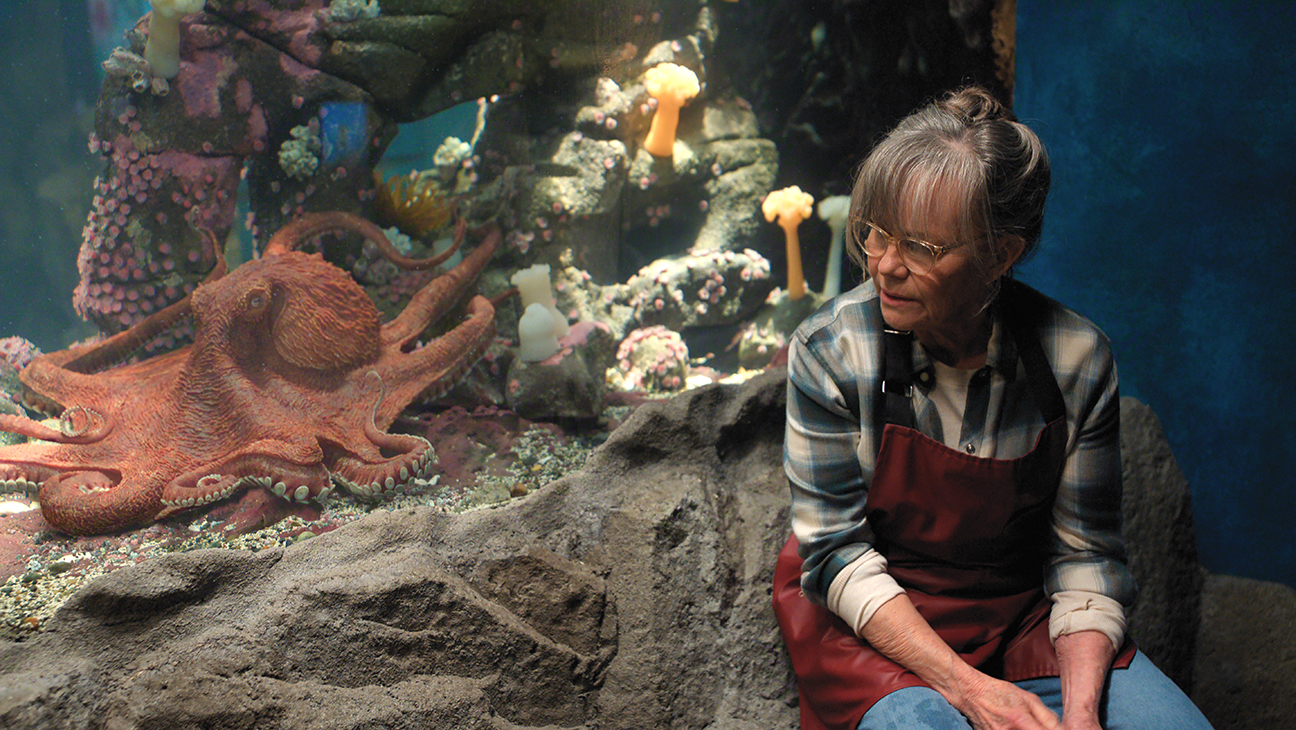


Over the course of Sally Field‘s storied career, there have been opportunities to discover her character on set (like the ad-lib-heavy Mrs. Doubtfire) and those where it was all on the page (Tony Kushner’s Lincoln script). In Netflix’s, an adaptation of Shelby Van Pelt’s novel that’s sold more than 2 million copies, it was a little bit of both. “Lewis Pullman and I were improvising all the time,” Field says of her primary co-star … at least the one that’s not a CGI octopus. “That relationship was really created out of he and I playing with each other. You can kind of see it in the movie.”
Her Emmy nom for the work isn’t just interesting because it’s her 10th (she has three wins), she’s also the first actress in nearly a decade to earn one for a TV movie. But for Field, who went from ABC’s The Flying Nun to an Oscar winner for Norma Rae early in her career, the medium is something she’s learned not to focus on.
Is there some role or project you’re still itching to do that’s not being presented to you?
My whole life, it’s been very difficult to find projects that I wanted to do. In the beginning, it was very difficult to find projects where they would even let me in the room to audition. I started in situation comedy television in 1964. In those days, they didn’t let you out. You lived and you died on that railroad track. You weren’t getting out. Even after I got to a place where [they’d let me audition], it has always been difficult to find films, characters, stories that I want to be part of me … that I would go, “OK, that’s it. This is the one.” It’s always taken me a long time. I never was an actor that was able to work back-to-back-to-back, doing one project after another. I just had to keep my head down, as they say.
What were the conversations with your team like in those moments where you felt like you weren’t booking what you wanted?
I didn’t think it was their responsibility. They would perhaps come across something that I might like, even if it wasn’t offered to me, maybe they would show it to me. But many times, the things that I finally, eventually did do, I found it. I came after it. Certainly Lincoln was one of them. I fight like crazy. You don’t get delivered things, and at least women don’t and certainly not older women. You don’t get a whole box of chocolate, so to speak, and say, “Hmm, which one do I want today?” It just doesn’t happen.
Was Lincoln the role that you fought the hardest for?
No, I fought hard for Sybil. That was a huge turning point. And I fought hard to get into this movie, Stay Hungry [1976]. That was the first [feature]. It was incredibly difficult to even get in the room. Nobody wanted me there. I could hear [director] Bob Rafelson in the back room yelling at Dianne Crittenden, the casting director, for even letting me sit in the waiting room because I was wasting his time. I had to use that anger as my fuel. It was a long haul to get to my movie career and then to find the things I wanted to do.
You talk about this stigma of working in sitcoms at the beginning of your career. You went back to TV in 2006 with Brothers & Sisters — a time before a lot of other Oscar winners started working in both mediums. Did you feel that the iron curtain was lifting?
I wanted to tell stories that were worth telling. I wanted to act. When I finally transitioned to film, I was able to find Norma Rae, Places in the Heart, Absence of Malice, Mrs. Doubtfire, Forrest Gump, Steel Magnolias and whatever they were. But the industry was changing at the same time. When Brothers & Sisters came along, it just struck me. Those five years, I’m proud of them. It’s about a woman who’s older, obviously, because she’d raised children. I understood that because I had raised sons. Also, I had a gay son who was just coming out or had just barely gotten his feet under him. I got to play a mother with a really great family and a great son [Matthew Rhys] who happened to be gay. And this was a very crucial time in our country when this was not done. I mean, Will & Grace had been done, but it was comedy and very broad.
Matthew Rhys, the onscreen son from Brothers & Sisters who you just referenced, is nominated for two Emmys this year.
Yes! Good for him. He deserves it.
Do you keep in touch with him?
I sure do.
A very important scene in film history for me and several of my friends is you repeating the phrase “The whole time?” in response to learning your husband had been cross-dressing as the nanny in Mrs. Doubtfire. Would you mind telling me a little about filming that scene?
That was me improvising. That whole sequence, we shot it at the end of the film. It was several days in that restaurant. But that moment, that is an ad-lib because the line was [supposed to be] very calm. “The whole time” was an improvisation. Robin [Williams] and I had created a relationship, a world where we improvised a lot. It allowed Mrs. Doubtfire to come alive because it was such a weird circumstance.
I don’t know how much you think about how the work is going to be received commercially or critically while you’re making it, but I’d imagine that many people involved in Mrs. Doubtfire expected it to hit as big as it did. Did you feel that was the case?
I think they thought it would be successful. Robin was at the height of just … brilliance. But I don’t think anyone saw it being as huge as it was. The script wasn’t what was on the page because of what Robin and I were allowed to do by [director] Chris Columbus. We did not want — and Robin felt this strongly, too — the mother to be the villain. We both felt that there were no villains in this divorce. Marriages don’t always last. Sometimes there are no bad guys. It’s time to move on. Without getting in the way of the comedy, it was a delicate dance to allow her to not be mean. She was hurt to lose her marriage, too, but he was impossible. Who could be married to this guy?
Looking back at the whole of your career, what do you feel like the biggest risk you took was?
Everything’s a risk. Otherwise, forget it. If it’s not a risk, then stay home. Easy is overrated.
You and your Lincoln collaborators Tony Kushner and Steven Spielberg saw Oh, Mary! before it went to Broadway. Now that Cole Escola has ceded the role to a revolving door of famous actors, would you ever step back into Mary Todd Lincoln’s shoes?
No, no, no. (Laughs.) Maya Rudolph [just did it], and I couldn’t be in her world. She’s never not great. And Cole is so dazzlingly talented. I think they tried to keep it from them, the three of us were in the audience when we saw it. I can be in awe of it, but I can’t do it.
This story first appeared in an August stand-alone issue of The Hollywood Reporter magazine. To receive the magazine, click here to subscribe.
Read the full article here