



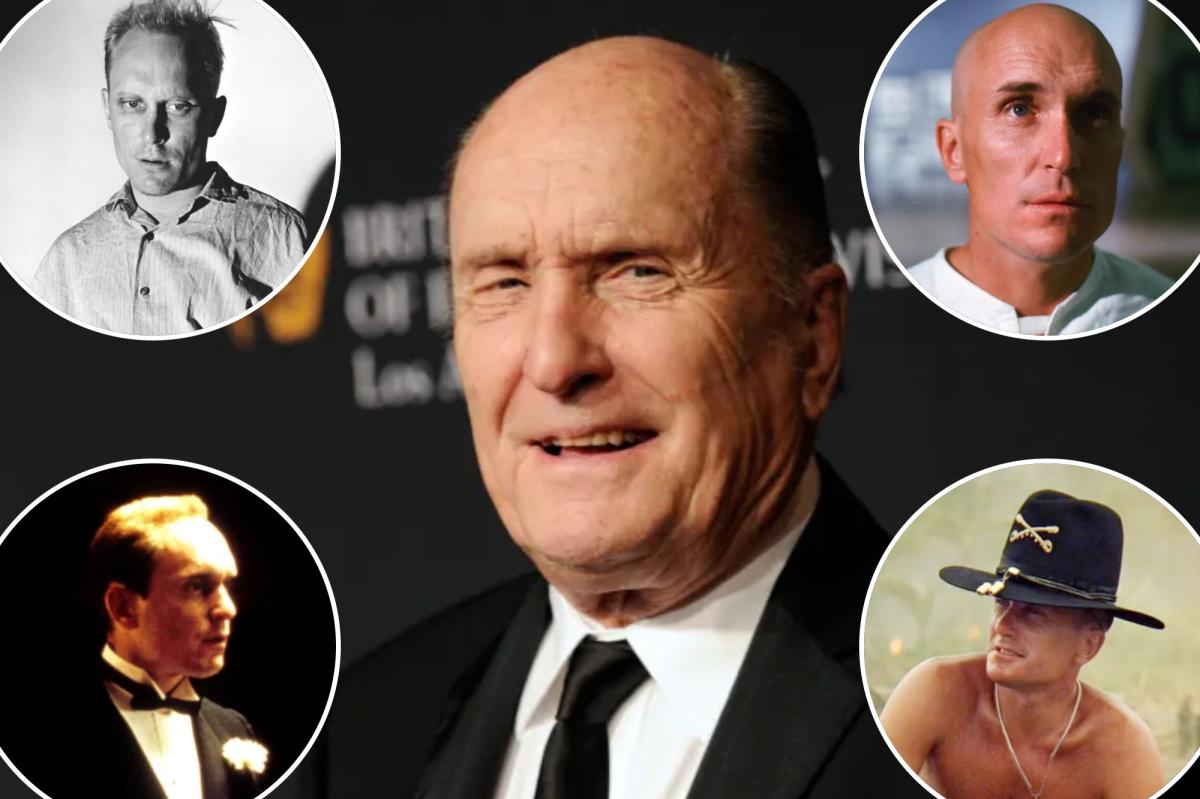


Robert Duvall, one of Hollywood’s greatest actors, was the shared DNA of some of the finest American films ever made.
From a mafia consigliere to an alcoholic country singer to multiple military men, the actor, who died Monday at age 95 at home in Virginia, disappeared into countless beloved movie roles, counterintuitively, by being himself.
“You’ve gotta keep it within your temperament,” he said on “The Late Show with Stephen Colbert” in 2021. “Your anger, your vulnerability or whatever — it’s gotta be your temperament without stepping out of that.”
Venturing too far away from your given palate of emotions, he believed, is “overacting.”
Even shirtless in a cacophonous Vietnam warzone uttering the iconic line “I love the smell of napalm in the morning,” Robert Duvall was never overacting.
That’s not to suggest the man’s performances were relaxed or calm. Quite the opposite. Many of his finest scenes were vicious fights. To be a threat came easily to him.
But, as Post critic Rex Reed wrote, Duvall was “always leathered as a muddy boot, and as natural as breathing.”
Born in San Diego, Calif., Duvall got his start studying acting with Sanford Meisner in New York, where he met friends Dustin Hoffman, Gene Hackman and James Caan.
Hoffman became his uptown roommate.
During the 1950s, he performed onstage at the Gateway Playhouse in Bellport, L.I., before landing his first major movie part — as Boo Radley in 1962’s “To Kill A Mockingbird” with Gregory Peck. The playwright Horton Foote helped him get the gig.
Boo is a silent role (his one line from the book was cut from the film), but Duvall, just 30, proved the power of his glare. His long look at Scout, first frightening then warm, is an enduring tearjerker as the young lady learns an important life lesson.
Duvall scored his Broadway debut in 1966 in the play “Wait Until Dark” at the Ethel Barrymore Theatre, and played a number of small roles on TV and in films.
However, it was during the 1970s when he appeared in a stunning string of acclaimed movies at a nearly annual clip, and his career exploded.
First there was 1970’s “M*A*S*H,” director Robert Altman’s Korean War dark comedy that was adapted into the much aired TV series two years later.
He played arrogant surgeon Major Frank Burns — a lot more seriously than Larry Linville eventually did on television.
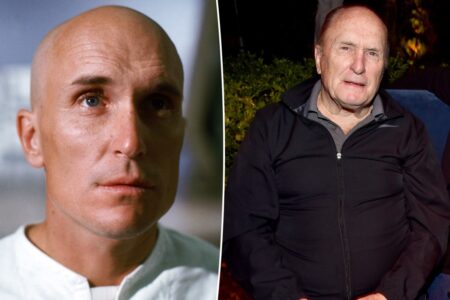
Then, Duvall helped pave the way for “Star Wars.” He starred in George Lucas’ directorial debut “THX 1138,” a dystopian science fiction film about a future where sex and reproduction are banned.
“THX” also opened a door for Duvall. The movie was produced by Francis Ford Coppola, who soon cast Duvall as the Corleone crime family’s lawyer and consigliere Tom Hagen in 1972’s “The Godfather,” arguably the best film ever made.
That glare from “Mockingbird” returns, more menacingly, when producer Jack Woltz rails at Hagen while bitterly refusing to cast Vito’s godson Johnny Fontane in a movie. All the while, Duvall’s Hagen sits there quietly eating and drinking and then politely leaves — off to order up a severed horse’s head.
“The Godfather” gave him his first of seven Oscar nominations, and he came back for the 1974 sequel, “The Godfather Part II.”
This was Duvall’s coat-and-tie phase. In Sidney Lumet’s brilliant “Network,” the actor got behind a desk to play TV exec Frank Hackett, who dresses down William Holden’s tradition-bound head of the news division as it struggles for ratings.
“So don’t have any illusions about who’s running this network from now on — you’re fired!,” he hollers in a tone that would send most normal people into uncontrollable sobs.
After that, Duvall sent his suits to the dry cleaners.
In 1979, he ripped off his shirt and reunited with Coppola for “Apocalypse Now,” the seminal Vietnam War film, as Lt. Colonel Bill Kilgore. He says the “napalm” line — one of the most memorable ever spoken onscreen — and The Post’s review said his 11 minutes of screen time were defined by “extraordinary forcefulness.” He received another Oscar nomination.
Duvall finally won the Academy Award for Best Actor for 1983’s “Tender Mercies,” a comparatively tranquil movie to his blistering run of ’70s flicks. He was a has-been country music crooner from Texas named Mac Sledge who’s battling personal demons. The actor did all his own singing, which he demanded in his contract.
“It contains one of his most understated performances,” Chicago Sun-Times critic Roger Ebert wrote. “It’s mostly done with his eyes.”
While Duvall made a whopping 57 more movies throughout his career — ending with The Pale Blue Eye” in 2022 — none had the weight of that extraordinary stretch of titles in his 40s and 50s.
Fans still have their favorites. His rare foray into family entertainment was in the Disney musical “Newsies,” in which he played Joseph Pulitzer. Journalists love his performance as the editor-in-chief of a tabloid based on the New York Post in Ron Howard’s hilarious “The Paper.”
Yet Duvall’s personal favorite role was on the small screen, as Gus McCrae on the Western miniseries “Lonesome Dove.” He loved that genre, perhaps because the actor grew up riding horses at his uncle’s ranch in Montana.
As the years went by, he took on more supporting roles, and focused on his personal life.
In 2005, Duvall, who had no children, married his fourth wife, Argentine actress Luciana Pedraza, who he met in 1996 in Buenos Aires while shooting “The Man Who Captured Eichmann.”
And he purchased a 360-acre property called Byrnley Farm in The Plains, Virginia, having spent much of his childhood in the state and in Maryland, in 1994.
“I feel at home here,” Duvall told Route Magazine. “My wife is from Argentina . . . but she loves Virginia and says for her, Virginia’s the last station before heaven.”
Read the full article here