




[This story contains MAJOR spoilers from the Paradise season two finale, “Exodus.”]
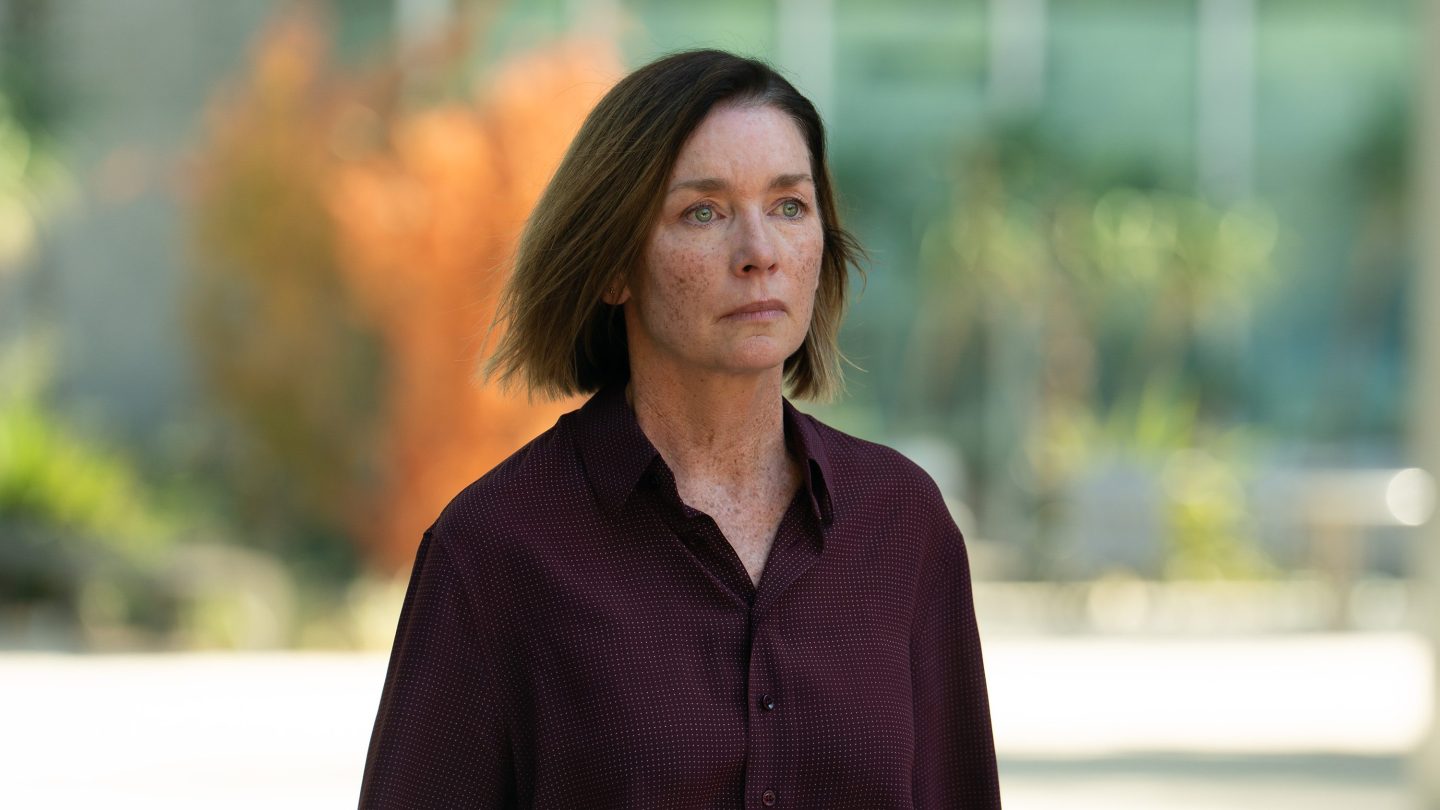
Julianne Nicholson didn’t know Sinatra’s fate when she first signed on to play the villain of Paradise. Creator Dan Fogelman likes to keep some mystery even among the cast, so the actress didn’t find out that Sinatra was going to sacrifice herself until they started production on season two.
“Going down with the ship, quite literally and visually, it’s pretty astounding,” Nicholson tells The Hollywood Reporter in the conversation below with Thomas Doherty, who plays Link/Dylan.
You can now perhaps call Doherty her onscreen son — as that revelation was dropped in the season two finale, titled “Exodus,” before Sinatra stayed behind to destroy the bunker she helped create, dying in the process. Paradise answered season two’s big looming question — Who is Alex? — by revealing that “Alex” is a quantum computer that is designed to play with time. When Sinatra meets Doherty’s character — who had been going by the nickname Link until now — she believes that he is her son, who died as a child, and that his existence is proof that Alex works.
“You have to believe in the story — and then go get your PhD in quantum physics and it will all make sense,” says Nicholson with a laugh. “But Samantha believes that Link/Dylan is her son, so that’s what I had to hold onto.”
Below, the co-stars share what the writers explained to them about the AI quantum computer named Alex that will steer Paradise into season three, now that Sterling K. Brown‘s Xavier has been tasked with going to find Alex and saving the world, while Nicholson shares how she’s processing that moving goodbye to Sinatra after two seasons: “She kind of breaks my heart.”
***
Now knowing the connection between you two, did you have a chemistry read before Thomas was cast? Julianne, were you involved in his casting? You two look alike.
JULIANNE NICHOLSON No, we didn’t know that. Dan [Fogelman, creator] did the casting. But that’s the feedback we’ve been getting!
THOMAS DOHERTY People keep saying it’s our eyes.
How much did you know once he was cast about this Link/Dylan role and how it would connect to Sinatra by the end of the season?
NICHOLSON I don’t think I knew right away. I probably knew two or three episodes in what was coming down the road. But then it was trying to make sense of that. How does that work? Which I’m still trying to figure out. (Laughs.)
DOHERTY And then [the writers] try and explain it to you, and it just makes it worse. It’s all quantum physics and mechanics and stuff.
What was your casting story, Thomas?
DOHERTY I wasn’t even going to do the audition. I was a huge fan of Paradise, and then we got the breakdown for the character, and it said, “Burly man.” I don’t generally fall into that category or description. (Laughs.) But, I was burly enough! It was really, really quick. I auditioned a few times in New York. Then I flew out to L.A. to meet with Dan and John [Requa] and Glenn [Ficarra], who directed the first two episodes and who are producers as well. Then I got told that Shailene [Woodley] was going to be playing Annie. I got the job on a Thursday. By Monday, I had moved to LA.
I had a week in L.A. to prepare, but Shailene went into fittings on Wednesday and started shooting on Friday. It was really, really quick.
Did you have the full scope of your character?
DOHERTY No. You have to go to Dan and be like, “Please tell me!” So he told me. He gave me a general idea of the direction that it was heading, which is amazing and quite rare in television. A lot of the time, they haven’t even written the scripts while you’re filming. So that was really good to know directionally where I was going to go.
The beginning of the season did dabble in the time and space realm with those memory flashes. Were you playing that straight in the beginning, where it could be effects from the blast or from radiation, or were you leaning into the Alex of it all?
NICHOLSON I had no idea. The nose bleeds and all those things were a complete mystery to me. It wasn’t until further into the episodes that it started to make sense in terms of alternate timelines, and when people come into your life — you know, the mind of Dan Fogelman.
I looked back on the conversation I had with you, Julianne, and Dan Fogelman after the season one finale, and he confirmed you were not dead after that finale and that you would be in season two, but you didn’t know what that was going to look like. He said he threw some big things at you right before our interview. Did he bring up Alex before our chat?
NICHOLSON Yes. Pretty much. He threw out the idea of Alex but also said, “Don’t say anything” — as I’m reeling and trying to make sense of it myself. (Laughs.)
When did you understand her full arc, and when did he tell you about her fate?
NICHOLSON Pretty early on in the season. The scripts hadn’t been written yet, but I knew how it was going to end and I loved it. Because I feel that Sinatra’s been a little bit misunderstood, and people have been a bit harsh on her. She’s deserved it in some regards. But giving her that humanity and that ultimate generosity was something I loved. I love her, so for her to have that as the way of saying goodbye felt really big and moving. Going down with the ship, quite literally and visually, it’s pretty astounding.
Did you know Sinatra was a two-season role from the start?
NICHOLSON No, I didn’t know. Dan likes to keep a little mystery around for everybody; keep everybody on their toes. But I didn’t need to know. I was very happy to take it as it comes and trust that whatever storylines Dan was coming up with was going to be the right thing for the show and the characters.
She was more of a villain, I would say, in season one. She finds her humanity more in season two, and seems more recognizable to the person we saw in flashbacks. What was that like for you to uncover more layers to her, and how do you feel about her in the end when you think about her?
NICHOLSON I find her whole storyline so genuinely moving. To be able to explore those different colors of a person’s life and to flesh those out was so fun. She kind of breaks my heart, actually. Dan is so good being in the gray area, which is like being a person. We’re not all good. We are not all bad. Obviously, these are extreme circumstances. But I thought Dan did a great job, and I loved doing those last scenes with Sterling and finding that closure.
DOHERTY You’re also so good. Something in your eye changes, and it’s almost like she goes from Sinatra to Samantha.
When you started getting scripts for the final two, and given this era of AI that we’re currently in, what did you make of Alex? Did she feel too realistic, in an unnerving way? What was your reaction?
DOHERTY For a long time, we discussed just trying to understand it!
Right, a quantum computer that does… what?
DOHERTY Exactly.
NICHOLSON “So, how is he my son? Somebody explain that to me?”
Did you get it explained? Can you explain it to us?
NICHOLSON Yes, it was explained to me a few times, but if you start getting literal, the whole thing goes down the toilet. So you have to believe in the story — and then go get your PhD in quantum physics and it will all make sense. If you hold onto a detail, the whole thing falls apart. You have to give some grace, and just believe it. Samantha believes that Link/Dylan is her son, so that’s what I had to hold onto.
What I was holding onto was Dylan’s reaction when Sinatra called him her son. He didn’t look at her like she was crazy. He looked at her almost with recognition. Can you talk about how you played that scene?
DOHERTY It was that panic. He was bombarded with so much information in that hallway — hearing that you’re my mother, that Annie [Shailene Woodley] was pregnant and has a child, and I have a child, and Annie’s dead. That all happened in a minute. I played it as very, very overwhelmed, but it wasn’t a denial. He built Alex. Link created Alex with the professor and someone stole her. So I think because of Link’s knowledge of Alex, it’s completely feasible and he understands. I like to think there were moments of him thinking about possibilities that this could exist, and be a reality.
Did you have sit downs before these final scenes, where you would have lessons in quantum physics or debates about what was happening?
NICHOLSON There’s always at least one writer on the set, so daily, we would have check-ins and say, “Ok, explain that to me?” And they would explain it so clearly, and it made so much sense that you were like, “Okay. I’ve got it.” Then if you try to describe it to somebody else, or explain how this could possibly be, it’s like sand through the fingers. It sort of falls away.
DOHERTY You’re right, you have to just believe. You have to trust and believe. It’s kind of an unusual thing. I’ve never had to do that before [in acting].
It gives Baby Annie a different layer of importance in this world. Do you have any idea about season three?
DOHERTY I have no idea about season three.
NICHOLSON I have literally heard nothing. So I’m not quite sure.
[Note: Paradise was officially renewed for the third and planned to be final season after this interview.]
In your final move as Sinatra, you task Xavier with saving the world. It seems like Dylan will have a role in that. What excites you about hypothetically teaming up with Sterling K. Brown to go and save the Paradise world?
NICHOLSON I’m imagining you guys flying around the world, popping into places and solving crimes.
DOHERTY Yeah, we’ll have a spinoff show. (Laughs.) But that would be amazing. I didn’t really get a lot of onscreen time with Sterling, and I’d love to love to work more intimately with him. So that would be awesome [if that happens]. And then, hypothetically, with Baby Annie, to play out as well.
Julianne, what was the final scene that you filmed?
NICHOLSON My very last day was that stuff with Sterling down the hallway when we have our goodbye. We filmed me walking through the ruins a little bit earlier. So the wrap on Sinatra was when she hands him the key and shuts the door and locks herself in.
How did you feel once they wrapped? What was it like to say goodbye to her?
NICHOLSON I found it really moving; genuinely moving. You grow to care for your characters. I remember feeling a little bit intimidated — that’s a big ending, and I was wanting to do that justice. I remember feeling like I didn’t know exactly what that was going to look like or feel like. Dan was there and I went over to him, and was like, “Dan, I just need a little help. Tell me something. Why am I saying this to Sterling?” And he said, “Don’t forget: You’re going to go away, but your husband and daughter are still going to be in this world. So you’re asking for help, you need him to help them and keep the world going for them.” That helped me so much to then say goodbye. I also love Sterling. He is so easy to be with, and I really love these two characters together: Sinatra and Xavier. It felt genuinely emotional and deep knowing where they’ve come from to now where they end.
DOHERTY You said it was almost a relief when you saw him alive.
NICHOLSON Yes, because I haven’t seen him for the whole season until the finale. I think Sinatra was genuinely happy to see him. They’re adversaries, yes, but there’s also a respect and admiration and care there, from her side anyway. Even though he does have a gun to her head — again — she’s happy to see him and relieved he made it back.
When you two said goodbye, Sinatra was so confident she’ll see Dylan again. Is there anything in your writers’ conversations that you could share to help make sense of that?
NICHOLSON It’s back to this idea of different timelines happening at the same time, and the possibilities that opens up. I feel like we also just needed some hope. We needed to hold onto love and hope, and whether that means we’re in the same physical plane together again or you go into the spirits, who knows. It’s more open than anything physical that you can put your finger on, I think.
Season one tackled climate issues, and this speaks to our current AI era. What do you hope viewers are thinking about in bigger picture terms, about how we treat and view the world?
NICHOLSON Much like the first season and the way we treat our environment and the climate crisis, it is a wake-up call. It’s alarm bells: Pay attention. And the whole AI thing is to really pay attention. Maybe ChatGPT helps you get your homework done, but there are bigger questions we need to be asking and holding people accountable to.
DOHERTY It’s absolutely petrifying. The climate crisis, and what the government has redacted in terms of policy is even scarier. The AI thing, I’m not smart enough to understand it, so that’s quite terrifying. There is something about this hyper-normalization of everything that’s happening in the world right now, where you become so apathetic because you don’t know what to trust. You don’t know what to believe. It forces you to then say, “Okay, what can I control?” And it’s how you conduct yourself in the world, how you move in the world and how you treat other people. When you can’t trust outside, with all these voices and opinions, it forces you to turn inward and return to yourself, and trust yourself and your gut. I don’t think anything bad can ever come from being more connected to yourself and knowing yourself more. That’s the silver line I can draw.
Julianne, you’ve been doing some comedy. What’s next for you?
NICHOLSON I’m doing a film next, a drama. It takes place in 1989; I play an American who grew up in Berlin. I’d love to do more comedy. It was so fun to break my way into that world.
***
Paradise is now streaming seasons one and two on Hulu.
Read the full article here