




“Let there be wealth without tears; enough for the wise man who will ask no further.” It’s fitting that the Aeschylus quote on the opening of James Gray’s riveting Paper Tiger evokes Greek tragedy. In this piercing account of the American Dream in tatters, the magnitude of that dimension feels appropriate, echoing the currents of betrayal, fear and death that course through the film like rivulets of blood. Calling it a sequel would be reductive, but the haunting drama is a companion piece to Gray’s 2022 film, Armageddon Time, again rooted in the director’s childhood. But it’s closer both thematically and tonally to his brooding 1994 debut feature, Little Odessa.
That lends Gray’s ninth and arguably best film a gratifying full-circle symmetry. The director has often mined personal and family history for dramatic inspiration — the Vanessa Redgrave character dying of a brain tumor in Little Odessa, just as Gray’s mother did; the passage of his émigré grandparents through Ellis Island, which informed key parts of The Immigrant; his own bittersweet coming of age, when his eyes were opened to prejudice and inequality in Armageddon Time.
Paper Tiger
The Bottom Line
A drama of almost overwhelming power.
Venue: Cannes Film Festival (Competition)
Cast: Adam Driver, Scarlett Johansson, Miles Teller, Roman Engel, Gavin Goudey, Cindy Katz, Patrick Murney, Victor Ptak, Dimiter D. Marinov, Yavor Vesselinov
Director-screenwriter: James Gray
Rated R,
1 hour 55 minutes
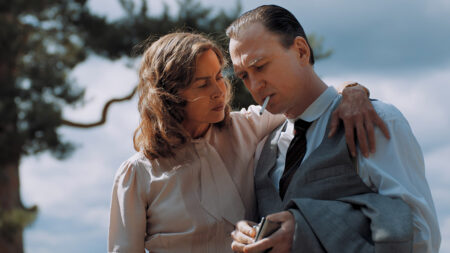
Paper Tiger is fundamentally a crime thriller, clearly adopting a free hand with fictionalization. But it’s just as much a domestic drama that plucks elements from Gray’s childhood, casting Scarlett Johansson and Miles Teller as his parents Hester and Irwin, variations on Esther and Irving, the roles played by Anne Hathaway and Jeremy Strong in Armageddon Time.
Initial plans were for Hathaway and Strong to reprise those parts, but when scheduling conflicts caused both actors to drop out, Gray decided to take the project in a different, more heightened direction. It became a bracing melodrama — the good kind, fueled by raw emotional power, not the artificial kind that traffics in overwrought audience manipulation — with a dark, burdened heart.
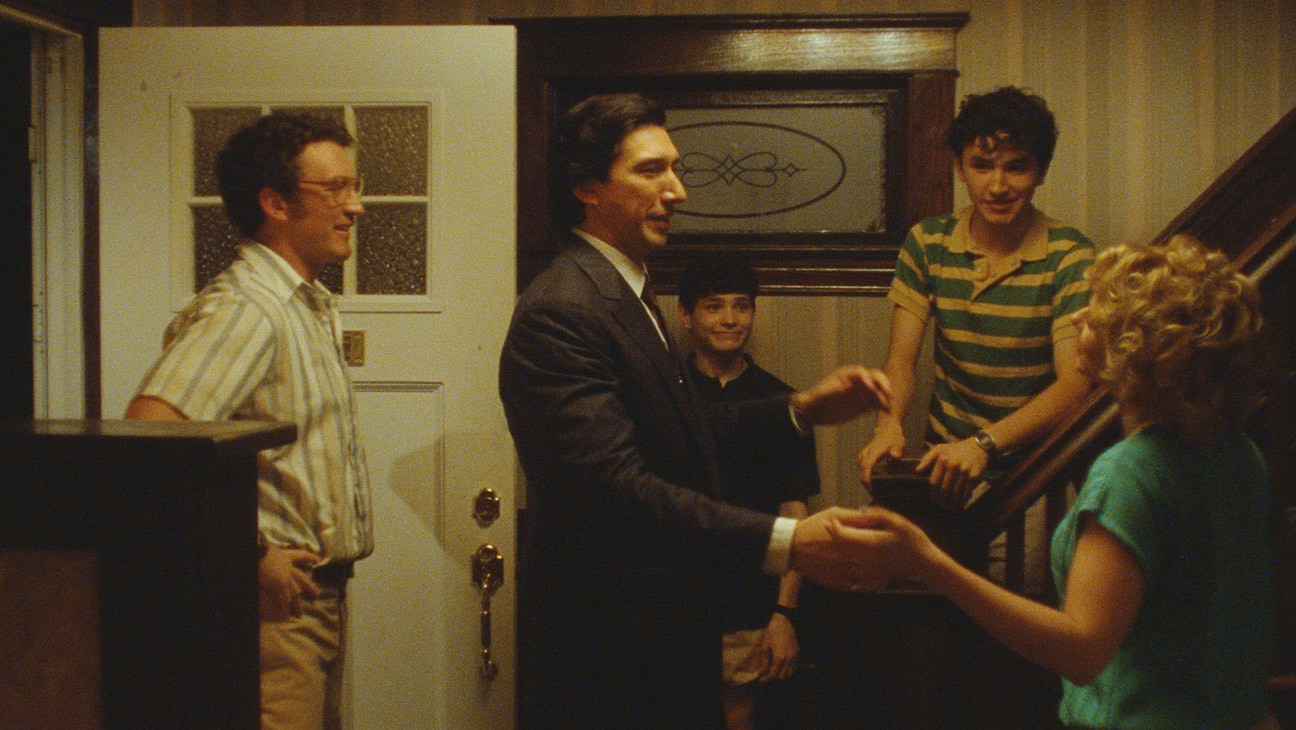
Gray and his older brother are again represented, this time as Scott (Gavin Goudey), about to turn 18 and go off to college, and Ben (Roman Engel), the younger brother he picks on. They both worship their Uncle Gary (Adam Driver), a former cop who is everything their engineering nerd dad is not. Gary drives a fancy car, wears sharp suits and, coolest of all, packs a gun in an ankle holster.
It’s not a big leap to imagine Gary getting into some shady business dealings, even if his record on the force was clean and he has remained in good standing with bureau chief Bob (Patrick Murney), a buddy who can occasionally be tapped for useful information.
A century earlier, Brooklyn’s Gowanus Canal was among the world’s most polluted waterways, befouling the entire Eastern Seaboard with tons of toxic waste. Even in 1986, the eye-watering stench of the murky waters remained. Irwin at first scoffs at the idea that the decaying industrial area could ever be gentrified. But Gary — who buttered up his brother by rolling up for dinner with caterers from Peter Luger Steak House and is considered in the family to have the Midas touch with business deals — persuades Irwin to hear him out on a proposed partnership.
Downplaying the fact that he’s in talks with the Russian mob to nail a lucrative contract, Gary whisks Irwin over to Gowanus to see their supposed cleanup operation and meet the thuggish type in charge, Alexei (Yavor Vesselinov). The Russians are looking for a way to get around city regulations, so Gary attempts to convince them they need his connections and his brother’s engineering know-how, proposing a consulting agreement. Despite being told by Gary to let him do the talking, Irwin starts asking questions, making Alexei prickly.
This is Driver’s best role in some time. Gary is a calculated charmer adored by his brother’s family; anytime he visits their modest suburban home in Queens feels like an occasion. But he’s also selective about sharing the truth, counting on Irwin’s lack of street smarts by reassuring him that the Russians are paper tigers, far less threatening than they appear.
Like an expert salesman, he convinces Irwin that a financial windfall is right at their fingertips. He shrugs off his brother’s concern about where all that industrial sludge will go by saying their involvement will be purely in an advisory capacity; it’s up to the Russians what they do with the information he and Irwin provide.
In a harrowing sequence that dials the churning dread up several notches, Irwin drives the boys over to Brooklyn one school night, against their frazzled mother’s wishes, to show them Uncle Gary’s get-rich-quick scheme. He leaves his sons in the car as he steps out to inform the workers of a safety hazard, which turns Alexei and his goons violent. While Irwin is getting smacked around, two mobsters terrorize the boys in the car before kicking them out and driving off in it. The most chilling moment is when Alexei after looking at Irwin’s papers says, “So now we know where you live.”
We are in prime James Gray territory as Irwin wrestles with the instinct to call the cops, he and the completely freaked-out boys opt to keep the incident from Hester and tensions escalate between him and Gary. It’s gripping stuff, directed with unerring tonal control and blanketed in ominous stormclouds by Christopher Spelman’s magnificently unsettling, full-bodied score, mixed in with the occasional bit of lugubrious Russian choral music.
While Gary is pissed at his brother for sticking his nose in and ruffling the Russians’ feathers, he’s cocky enough to believe he can saunter in and fix things with a few calming words. But that’s not how mob boss Semion Bogoyavich (Victor Ptak), who controls a vast criminal network, operates. The Russians regard Irwin’s unannounced visit as a grave breach of trust, setting a hefty price to make the problem go away.
The spiral of menace is breathtaking as Gary continues to dig them in deeper with his misplaced confidence and reckless moves, and a bone-chilling warning left in the dead of night forces Irwin to bring Hester up to date. Johansson has never been better, notably so as she’s simultaneously gripped by rage and blood-curdling fear when she learns of the danger to which Irwin exposed their sons.
Teller also expands his range in an affecting performance that sees Irwin struggling with regret, self-castigation, disillusionment with the brother he has always admired and stone-cold terror for the fate of his family.
Meanwhile, Hester has been privately dealing with mental lapses and throbbing headaches, refraining from telling her family about the medical tests her doctor ordered. Nor does she tell her good-natured meddler of a mother (Cindy Katz), who’s forever nudging them to get out of the city and move to Great Neck. Johansson plays her with a tough edge to match her Queens accent, but Hester is clearly petrified by this perfect storm of ugly events.
In a movie that’s almost operatic in its cymbal clashes of violence, its agonizing tensions and vicious threats, the heartstopping scene in which Hester receives her diagnosis at the doctor’s office is perhaps the single most devastating moment. It’s a shock even though it’s been amply foreshadowed.
There’s no shortage of other dramatic crests, among them a climactic shoot-out in a cornfield that’s a model of steadily mounting suspense. And the ending hits just the right note, both tragic and redemptive.
Paper Tiger is a great-looking movie — cinematographer Joaquin Baca-Asay (who shot We Own the Night and Two Lovers for Gray) slathers on the dark, gritty textures while never stepping too far into noirish stylization. And editor Scott Morris delivers a compact cut of just under two hours that nonetheless breathes like an epic. While the obvious antecedents outside of Gray’s own body of work might be Coppola or Lumet or Scorsese or Mann, I kept thinking while watching of the early crime films of Akira Kurosawa, from Drunken Angel and Stray Dog up to the classic police procedural, High and Low.
Gray and his superb cast are in blazing form and full command here in a bruising movie that reveals the heavy price of pursuing the American Dream too recklessly, instead of heeding Aeschylus’ words. The Ronald Reagan era now seems a precise point on the country’s timeline when wealth became an obsession, no longer just a goal.
Read the full article here