



[This story contains spoilers from the two-part Matlock season two finale, “Who Are You?” and “Matty Matlock.”]
As promised when Matlock creator/showrunner Jennie Snyder Urman last spoke to The Hollywood Reporter on how the second half of season two would unfold, the big pharma Wellbrexa opioid scandal and Jacobson Moore’s unscrupulous role in it is now wrapped up. But that didn’t happen until the very last minutes into the second episode of the two-part season two finale.
After all the hard work of blowing up her life — transforming from wealthy lawyer and happily married Madeline Kingston into Matty Matlock, the folksy septuagenarian left bankrupt by a no-good husband and forced to still work to take care of her grandson Alfie (Aaron Harris), it looked like Matty was going to walk away from it all. But it wasn’t from defeat or bitterness. Instead, she reached a point of forgiveness primarily for herself regarding her daughter Ellie’s deathly drug overdose that she never anticipated. She also realized she wasn’t willing to walk away from her friendship and connection to Olympia.
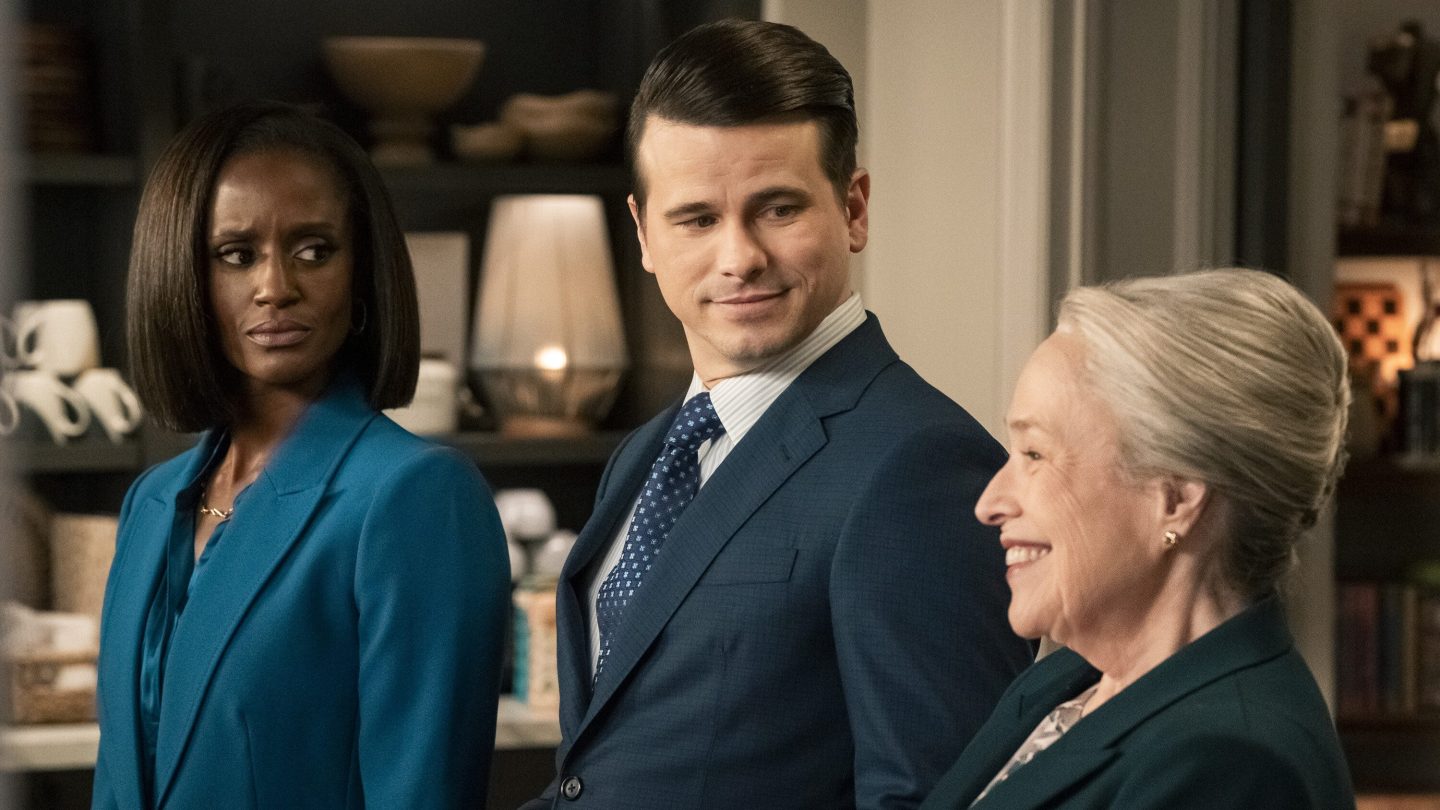
Getting to this point broke with a lot of conventional TV storytelling. Skye P. Marshall’s Olympia found out who Oscar and Emmy winner Kathy Bates’ Matty Matlock really was at the end of the first season. Television of yesteryear would have likely had that play out for another season or two. But after Matty and Olympia begin rebuilding their friendship, they revealed to Jason Ritter’s Julian, the son of chief villain Senior (a very savvy performance by Beau Bridges), who Matty really is. Considering that Julian has been sitting by his father’s hospital bed following a stroke, the move was even riskier. Julian, who has dirt on his hands from doing his father’s bidding and removing the damning study revealing Wellbrexa’s wrongdoing, surprisingly joins the duo.
By the show’s end, Julian, especially on discovering that his dad has been faking early dementia and that the father-son closeness he’s longed for is yet another manipulation, is committed to doing whatever it takes — even risking prison time, by working with the DOJ, particularly with Lida Guitierrez portrayed by Gina Rodriguez, the star of Jane the Virgin, the show that got Urman noticed. Julian’s attempt to outsmart Senior boils down to a dramatic moment of his father discovering the wire and crushing him per usual. But everything isn’t what it seems. As Matty and Olympia walk away from Jacobson Moore on their own terms seemingly without bringing down Senior and his precious law firm, it’s revealed they actually did snare him, along with Justina Machado’s Eva, Senior’s disgruntled ex-wife and a partner in the firm and many others, including Julian.
So much happened in the second half of season two. Despite being married 50 years, Matty and husband Edwin (Sam Anderson) weren’t on the same page, mainly because he wants to return to their old life in San Francisco. And then there is the uneasy relationship with Alfie’s father Joey (Niko Nicotera) and the threat of Alfie going through what they did with Ellie after Joey relapses. A case of the week dealing with a company that creates AI versions of your loved ones you can chat with not only raised serious ethical questions with Jane the Virgin’s Yara Martinez as Vicki, who is not just grappling with her sister’s death but must also contend with a claim on the company as her last wishes. It also resulted in Matty finding addictive comfort in chatting with an AI version of Ellie. That storyline introduced Marshall’s husband Edwin Hodge as Langston, a super smart tech expert with multiple impressive degrees.
Urman spoke to THR below about wrapping up season two and building to this ending, and she offered insight into how smoothly the show handled the exit of one of the show’s core characters with actor David Del Rio’s dramatic departure as Billy amid bombshell accusations involving his co-star Leah Lewis, who plays attorney Sarah Franklin. She also talks about Julian’s dramatic arc, the fun Jane the Virgin reunion in the finale — and Urman also leaves clues about what to expect in season three when the show returns midseason in 2027.
***
Why was this the right ending for season two?
Myself and the writers wanted to wrap up Wellbrexa. We wanted to give some real answers and also have characters face real consequences. That was exciting for us. We just don’t want to sit in the same things over and over. We want to keep pushing storytelling forward and find new and interesting things to dig up about the characters, and their relationships and their complications.
It felt like we had gone on this two-year journey with both Wellbrexa and Matty, sort of understanding her grief and what the loss of her daughter did to her and how it changed her. But also finding new life and new choices and new avenues she didn’t expect or see coming. It felt like the culmination of all that storytelling. It was the right time for it.
Was wrapping Wellbrexa up now in season two your plan originally?
Our plan was to wrap up Wellbrexa [early]. The ending of last season was the midway point. The hardest thing to figure out was: Why would she organically stay Matty Matlock? We knew we had to solve that. And we didn’t know what that answer was because, obviously, the show is called Matlock. And what we came to was something we couldn’t have imagined at the beginning of the storytelling, because it took in all [the ways of] how she had changed, Kathy Bates’s performance, and all of the ways she realized how much she had gained that she didn’t expect to gain by doing this mission. So it felt like the right culmination.
When did Matlock become a show about these two women — Matty and Olympia, and not just about Matty Matlock?
I always pitched it as a love story between Matty and Olympia. That was always the storytelling plan. I always knew we would have the “my daughter led me here to you” [realization]. I didn’t realize it could come at the end of season two, and what it would allow us to do moving forward, which I’m excited about for season three. I thought that would be more of an endgame realization. And I realized, “No, we’re here now.” This is what she’s going to do. She really has processed her daughter’s death in deeper ways than she could have anticipated. She’s so many years past [Ellie’s death], but it’s haunted her and she didn’t expect to get more resolution beyond the resolution she gets from finishing her mission and doing this last bit of mothering for her daughter. That’s how it was in her head.
What she realized at the end was that it felt so right for her to acknowledge that she could, in fact, give up this mission if she had to, because she realized what it was about for her. She realized what she got from it — her connection to Olympia [and] their relationship and where she is in her life. That felt significant for the character to say: “I could give it up if that would mean not ruining your lives, Olympia and Julian.” That felt like a really significant arc for the character, and one we had earned after two years of storytelling.
How did you so easily transition Billy [actor David Del Rio] out?
You just look at the pieces in front of you, change some storytelling and move forward and keep pushing the story forward, and take seriously the fact that he was gone for the characters and let them process and have that lead them to more change and growth and connection. That’s what we did. When he was no longer there, we also investigated how that felt for Sarah and for Matty, and how it could push them closer. People move in and out of our lives, and you have to deal with it. So we took it as that, in terms of inside the show and with the storytelling.
The episodes involving AI Ellie was unexpected, especially considering behind the scenes drama and controversy in the industry over it when it as it impacts writers. Take us through the process of why you elected to include the AI storyline and what it accomplished for the story.
A few things. One is that AI is obviously so prevalent right now, and there is this big afterlife industry, and we’d read some interesting articles about it. The show is about grief and addiction, and it felt like the right way those two things could specifically hit Matty in new ways was that she could get addicted to this idea of being able to talk to her daughter once more. But that’s not really her daughter. What would that feel like? The complications of that in her regular life felt interesting.
And then being able to close the computer at the end and step back into her real life felt like the last ledge she had to stand on before getting to that finale revelation of, “I think my daughter led me here to you” and “I could lay down my sword if I need to in order not to blow up our relationship.” This understanding and metabolizing of Ellie and being able to close that computer on her daughter was an important emotional step on the way to her larger emotional arc.
Since we’re talking about things in the past, let’s talk about bringing in Jane the Virgin faves, especially for the finale.
I just love all the Jane the Virgin actors. I had all these things in my mind [of] if I should save this person for this or that. And then towards the end of the second season, I was like, “I’ve got all these great actors that I would love to just be in the show.” Once I made that decision, it was great. I was able to call so many people, and Yara Martinez came in in 13 [playing Vicki the owner of the afterlife AI company in “The Future Is Nigh”] and did a great episode for us. Bridget [Regan] and I had been texting, and suddenly I was like, “Oh my god, she could be our district attorney and, holy shit, she’ll be so great going toe to toe with Olympia.” Justina [Machado] has been in our show since episode three [as Eva, Senior’s ex-wife and now one of the firm’s partners], and I just love the scenes she has with Skye [P. Marshall who plays Olympia] in the finale. I really love seeing those two women go toe to toe.
Then I knew I needed someone [with the DOJ] who would come with a lot of meaning, who could do a lot and make a character really fly off the page and make her significant even though she’s not in a million scenes. It was 11 o’clock at night, and suddenly I was like, “Oh my God, that could be Gina Rodriguez!” I just texted her, and I think she texted me back within like three minutes [and said], “Yes, I don’t need to know what the part is. Yes!”
It was awesome. And then I was able to really write that character because I knew what Gina does. We have Yael [Grobglas], she’s been there [as Shae]. So, there’s a lot of Jane people on the set, and having a picture with Gina and Kathy was really special to me and just awesome!
Let’s talk about what Julian goes through, especially in this second half and how emotionally torn he is because he is being asked to send his own father Senior, who almost dies and who he believes has dementia for a lot of this second half, to prison. In the finale, him going through with it in the end is an act of bravery. Talk about what that means for his character.
He’s always been the character who believes he’s a good person. But then when things are tested, he chooses the easy way out. Morals are great on paper, but when they really count is when you’re up against it, and you have to make choices that are difficult. We really have been building towards this moment for Julian, where he finally makes the ultimate sacrifice [and] makes a move that is so definitively not what his father would have done [which] would have been just all about self-preservation. Julian really did something selfless and something good, and he lived up to, I think, who he wants to be. It was important for him as a character.
And we’ve been building towards this. [Julian] understands what happened to Matty and what she’s lost, and how many people have lost as a result of his action, which he kept in a little shoebox and didn’t think about who suffered emotionally and internally. I think he had a hero moment at the end, and it’s going to come with consequences in the third season. But [this season] he had his hero moment and became the person he wanted to be and who he believed he was deep inside.
That scene when Julian is in Madeline Kingston’s home, sitting on the staircase, and he just breaks down in tears is a very powerful moment.
Exactly. We’d been in the writers room trying to carefully arc his moment from realizing from fury that he was set up to redemption, and also really carefully calibrating the way in which Matty interacted with him at every level so that their relationship started to slowly build too once the truth [of who Matty really is] was between them.
That moment when Olympia is sitting with Eva for lunch and then realizes that Eva was involved in Wellbrexa is very tense. Talk about that gotcha moment.
We wanted that reaction. We’ve been building towards that since the beginning of the season, where [Olympia] finally thinks Eva’s her ally, and then realizes Eva’s in on it, too. So we’ve been very excited for that [moment]. What was important within that interaction and confrontation is that Eva’s not an arch villain. You understand what happened to her, what her circumstances were, what she was sort of trapped into, and how much power she did or didn’t have. Also, what it means to be in those rooms where decisions are made and what your responsibility is once you’re in those rooms.
We wanted that all to be part of that conversation with Olympia, and we wanted to make sure you could see on some level Olympia saying, “Okay, what? Why am I continuing to excavate the past? Maybe we could get these bad guys out, move forward with intention and precision and make this the place that we want it to be.” Eva’s a part of her circumstances as well, and she makes a different choice than Olympia, but a choice we can understand. That was the most important thing to us in the writers room.
With Matty and Olympia going off on their own to establish their own firm, what does season three look like without a Jacobson Moore?
We have a lot of exciting storytelling [ahead]. There will be a part of Jacobson Moore in it, but we are leaving with a lot of forward momentum, and things will be very different in the third season in an exciting way. We get to shake up our storytelling and really build a great new, contained mystery that relates to but is not a part of the old mystery, and it gives us a lot of fresh storytelling. Even though you repeat certain elements in a procedural, I don’t want the show to ever be repetitive. The cases of the week are the things that stay consistent, but I want us to always be pushing our characters into new situations, new challenges, and really make the storytelling as exciting as it can be.
With Sarah and Emmalyn or Belvin showing up at the Kingston home and Edwin welcoming them in, season three seems like it will be even more female-focused.
It’s got a female focus, but Julian’s part is big. I want to bring back Langston, and he and Olympia are going to be in a certain situation when we come back.
We didn’t even talk about Langston being portrayed by Skye P. Marshall’s real love in real life.
I have been trying to get Edwin [Hodge] on forever, and I’m so happy that that worked [out]. There are going to be new dynamics [that are] female-focused, and also male-focused, and just new elements in the storytelling; we’re shaking up the pieces on the board. We’re going to have a lot of the same pieces, but there’s going to be a few new ones in there too that I think will be fun.
Matlock seasons one and two are now streaming on Paramount+.
Read the full article here