



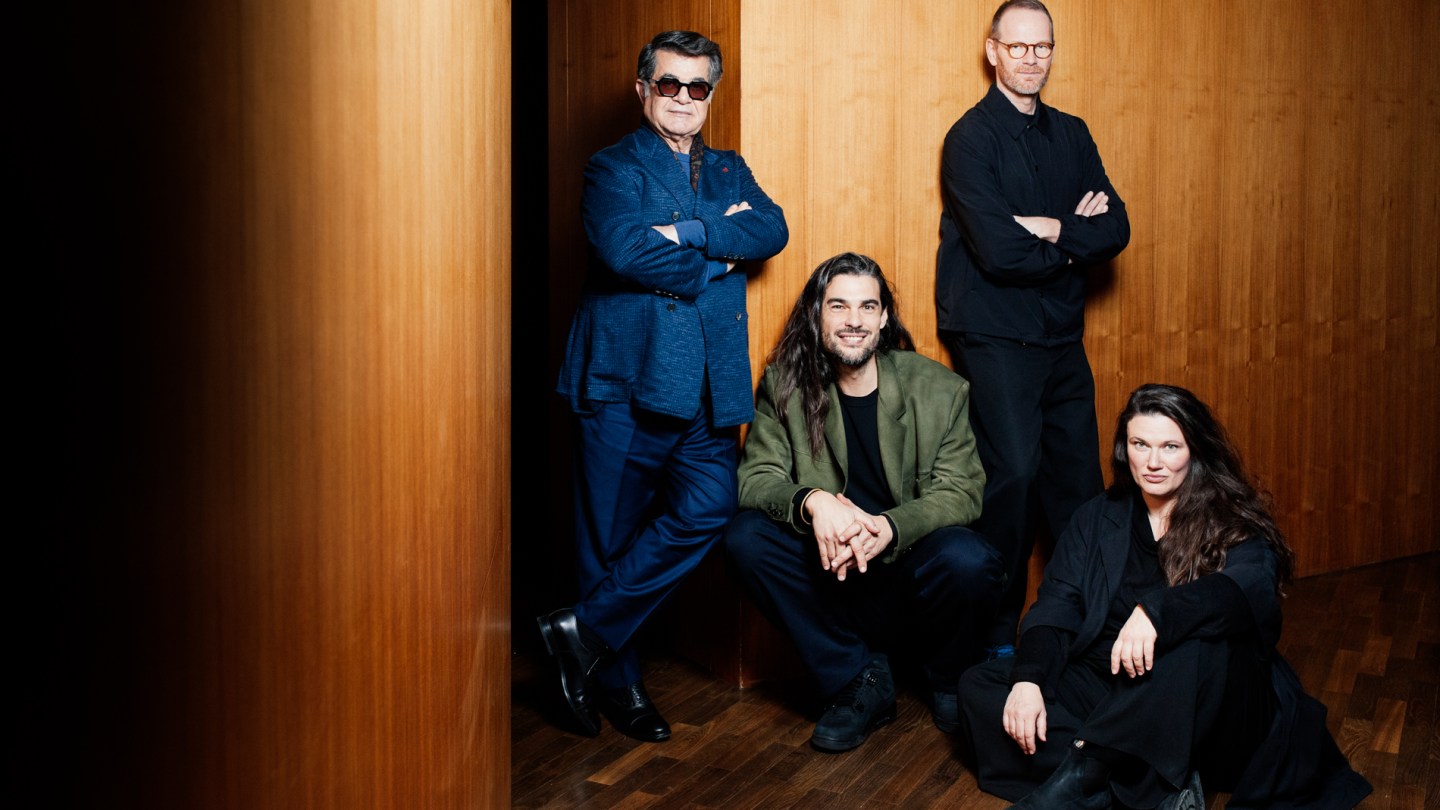


For our European Cinema Roundtable, we’ve brought together filmmakers behind four of the most discussed and debated films of the past year, and of the current award season.
They range in across style and genre. From Joachim Trier‘s subtle Norwegian melodrama Sentimental Value and Masha Schilinski’s century-spanning German period epic Sound of Falling, to Oliver Laxe‘s surreal dystopian Spanish road move Sirât and Jafar Panahi‘s Iranian moral thriller It Was Just an Accident (representing France in the Oscar race).
In a wide-ranging discussion, the directors move beyond awards-season narratives to confront bigger questions: Whether filmmaking is inherently political, how trauma echoes across generations, and why cinema — especially on the big screen — still matters.
The European Cinema Roundtable — European Cinema on the Edge — is a collaboration between The Hollywood Reporter, German broadcaster DW and the European Film Academy and was recorded on January 16 at DW’s studios in Berlin.
Why did you all become directors? Joachim, you started as a professional skateboarder…
Joachim Trier: At least I had a sponsor. I was a competitive skateboarder, yeah. I think [I became a director] because I’m a third generation filmmaker. I would probably have been ashamed about saying that earlier in my career. But my grandfather was a filmmaker. That affected me tremendously. My parents were both in movies. My father is a sound designer. My mother is a director of documentaries. I kind of grew up on film sets. And I love those people.
I was a bit of a kind of restless young person. I didn’t love school. I found my way into skateboarding. And there I started filming my friends. I made these films when I was 15-16, years old, where I would just film a whole summer and cut it together with music. It wasn’t only skating, it was also the lives of people I knew, kind of recounting a summer every year. Slowly, I just realized that’s what I want to do with my life.
And Mascha what was it like for you?
Mascha Schilinski: I was a little bit a troublemaker in school, so I left school before school could kick me out. I didn’t have a diploma and I traveled some years. Then I realized I would love to study,[film] but I hadn’t graduated. So I looked for something I could study without [a high school diploma]. And the only thing was film.
The good thing was I knew something about film, because, like, you Joachim, my mom worked on film. I knew there were jobs there, knew about this film life. First I studied screenplay writing. I wrote for a couple of years. Then I decided I want to do my own films. So I studied directing.
Oliver, you came from a completely different direction, right? You didn’t have any sort of formal training. Why did you feel compelled to become a director?
Oliver Laxe: I like images. They are tasty. When I see pictures of myself being a child, I never look at the camera. I’m all the time playing. I’m all the time making films in a way. In a way I’m escaping — I was escaping reality. The images, this inner world was warm, was tasty. It’s this taste of images, this flavor, that I like to imagine, I like to translate it into images. It’s warm, it’s just a good feeling, I don’t know. I just surrender to this. I surrendered to the images and their warmth.
Jafar Panahi: I was raised working class and for us, there was no entertainment. All we had was a library in our neighborhood. So I always was there. I was, I think, 11 or 12, and I was quite a chubby boy. Because of that, someone asked me if I want to act in a film, a super 8 film. I said, ‘Yeah, why not?’ On set for the first time was the first time I saw a camera. I realized there is some person looking from this camera into the world. I really wanted to be that person behind the camera.
I really had this obsession to look at the world from behind the camera. I started working in the summer and I saved my money until I could buy a photography camera that was a Zenit [Soviet model] camera. That was the starting point. I started taking photos. I started working with images. Then I studied cinema at college.
So the main link between all of you is that you were all misbehaved children. Now, we’re going to talk about your films in a second, but Jafar, given the brutal crackdown in Iran by the government on protesters, I have to start there. What’s your reaction to what’s happening in Iran right now?
Jafar Panahi: The reality is that this repression has always been there in Iran after the revolution. Every time people [protest] something, the answer, the response, was repression. It’s nothing new. The new thing this time is that we see them attacking people, shooting people with weapons. Within 48 hours [of the start of the countrywide protests], we saw mass murder. It’s unbelievable what has happened. It’s very difficult to understand.
The more people they murder, the better you realize that the time of this regime is over. They are fighting against their own people with military weapons. I don’t know what to say. I’m speechless. In my last film, I had a kind of hope that this circle of violence would end at some point. That after this regime we will have some kind of peace. But with the kind of violence that we have experienced, my fear is that even after this regime, this violence will not be forgotten, and even worse will happen.
This may be awkward to transition to talking about films, but do all of you consider filmmaking a political act?
Oliver Laxe: I think that just deciding what you are going to shoot, what is interesting for you, is a political act. I think there is nothing more political than the poetic. And I think cinema is really a tool that can heal the collective [imagination]. I think it can elevate conscience. There are a lot of different kind of filmmakers. There are ones who are more ideological, others more poetical. I think the purpose is to touch the human heart. If we do this, this is the most political act that we can do. No matter the way. This is the important thing, to move you.
Jafar Panahi: I want to say that I don’t see myself as a politically-engaged filmmaker, because I have a certain definition for political films. For me [political films] are like political parties. They are about ideology that divides people into good and bad. I’m more a socially-engaged filmmaker. In [socially-engaged] films, there is no absolute good or bad human being, but it’s the situation that makes this person good or bad.
I think that everyone, and every ideology, should be respected. They all should contribute. This is what happens in my film with the torturer. In the whole film, every character is talking about this one person [their torturer], who is absent. He’s in a box, in a car.
But because I wanted to be fair towards him as well, I made the decision, at the end of the film to give him a shot, a 13-minute long medium shot, so that we can see him. We see the others come and go [in the shot] but the camera doesn’t turn towards those other people. That’s his share [of the story]. He also has the opportunity to get a defense of what happened to him, to tell his story.
My films are mostly social films with a political subject or theme. Maybe I make a film about war, but it is still a social film about the war, not one about the politics.
To be sure, in this world today, in countries under authoritarian regimes, even your clothes can be political. How you live, how you behave, everything can be political. But when we are talking about films, it’s not about politics anymore. It’s about the society. It’s about the humans.
Mascha, your film, Sound of Falling, carries through a century of German history, told from a female perspective, young women and girls growing up on this same small farm in Eastern Germany. These are untold stories of intergenerational trauma. Did you see the film as a political statement when you were making it?
Mascha Schilinski: Initially, we weren’t concerned about the political aspect at all. What we really wanted to do was to look into the deepest depths of the people who lived there and generate [something] from those depths. While we were conducting the research, we realized that there are these concealed stories. There are hidden, untold stories of women, which tend to be neglected because they’re in the margins of history.
Many of those women could not read or write, and these are often stories that are so shot through with shame that people wouldn’t even talk about them on their deathbed. Initially, we didn’t intend to make a film told just from the female perspective. We started looking broadly into intergenerational trauma and the way in which trauma is passed down from generation to generation.
However, at one point, we realize that there is a striking distinction. There was a question as to how women were looked at for over a century, and that women were looked at differently than men. Over the course of time, we realized, as well, [the importance] because we were looking at this specific location where we shot, in the former GDR, what used to be East Germany. The film became more and more political as we were making it. But that wasn’t our initial intention.
Joachim, although your and Masha’s films are very different, I think there are connections. Sentimental Value is the story of a film director, played by Stellan Skarsgård, trying to reconnect to his estranged daughters and he only seems to be able to do so through the medium of film. As you mentioned, your dad and grandfather were in the film business. Are they autobiographical components to your movie?
Joachim Trier: I think the film is about autobiography. It’s about how people express themselves in indirect ways through the medium they choose. Norway has been a country of peace since the Second World War and the five-year occupation by the Nazis. My grandfather was in work camp during the war because he was a very brave man, and he was in the resistance. It’s kind of magical that he survived.
He started doing music as a jazz musician, and then became a film director. I’ve always thought he did it in order to survive. He tried to find a way to express himself in my life. [After the war] he became a pacifist and quite political.
Now I have got two children, and the world is a very complicated place. Writing this film with [co-screenwriter] Eskil Vogt, I was asking myself these questions. Even though we’re making a story about a family at peace, they’re trying to reconcile with history. They’re trying to forgive a difficult father that has been very affected by being the first generation after the war and by having a mother who has been traumatized by the Second World War.
I ask myself: How many generations does it take after a war or after a war trauma, before it stops affecting people? That’s the question I ask when I look at my kids: Will I be the wall that changes things, or will those events that are so far in the past seemingly still be alive in them?
There’s a really strange dichotomy. [to Schilinski]: I also love that in your film, [there is] the ambivalence of memory. We owe it to the past to remember and to tell those stories, yet we also owe a new generation a sense of openness to the possibilities of a future that’s not affected and tainted [by the past]. That ambivalence becomes then the individual’s relation to history. In a strange way, I see a lot of films this year that deal with that.
Oliver Laxe: I think that we are, all of us, broken because of different factors. We are broken, but in a way, we hide this wound. I think that the ravers [in Sirât], they are broken but they show it. I think that’s really healthy — in order to stop the pain, to stop this suffering.
The suffering is provoked from people who are suffering. We suffer so we provoke suffering. To stop this, it’s really important to connect with the wound, to celebrate the wound, to dance the wound, to connect with our shadows. It’s something [I felt] since the beginning, when I met this community [of underground ravers]. Then I was more idealistic, I identified with an idealistic image of myself, and the process of being with them and raving became more about looking inside. About dancing this wound in order to stop the pain.
The ‘dancing the wound’ you talk about takes place against a powerful soundtrack from electronic artist Kangding Ray. Why did you think this kind of music, this dark techno, would be the perfect mirror of your film’s themes?
Oliver Laxe: It’s curious. You say dark techno. It’s called deep techno.
I’m not an expert!
Oliver Laxe: No, it’s fine. Because [the idea of deep techno] is that through shadows you arrive to the light. That was the idea with Sirât, to take this tunnel, to look inside. Sometimes it’s painful. But the idea was at some point, to arrive at a kind of transcendence. I hope that people could feel light at the end of this demanding film.
Mascha Schilinski: I find so interesting what you said right now, Oliver, because when my co-author Louisa [Peter] and me started the writing process on Sound of Falling, we were so curious about the fact that our bodies are more transparent than we are. There’s a line in the film where Angelica, this girl in the 80s, says: ‘It’s so funny that our head blushes when we are full of shame and trying to hide it.’ Our body is so much more transparent than we [are].
During research for the film, we found many hidden writings, small half sentences in between descriptions of idyllic childhoods, written in this almost profound tone. In between, there’d be a sentence, like: “Women have to be made so they aren’t dangerous for men.” Or a maid who says: ‘I’ve lived for nothing.” We could feel these many small, hidden things. And we were interested in these moments. Because when you think of trauma, you often think about war and things like this. But I think there are also little, tiny moments that can happen during a life that are so impactful. There’s a character in the film, living in the present, and she receives a gaze, and this gaze, this look will form her complete life after this.
We wanted to create a stream of images so that you have the feeling that everyone who lived at this farm is thinking or dreaming at the same time. It’s about memory itself. How unreliable memory is, and how abrupt, fragmented and also associative. This became the structure for the whole film.
Do you see filmmaking partially as personal therapy?
Joachim Trier: I don’t know. I don’t make films with a clear plan on why I’m doing it. I just don’t know how to do anything else. I don’t know how you guys feel, but it’s also a passion for the form. I love movies. I grew up in movie theaters. I think movies all the time. I am sitting in situations and I’m looking at people, all this interesting behavioral stuff, psychological stuff, the mysteries of the others. I find that engaging and interesting. Then to make characters that are not me or my co-writer or my actors, but something in between us.
It’s just far enough removed from myself so that I don’t have to be ashamed of what they’re doing or protect them or anything. I can be three dimensional. I can look at them and study them and collaborate around these characters. And I think that’s the kick: To find images that show some sort of human experience.
Oliver Laxe: I don’t know what I’m doing, you know? I just give myself to my intuition. Now with my future project, I’m already feeling something in the body, as you say, Masha, my body knows things that my head doesn’t yet.
Jafar Panahi: I think when the filmmaker has pain, something moves, and this is the kick the filmmaker needs to tell something, to show something and show it to others. This pain could be very simple, a very simple conversation, that kicks something in you. It won’t be an idea right now, but you will keep it in your mind unconsciously and you can’t get rid of it.
It happened when I was in prison. In prison in Iran, they ask you questions. If you are a political prisoner, it takes 7-8 hours. You sit close to the wall, you have a pen and a paper and someone behind you asks you questions. You have a blindfold, and you have to push it up a little bit so you can write your answers.
When I was doing that, I wasn’t thinking about the questions or my answers. I only thought: ‘Who is this person behind me?’ I couldn’t see anything, but I could hear him. I started asking myself: ‘How old is he? What is he wearing? If I see him outside, would I recognize him? If I do, how would I behave?’
At that moment, I didn’t know that at some point I would want to make a film about this person. I was there. I saw everything. I sensed everything, and I memorized the situation. It was that which came out as a film later.
Whatever you do in your life, I think it will be in your films at some point. You don’t know how. You can’t decide how. We can’t help finding subjects in our life. We see, we observe, and we want to tell.
Mascha Schilinski: I think there are so different starting points for a film. Sometimes it’s an image. Sometimes it’s something that you heard, or sometimes it’s it’s a strong feeling inside of you where you have to find a way, a language for it. In Sound of Falling I was so interested in this invisible thing, these things you have no name for, things you can’t tell about. And trying to find a form to show them, to turn them into a film. I think questions are a good starting point. Not having the answers already but seeing what happens during the process of writing.
All of your films are official Oscar submissions. What’s the experience been like, going through the crazy circus of awards season?
Joachim Trier: Part of being a filmmaker is what I call paying promo tax. It’s a privilege. It means that you are being seen and people care. I don’t take it lightly. I come from Norway, a tiny country, the suburbs of Europe. We’re very grateful when anything we make travels.
But [touring with your film] you also find a kind of a secondary story to the film you’ve made. You don’t know it when you made the film, because you’ve been in this tumble dryer of intuitive creativity. I hadn’t negotiated what my film was until I showed it in Cannes and got the applause. Then you’re standing there, very vulnerable and nervous. Then people start writing about it. People are talking to you about it. And slowly you start understanding how you communicate about your film.
I feel by now, we’ve probably all kind of peaked a bit. We’ve told our story now. So now we have the choice of either starting to invent some bullshit secondary story, to find more entertaining stuff to say, or we find new ways of telling the story.
But once in a while, you meet people still that connect you to the core of what the film came from. Someone will share a personal anecdote about something relating to your film, and that also brings you back. It’s so creatively stimulating, even though it takes a lot of travel and a lot of talk.
In Norway we’re a little bit shyer sometimes than other cultures, and you feel this kind of shame about the attention you’re getting. But it has a flip side, that we can be part of a bigger presentation of a group of films. [To the group] I’ve met all of you before. We’ve kind of been on the road together, and I’m seeing you all doing well. We know about the award aspect of it, but at the end of the day, we’re privileged to be in a group of films that people are seeing and discussing.
Oliver Laxe: I think it’s a luxury. It’s a privilege to share your films at this level, worldwide. In Japan it’s not the same thing as in Mexico. You’re having new interpretations, people are having different experiences with your films. You understand how a film transcends us, that whole art has to transcend the author, and the level of meanings are infinite sometimes. That’s powerful. I really come from the underground. This is my fourth film but it’s the first time I can share a film at this level. So I’m really grateful.
Jafar Panahi: The reality is, watching films in movie theaters is one of the most enjoyable things you can do. It’s so joyful. It was such a pity for me that I have seen [your films] alone, because I need to watch with Persian subtitles. I think the joy of seeing them with an audience would be very different. But finally, last year, I could travel to Cannes and see my own film with the audience in Cannes. This was the first time after 17 years [Tehran had banned Panahi from leaving the country]. Because my films were never screened in Iran, I couldn’t go to movie theaters and see them with an audience. And I hadn’t been outside of Iran.
For a director, watching the film with an audience is important, because you see your strengths and your weakness, you realize where you connected with your audience. Sometimes it happens that your audience finds something you never thought of. I’ve watched my film with audiences over five continents and I see difference. In the United States or Canada, for example, they laugh more [at the film]. In Asia, they laugh less. Or sometimes they laugh so hard I can’t understand why? There’s a scene when the wife and child of the torturer are at the hospital, and people were laughing. I said: ‘Why? It’s not funny.’ And they said: ‘It’s quite funny. These people wanted to kill [their torturer] and now they are helping his wife and child.’ I don’t know why, but that turned into laughter in the movie theater.
During the 12 Day War in Iran, when Evin Prison was bombed, some prisoners got free. It was in section four, the section I was in, and there is section 209, where the torturers are. The prisoners got out and the saw the torturers. And before they ran away, they helped the torturers get out, before the area was bombed. Is that funny? Maybe when they see them again on the outside they will think of revenge. But this again is this humanism, that is the subject of socially-engaged cinema.
Speaking of watching films in cinemas, Joachim, in Sentimental Value, your director, Gustav Borg, initially tries to make a European movie. But when his daughter [played by Renate Reinsve] doesn’t want to be in the film, he gets a Hollywood star, played by Elle Fanning, and a Netflix deal to do the film. For all of you, if Netflix came calling, offering a lot of money but with a lot of rules, would you do it?
Joachim Trier: I’ve always had final cut. That’s how I make movies. That’s not a discussion. [And] for me, theatrical is important. I shoot on 35 millimeter. I love the big screen. It’s the art form that I’ve committed my life to. Yes, I saw the films of [Soviet director Andrei] Tarkovsky on VHS tape when I was a kid. We will always have those formats, but theatrical is special. I see it with young kids. Being in a cinema, in a dark room with no other screens around, and you have to focus on these other human beings. I feel that all of us at this table and many of our colleagues in this award season have made humanist films. They are about using the possibility of empathy and the mystery, [creating] a space for the audience to interpret. To have that focus in the theater is, to me, very important. I think Netflix has made a lot of good movies. They are supporting a lot of great filmmakers. I just wish they’s show them in the theaters.
Oliver Laxe: For me, it’s a red line. It’s necessary to preserve these temples that are theaters. We are making a social ritual. It’s very complex, what is happening between an image and us. We were talking about the body, how the human metabolism feels images, how the images can make something in your body, this subtle relationship. Even in the dark, when we think we are alone in front of the images, we are sharing things with the people [in the theater]. This is powerful.
At the same time, I think the chronology of cinema has to be respected. It’s how also we can finance our films, and how we can maintain our independence. I’m happy to be a European filmmaker. We have an expression in Spanish, which in English would be: ‘Bread for today, hungry for tomorrow.’ It means if you take the easy path today, you will be hungry tomorrow. I think we have to think about the future and [be suspicious of] the easy path.
To end, if I could take it back to politics — as filmmakers, as directors, where do you find the courage to try to meet the moment, to try and make movies that say something about what is happening in our world right now?
Oliver Laxe: We are kidnapped by the films. I think we don’t decide. We give our bodies, not to the science, we give them to the art. We get drunk on it and through us, through our bodies, we express something that is reflecting something of our time. In my case, when it comes to courage, I find that even failure, even crisis, can make me grow. Obviously, I have fears. But I think we are learning to deal with fears. That’s the point, to accept being fragile and vulnerable, to understand that it’s part of the creative process. When you surrender, when you give yourself over to intuition, it is like the film is using you.
Jafar Panahi: Every time I hear the word courage, I get a little concerned. Because I think I don’t have that courage. I can only make films. It is my job. If I feel pain about something, I make films about it. It’s not about courage.
Maybe the courage is that I don’t let others decide for me. I do whatever I believe in and do whatever I want to do.
I want to tell you something. When I was a student and I wanted to make a film, I had everything I needed, because I was making it for television. I shot the film. Then while I was editing, I realized, ‘wow, this film is quite horrible.’ Technically, everything was okay, but there was no emotion in it. Nothing with my signature. We worked with film negative at the time. So I snuck into the laboratory and destroyed all the negatives so no one would ever see that film.
That’s why I say it’s important to express yourself, to be yourself. If being yourself means courage, ok. But if it means you are very brave and you can change the world, well I don’t think that I am that person.
Read the full article here