





[This story contains spoilers from Dead Man’s Wire.]
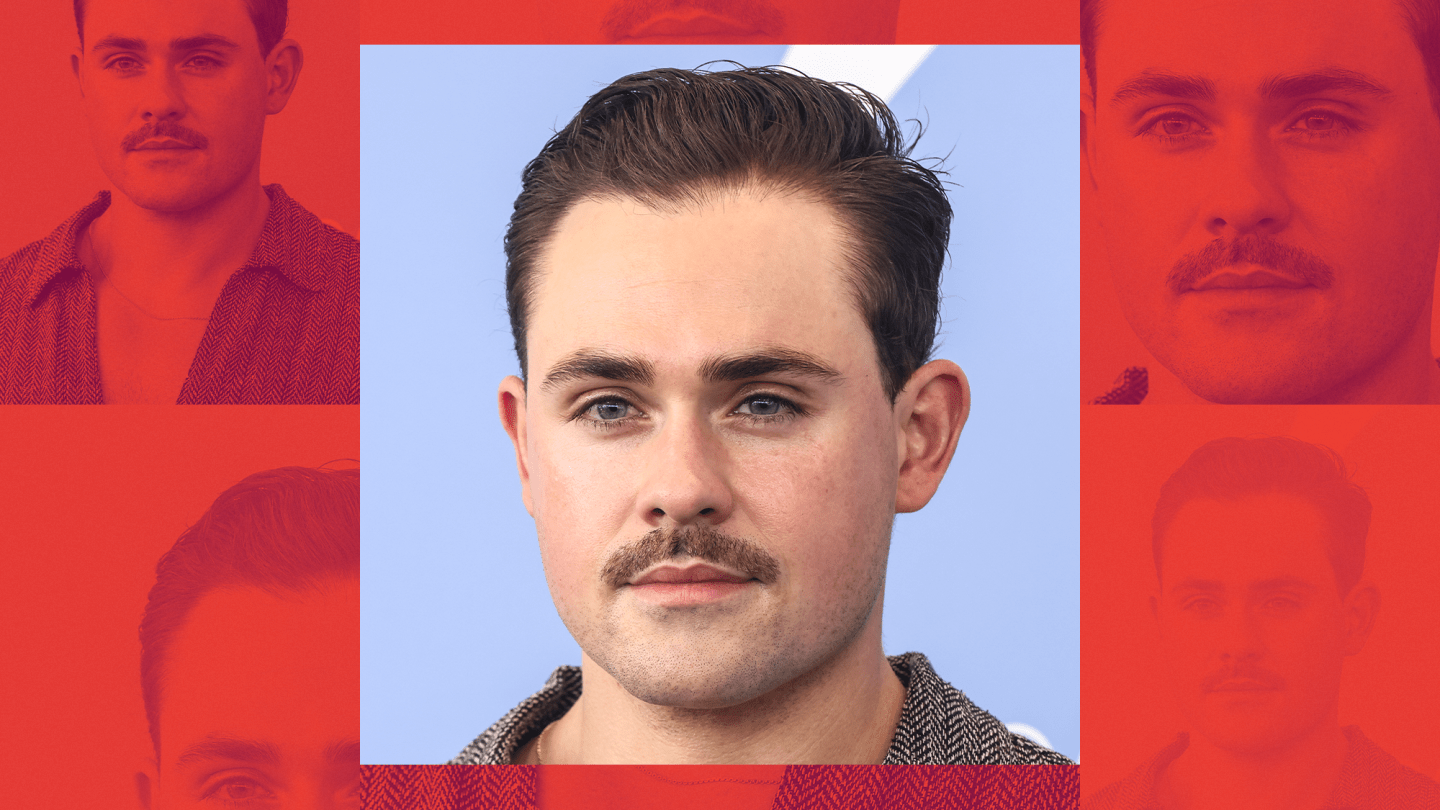
Don’t expect Dacre Montgomery to half-ass his performance, and especially not in his new movie, Dead Man’s Wire.
The 31-year-old actor slowly fell “in love with movies and the idea of the process of making films” growing up while watching his parents, who worked as a 1st AD and sound recordist. After grinding for 10 years and studying drama in college, Montgomery eventually landed his breakout role as Billy in Stranger Things in 2017.
But as someone who is always looking to “explore the limits of what I’m capable of in every way,” the actor says, his latest role in filmmaker Gus Van Sant’s Dead Man’s Wire made for the perfect challenge. The film is based on the real 1977 Indianapolis hostage situation, where disgruntled businessman Tony Kiritsis (Bill Skarsgard) held mortgage executive Richard Hall (Montgomery) captive, with a shotgun rigged to a “dead man’s wire” around his neck.
“I’m always someone who’s going to be pushing to have the handcuffs tighter and the wire to be real,” he tells The Hollywood Reporter of how he made the filming process a more immersive experience. “And sure, I left set with bruises around my neck and my arms and a sore back and whatever else, but I think it helps believe the performance.”
Below, Montgomery opens up about his preparations to portray a real person in Dead Man’s Wire, how physically taxing the role was and working so closely with Skarsgard. He also reflects on Stranger Things, with the megahit series wrapping last month.
How did you first get attached to Dead Man’s Wire and what attracted you to the script?
I got a text from a rep saying, “Gus [Van Sant, director] wants to call you about playing one of the leads in his first film in eight years.” I obviously freaked out. Gus is a bucket list director of mine, so when I got the call, I was like, “Oh my God. He FaceTimed me the next day and was like, “Look, I’m doing this film. It’s called Dead Man’s Wire. It’s based on a true story and I’d love it if you could play Richard or Dick Hall.”
I didn’t know anything about the true story. I was looking it up while we were chatting and I was like, “Gus, Dick Hall is 55. You do realize I’m 29.” Gus was like, “Yeah, I don’t care.” I was like, “Okay, well, who are you casting to play Tony?” Tony’s 48, he’s 5’10 [and] he’s an American Greek man. He goes, “Bill Skarsgard,” who as we know is 35, he’s 6’8″ or 6’7″ and he’s Swedish. So I was like, “This is not obviously what the true characters look like,” but it’s a testament to Gus. It’s not about that. It’s about the soul or the creative spirit of the actors he casts in his film.
I’ve learned that as part of his process, even in making the film. He said, “Obviously let’s try and get you looking like Richard, but let’s not put an emphasis on it.” But I don’t do things in between. So I went to 1,000 percent — bolded myself, got rid of my eyebrows, tried to become this man, this character. And it was a really rewarding experience because Gus is super collaborative and trusts the process.
Given that the film is based on real events, what did your preparations and research look like to take on the role of Dick Hall?
I have a random, abstract way of entering that space, which is [that] I create a perfume for every character I play, which I’ve done in the past, and kind of hybrid the real story and the fictionalized Bill/Dacre/Gus version of Tony and Dick Hall’s story. I created a perfume that embodied what I wanted to bring to the character and what I knew about Dick Hall.
Dick Hall wrote a book after the situation that happened in his life. It’s a really tragic story. He was sober and ost his sobriety after everything happened; he lost his brothers and his dad. I tried to put all of that into the scent, and also this idea of the ’70s that I had because Gus is very artistic and tactile and was able to describe the ’70s to me in detail. I found that really rewarding, and I tried to bottle all of that up into a scent that I could spray on my costume every day that smelt like the moment.
Across the film’s 105 minutes, there are only a handful of settings that you filmed in. When you can’t rely on your environment as much, how do you go about getting yourself into your character’s headspace?
The biggest thing that was really helpful was actually just getting Bill and I in a room together and the wire around my neck and his hand on the gun, because we’re more like dance partners than scene partners. We have to move as one for so much of the film, and the funny thing about that was that it was kind of a catalyst for this darkly funny version of the film to emerge. The film on paper was a lot darker, a lot more dramatic. And I think the film is very morbidly, absurdly funny.
But a lot of that was born from this odd couple dynamic that Bill and I fell into because you put two people in a room — one who’s on the far right, seemingly, and one who’s on the far left,seemingly. It’s a really interesting thing to see nowadays, especially in this country: two people put in a room for four days who have to have discourse about the gray area in between; the right and left forced to merge closer and have a discussion. U
ltimately, because of that, I, as Dick, found a lot more empathy for Tony, and Bill as Tony found a lot more empathy for Dick, especially with the relationship with his father and seeing that it’s subjective to each of our circumstances. Even though Dick represents so much to Tony, he isn’t ultimately that. They can kind of bond in this weird way, which I think, is again, a testament to Gus for finding a story that puts two people with opposing ideologies and different backgrounds in a room together.
Because of the limited surroundings, do you enjoy a role like this where your microexpressions have such a massive impact on the audience?
Every single one of the characters in the ensemble of this film is a huge personality — a huge, amazing, intricate performance, and Dick fundamentally isn’t. It’s not what I wanted to give to the character. I wanted to create someone who is kind of frozen among all of these people. And, how far could I push that? Not just aesthetically with my hair, my eyebrows, the costume, the scent, which people don’t see, but how far could I push that in terms of the minutia of the idiosyncratic behavior or mannerisms that he would use? It was a really, really difficult role to play. It was physically taxing because the wire was real — the handcuffs were tight, Bill was at my back, the whole film.
I’m a control freak and Gus is very much like, “Let’s just find it as we go along.” At the start, I found that really hard, to be honest with you, but then I found all these amazing wins in being pushed to get out of my head. Bill was pushing me to just go with the flow of the run and gun. We didn’t have enough time, we didn’t have enough money, but what good can come out of that? I learned a huge amount and I’m very happy with how the film came together and everyone’s performances.
You also spent a lot of time leaning over with something tight around your neck. Can you talk about how phsyically demanding that was?
It helped make it a more immersive experience. I’m always someone who’s going to be pushing to have the handcuffs tighter and the wire to be real. I left set with bruises around my neck and my arms, and a sore back and whatever else, but I think it helps believe the performance. It helps if I’m cramping as I’m sitting there and feeling exhausted and fatigued and tired, because that’s what it was. I will always push to try and find something more in performance and process that helps the audience believe what the character’s going through. I invented the knots that Tony used to tie me down on the ground with the bolt in the ground of his apartment floor because I wanted it to feel real. I hated movies when that rope looks slack or the handcuffs look loose. For me, it was all about believing every single component of what you’re seeing on screen, especially when it’s a hostage film.
The film has quite an impressive cast, including yousrself, Bill, Al Pacino and Colman Domingo. What was that like working with all of them?
Al texted me, took me out for dinner in L.A. before we started the shoot in Kentucky, and we talked at length about the characters, but also his love of the film industry. He’s not jaded at all by the amount of years he’s been doing it. He’s in love with it. He’s in love with acting. He’s in love with film and theater and television and all of these things. So that was really nice to actually spend time with him before going and doing the shoot. He was very generous in that capacity. Coleman’s amazing. I didn’t really get to [spend a lot of time with him on set]. I’ve gotten to know him afterwards and he’s amazing.
I just can’t say enough good things about Bill. He’s wonderful. He’s the best friend I’ve made on a set. He’s one of the best scene partners I’ve ever had. He gives it his all. And there’s some other amazing character performances, like Cary Elwes playing Michael Grable and Myha’la is amazing as well. And again, it’s a testament to Gus. He gets the most amazing ensemble and heads of departments. The crew was unbelievable.
With Stranger Things coming to an end this final season, I can’t not ask you about the show. What comes to mind when you reflect on your role as Billy in seasons two and three, and the impact it had on your career?
So much. It’s such a formative period of time. I wouldn’t be allowed the opportunities I have had since if I hadn’t been a part of that show. Someone was asking me, “Are you really sad about Stranger Things coming to an end?” Because I feel like I have to be a glass-half-full kind of person… [creators] Matt and Ross Duffer have so many other ideas that they wanted to explore, make [and] develop for years. And because of the size of the show, they have had zero bandwidth or ability to do anything else. And the thing that I have to remain positive about with the show coming to an end is that this new chapter for them… it’s like if audiences love Stranger Things, imagine what’s next? That’s what I have to remain excited and optimistic for, for audiences to be taken on the next journey and next generation of maybe younger people as well growing up with whatever the next Duffer Brothers’ show is.
Do you have a dream role or genre that you would love to take on in the future?
I’m forever an optimist. I’m forever a cinephile. There are so many things I could tell you right now, but the biggest thing that I’ve been chasing my whole life is directing my first film. That has been my north star and has taken a huge amount of work convincing people to believe in me. That just finished 10 days ago and it’s been a life-changing experience, and anything and everything I’ve been chasing. I was saying to someone the other day, if it’s the last job I ever do, I’m happy. That’s what I wanted. I play the lead in the film as well, so it was also not only a challenge to direct, but to direct and star. I just want to be pushed. I want to explore the limits of what I’m capable of in every way. And this was the hardest, most rewarding experience of my adult life.
What’s one of the biggest challenges you’ve been able to overcome to get you where you are today?
I suffer a lot from really bad anxiety, and that can bleed into every part of your life. And my greatest challenge was figuring out that my anxiety is my superpower, to use that analogy or the metaphor. And it took a long time to figure that out. For a long time, it hindered me. It didn’t help me. I really do think and believe and have talked a lot publicly about that, and about anxiety actually being a superpower, depending on how you look at it. And putting a lot of work and time into making sure that it is and that it doesn’t hinder you or your process or your life, and reminding people it’s an everyday process. I work on it every single day, but I am actually thankful for it because it pushes me to try and achieve new things, and have new goals and desires and dreams and try new things and be bold.
If you had to describe what makes Dacre Montgomery, Dacre Montgomery, what would you say?
Probably my OCD (Laughs). I’m super OCD. I think a lot of my friends would say, “What’s his No. 1 trait that makes him everything: the good, the bad, the ugly, everything?” It’s definitely my OCD, 100 percent. I know that’s a lame answer, but it’s so true.
Read the full article here