





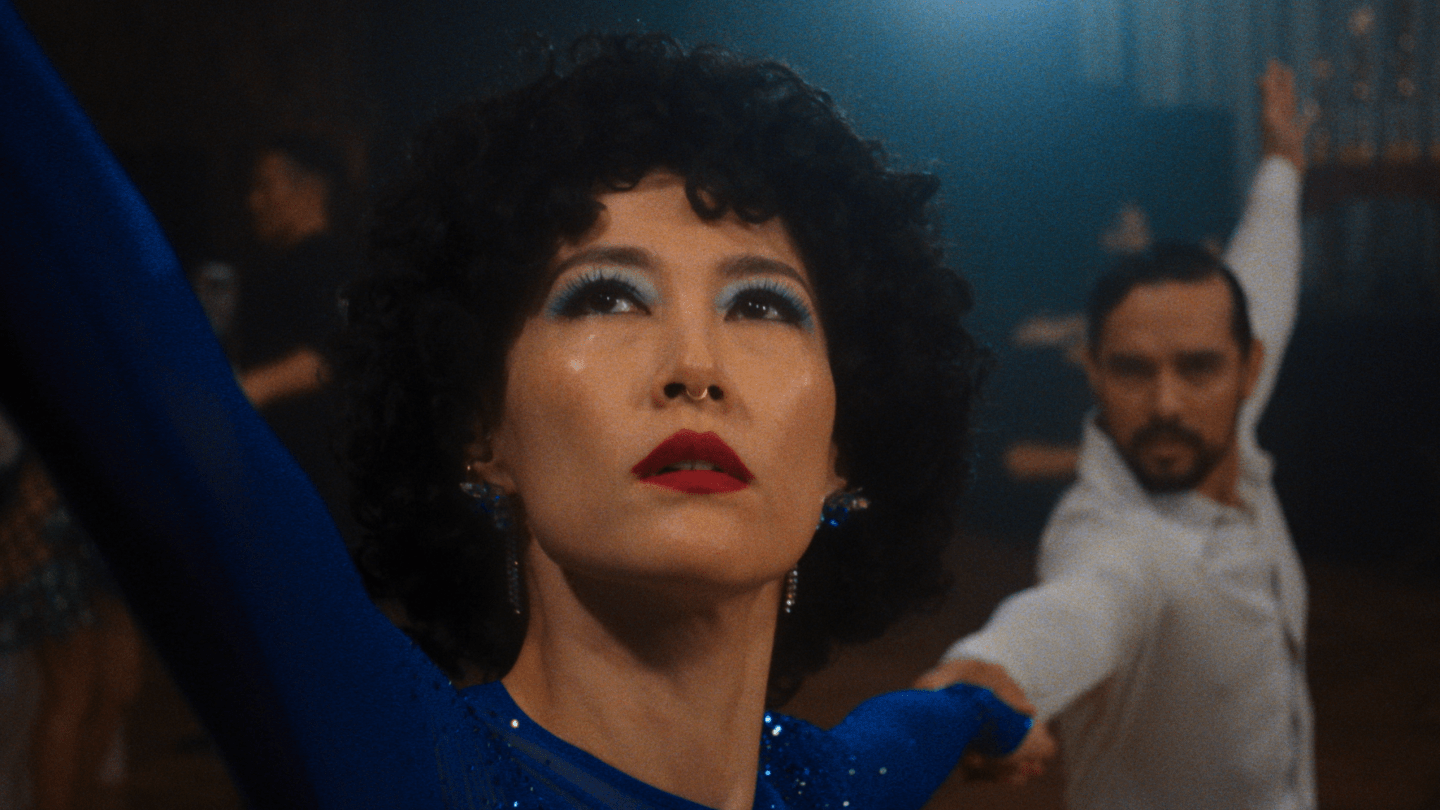


The rumba, the cha-cha and the tango help bring a widow out of mourning in this surprisingly buoyant, unsentimental film about grief. Rinko Kikuchi is affecting and funny as Haru, a middle-aged woman with an unstylish mop of curls, wearing heavy blue eyeshadow and spangly dresses when she and her Mexican husband, Luis (Alejandro Edda), enter ballroom dance competitions in Tokyo. When Luis dies suddenly, Haru hides away until her sister drags her out to a dance class and she finds that her new instructor, Fedir (Alberto Guerra), is irresistible.
Josef Kubota Wladyka, the director and co-writer, shifts from poignant emotion to comedy to surreal scenes that take us inside Haru’s fantasies just as gracefully as the dialogue shifts from Japanese to Spanish and English. Ha-chan, Shake Your Booty! — the title, cringey though it may sound, is knowingly ironic in context — is a small delight.
Ha-chan, Shake Your Booty!
The Bottom Line
An unexpected charmer.
Venue: Sundance Film Festival (U.S. Dramatic Competition)
Cast: Rinko Kikuchi, Alberto Guerra, Alejandro Edda, YOU, Yoh Yoshida
Director: Josef Kubota Wladyka
Writers: Josef Kubota Wladyka, Nicholas Huynh
2 hours 2 minutes
Kikuchi, star of Kumiko, the Treasure Hunter, and an Oscar nominee for her supporting role in Babel, elegantly navigates the changing tones. She is heartbreaking when Luis’ father and sister plead with her to let them take his body to Mexico for burial, and Haru resists, saying his spirit will never be at rest unless he is cremated. But Kikuchi and the film become increasingly comic when her crush on Fedir spurs her back into the world. Emerging from her isolation, Haru boldly asks Fedir out to dinner, and to her delight, he says yes. She also searches online to find photos of him with his absent wife and evidence that he is in an open marriage. Kikuchi makes Haru believable even when her behavior is silly or unmoored because it is clear that her grief still exists under her new obsession.
The American-born Wladyka has said the film was inspired by his Japanese mother (Haru’s last name is Kubota), and it marks a stylistic turn from his gritty previous work, all of them thrillers. Manos Sucias (2014), about Colombian drug runners, was nominated for an Independent Spirit Award for Best First Feature. Catch the Fair One (2021) dealt with boxing and the trafficking of Indigenous women, and he has directed many episodes of the Netflix series Narcos.
The unexpected light touch he brings to Ha-chan is especially evident in surreal scenes that blend easily into the realistic trajectory. Daniel Satinoff’s cinematography makes those transitions clear and smooth. The background light onscreen changes, a spotlight narrows to highlight Haru, and we are inside her fantasies. She sees herself dancing alone with Fedir, when in fact she is just one member of his class.
In another surreal scene, a giant black crow walks into Haru’s house, soon revealed as her fantasy of Luis wearing a crow costume. The bird is both an avatar of death and a reassuring presence. Wladyka uses the fantasy scenes just enough to reveal Haru’s thoughts, to show how reality feeds her fantasies and those fantasies inspire her actions.
Even when it is most concerned with death, though, the film is full of life, from the colorful production design to the well-chosen costumes. Haru goes to a costume party in the dress and skeletal makeup of the Mexican Day of the Dead, an unspoken tribute to Luis even as she has eyes for Fedir.
The film is not a musical but it is filled with a pop soundtrack, and the dance scenes evoke both Haru’s passion for dancing and Wladyka’s love of films. Brightly colored chapter headings include “Nobody Puts Baby in a Corner,” which leads to an homage to Dirty Dancing. In another cheerful musical set piece, Haru and Fedir run into a group of belligerent drunken men outside a train station, and in her fantasy the men in business suits start dancing to “Be My Baby” in choreographed unison.
The engaging supporting characters include Haru’s concerned, sympathetic sister, Yuki (Yoh Yoshida), and their brash cousin, Hiromi (YOU). It’s Hiromi, who wrongly imagines that she grasps American culture, who tells Haru to get out there and “shake your booty,” a phrase that instantly registers as the over-the-top Hiromi being out-of-touch.
The film is clearly not aimed at a young demographic. Haru and Luis enter the Amateur Latin Senior dance competition and her sister throws her a 46th birthday party. But with an engaging star and a story that leads to a touching, optimistic ending, Wladyka has created a little gem likely to find its audience.
Read the full article here