



Marcia Lucas, the ex-wife of George Lucas and editor of iconic films including 1977’s Star Wars and Return Of The Jedi, has died at 80.
Lucas died on Wednesday at her home in Rancho Mirage, California, a representative told TMZ.
She had been battling metastatic cancer at the time of her death, and she was surrounded by loved ones when she passed, they revealed.
The film editor (born Marcia Lou Griffin) was renowned for her work on blockbuster films, including the original Star Wars film, which earned her an Oscar.
‘Marcia will be remembered as a brilliant storyteller, a trailblazer for women in film, a loving mother and grandmother, a generous host, and a loyal friend whose humor and sparkle filled every room she entered,’ Lucas’s family said in a statement, via Variety. ‘Her influence on film is indelible, but those who knew her best will remember the way she made life feel more vivid, more beautiful, more fun, and more full of love.
‘Her work was known for its emotional intelligence, rhythm, and humanity — a rare ability to find the truth of a scene and bring heart, momentum, and clarity to the screen.’
Marcia Lucas, the ex-wife of George Lucas and editor of iconic films including 1977’s Star Wars and Return Of The Jedi, died on Wednesday at 80 following a battle with metastatic cancer, TMZ reported
Marcia came to be known as her ex-husband’s ‘secret weapon’ in the wake of the poor reception of later Star Wars prequels and more recent sequels and spinoffs, none of which she was involved with; Mark Hamill, Carrie Fisher and Harrison Ford pictured in Star Wars (1977)
Marcia came to be known as her ex-husband George’s ‘secret weapon,’ particularly in the wake of the poor reception of the later Star Wars prequels and more recent sequels and spinoffs, none of which she was involved with.
Marcia and George married in 1969, and she went on to be an assistant editor on his feature directorial debut, 1971’s THX 1138, while he was the lead editor.
She took over the lead editor position on his follow-up, 1973’s American Graffiti.
The film was a hit with critics and audiences alike, and it became one of the most profitable films of all time after it earned more than $140 million in ticket sales and subsequent home video sales against a modest budget of just $777,000.
But the couple’s greatest success came four years later with the release of Star Wars, which was at one time the highest-grossing film of all time and remains one of the most commercially successful films ever made.
Marcia collaborated on Star Wars with Richard Chew and Paul Hirsch, the latter of whom was the sole credited editor on its sequel, 1980’s The Empire Strikes Back, which was directed by Irvin Kershner.
In 1981, she and George adopted a daughter, Amanda Lucas, who went on to become a professional mixed martial arts fighter.
Even while she was raising a young daughter, Marcia returned to work with her husband again on Return Of The Jedi (1983), which was directed by Richard Marquand, while George co-wrote and produced.
Marcia was honored with an Oscar for editing the original Star Wars; (L–R) Richard Chew, Lucas, Paul Hirsch and Farrah Fawcett pictured in 1978
Even while she was raising a young daughter, Marcia returned to work with her husband again on Return Of The Jedi (1983; pictured), which was directed by Richard Marquand, while George co-wrote and produced
She served as the third editor on the project, behind Sean Barton and Duwayne Dunham.
In a 1983 interview with Time, George said his then-wife was responsible for Return Of The Jedi’s emotional ‘dying and crying’ scenes.
In the same interview, Martha said of her editing skills, ‘I have an innate ability to take good material and make it better, and to take bad material and make it fair. I think I’m even an editor in life.’
Marcia met George in 1967, when they worked together as assistant editors on a documentary about President Lyndon B. Johnson’s December 1967 trip to Asia. The two were engaged the following year and tied the knot in 1969.
In the same Time interview, George spoke briefly about their domestic life: ‘We’re basically simple people, with simple wants and needs.’
During the period between Star Wars and Return Of The Jedi, Marcia took a lead role in designing and decorating the offices of her husband’s production company, Lucasfilm, which he founded in 1971.
Despite being intimately entwined with her husband’s work, Marcia came into conflict with George over his nonstop work schedule in the early ’80s, which included his work producing The Empire Strikes Back and the Indiana Jones film Raiders Of The Lost Ark.
The 1981 blockbuster, which was directed by Lucas’s friend, Steven Spielberg, was based on a story and outline from Lucas, and he went on to executive produce and be a second-unit director.
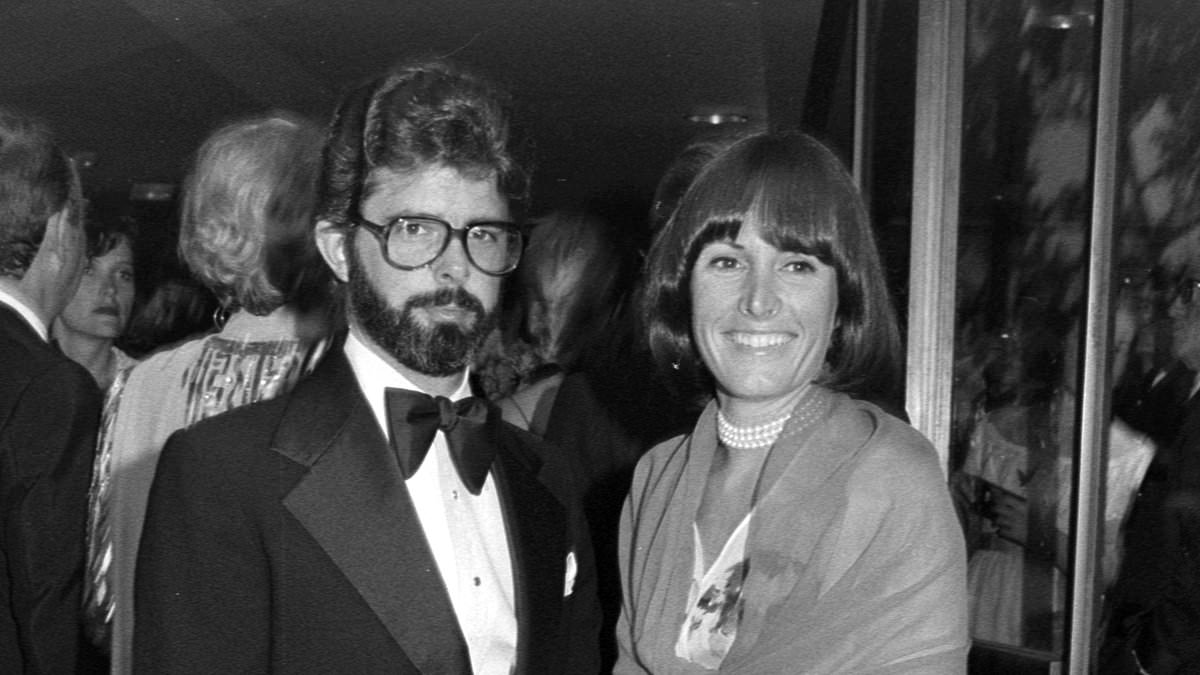
Marcia met George in 1967 when they worked as assistant editors on a documentary about Lyndon B. Johnson’s December 1967 trip to Asia, and they were engaged the following year before tying the knot in 1969; they’re pictured together in 1978 after she won her Oscar
Marcia asked for a divorce in 1982, but agreed to wait to announce the news until after the release of Return Of The Jedi the following year; Carrie Fisher is pictured in Return Of The Jedi
After her divorce from George was finalized in 1983, she married Skywalker Ranch production manager Tom Rodrigues later that year. The couple welcomed a daughter, Amy, in 1985; seen with George in 1981 in Beverly Hills
Marcia reportedly told George she wanted a divorce in 1982, during the production of Return Of The Jedi, but she agreed to his request to wait to announce the news until after the film’s release so as not to jeopardize the operation.
After her divorce was finalized in 1983, Marcia married her second husband, Tom Rodrigues, later that year, and the two welcomed a daughter, Amy, in 1985.
Rodrigues, a stained-glass artist, had worked as a production manager at Lucas’s Skywalker Ranch in the early ’80s.
While she’s best known for her work with her first husband, Marcia also worked with some of the greatest American filmmakers of the 1970s.
She served as an assistant editor on Francis Ford Coppola’s 1969 feature The Rain People, and the same year she was an assistant editor on the influential political drama Medium Cool, which was directed by Haskell Wexler, who was best known as as one of the most influential cinematographers of the 20th century.
She also worked as an assistant editor on the 1972 Robert Redford dramedy The Candidate, which was directed by Michael Ritchie.
In the mid-’70s, Marcia developed a productive working relationship with Martin Scorsese, first with his 1974 drama Alice Doesn’t Live Here Anymore, which earned its star, Ellen Burstyn, the Oscar for Best Actress.
She went on to be the supervising editor on one of Scorsese’s most iconic films, 1976’s Taxi Driver.
In the mid-’70s, Marcia developed a productive working relationship with Martin Scorsese, first with his 1974 drama Alice Doesn’t Live Here Anymore, which earned its star, Ellen Burstyn, the Oscar for Best Actress; Burstyn (R) is pictured with Diane Ladd (L) in the film
She went on to be the supervising editor on one of Scorsese’s most iconic films, 1976’s Taxi Driver. The dark drama stars Robert De Niro as a taxi driver and Marine veteran who becomes obsessed with rescuing a teenage sex-trafficking victim (played by Jodie Foster)
Taxi Driver (pictured) won the Palme d’Or, the top prize at the 1976 Cannes Film Festival, and it was nominated for four Academy Awards, including Best Picture, Actor and Supporting Actress
The dark drama, which stars Robert De Niro as a taxi driver and Marine veteran who becomes obsessed with rescuing a teenage sex-trafficking victim (played by Jodie Foster), won the Palme d’Or, the top prize at the 1976 Cannes Film Festival, and it was nominated for four Academy Awards, including Best Picture, Actor and Supporting Actress.
Marcia returned to work with Scorsese the following year on the period musical New York, New York.
The film, which starred Robert De Niro and Liza Minnelli, underperformed at the box office and received mixed reviews, though contemporary critics now rate it more favorably.
Following her work on Return Of The Jedi, Marcia largely eschewed Hollywood, and her only significant later credits were for executive producing 1996’s No Easy Way and producing the 1998 short film A Good Son.
According to Variety, Marcia Lucas is survived by her daughters, Amanda Lucas and Amy Soper, as well as her grandchildren, Felix Hallikainen, Aeliana Hallikainen, and Knox Soper and her chosen family, Sarah Dyer and Jon Taylor.
Read the full article here