




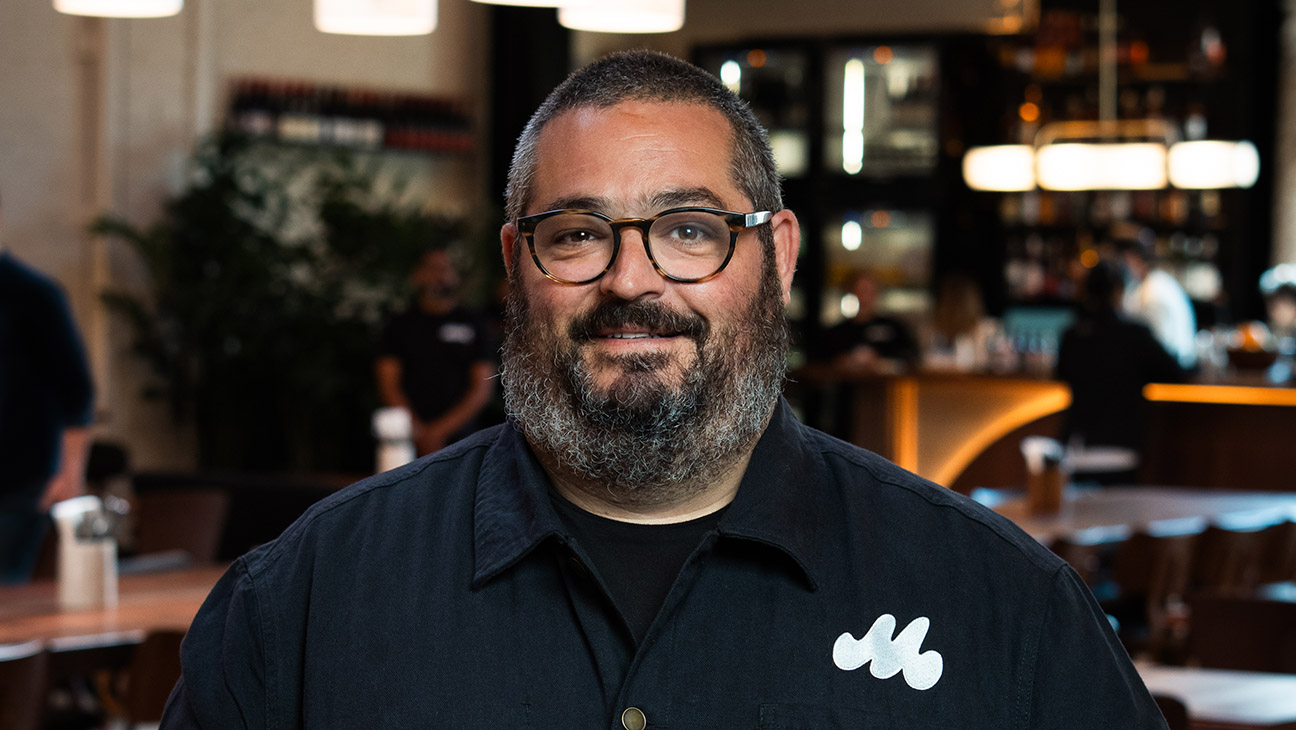


Chef Eric Greenspan, the seasoned L.A. restaurateur who often materializes on the food TV circuit, has debuted Mish, his modern update on the classic Jewish deli in Mid City. “I’ve always been jealous of chefs who’ve explored their own personal culinary memories as children and their own family culinary traditions,” says the James Beard Foundation finalist. “I’ve never done that in my career — until now.”
Greenspan has cooked under the likes of Alain Ducasse, Ferran Adria and Joachim Splichal. He’s also been a disciple since childhood of delicatessens. Or, as he puts it, “a student of the game,” studying during pilgrimages to the likes of Katz’s in Manhattan. But, Greenspan insists, they’re a genre in need of an overhaul for the appetites of younger generations. “I’m cooking for 20-, 30- and 40-year-olds and their kids — not 60-, 70- and 80-year-olds.”
“I love the legacy Jewish delis: I stand on the shoulders of giants,” he says. “But not much has changed in the past 65 years. And yet the perception of Jewish food has changed, including in L.A.” Greenspan, 51, cites the Levantine-inspired local hits Bavel in downtown L.A. and Avi Cue in Studio City, adding, “I wanted Gjusta, but J-E-W,” referring to the hit Venice restaurant. “That was my elevator pitch.” (Other touted next-gen local Jewish spots include Belle’s in Highland Park as well as Courage Bagels in Virgil Village.)
The non-kosher menu at Mish on La Brea Blvd., just south of 1st St., runs the gamut of Jewish deli standards originating in Eastern Europe and then Americanized along the Eastern Seaboard: chopped liver, fried kreplach, matzah ball soup, potato latkes, noodle kugel. “When you order a Reuben it’s griddled in schmaltz,” assures Greenspan, who previously tinkered with deli a decade ago with the brief L.A. run of kosher Fleishik’s. His local culinary resume has also included Silverlake seafood specialist Mare and the New American restaurant The Foundry along Melrose Ave. (As a consultant, he’s scaled up MrBeast Burger.)
Mish’s L.A. aperture is widened beyond the Ashkenazi tradition to encompass the broader diaspora of Mizrahi and Sephardic Jewry. Expect riffs on the Persian frittata kuku sabzi, a variant of the toad in the hole involving shakshuka, plus sabich reconceived in bagel form. “My chicken salad has amba,” he says. “My pastrami’s rub brings in cardamon. We have a hummus bowl.”
Mish also features a serious cocktail program, courtesy of the noted barman Julian Cox, which includes daytime matcha offerings in flavors like lemon halva with salted tahini cream and banana Einspanner with turmeric and saffron. Greenspan and his operating partner Bill Chait, who’s worked on everything from Republique to Tartine, are planning to open late, playing vinyl records on a DJ rig, under the heading Bar Mitzvah. “Kind of like a Kibbitz Room situation,” he says, alluding to the venerable Canter’s deli annex.
Greenspan’s most high-profile — and controversial — project was his most recent: opening the Tesla Diner in Hollywood. Chait brought him in as a consultant while they were cooking up Mish. Greenspan, describing the job as “the craziest fucking thing I’ve done in my time,” was drawn to a logistics challenge under extreme public scrutiny. “Who wants to stand in the middle of a tornado and control it? I do. It’s about attention, emotion, effort, challenge.”
Greenspan recalls that Tesla’s executives were “not the easiest people to work with,” and that he didn’t expect to be caught up in blowback against CEO Elon Musk’s hard-right politics. (The diner opened as the Tesla head took a hatchet to the federal government as a senior advisor to President Donald Trump.) “I had started the project with the hubris of a standard liberal Democrat who thought that there’s no way Trump’s going to win this goddamn thing again,” he says, referring to the 2024 presidential election.
Greenspan is aware that debuting a deli in 2026, amid a historic spike in anti-Semitism, may be perceived as a political act. “People ask me, ‘Is now the time to do a Jewish restaurant?’ I say, ‘Now is exactly the time to do it.’” He’s blunt about what he describes as the “terrible shit going on in this country right now towards my people,” and how he sees Mish, which he’d like to replicate, as an opportunity to “bring into the world, in my own way, what’s beautiful about Jews and Jewish life. A deli brings people together. It’s a center for community. Not just for Jewish community, but community as a whole. It’s a culinary multi-state solution.”
Read the full article here