



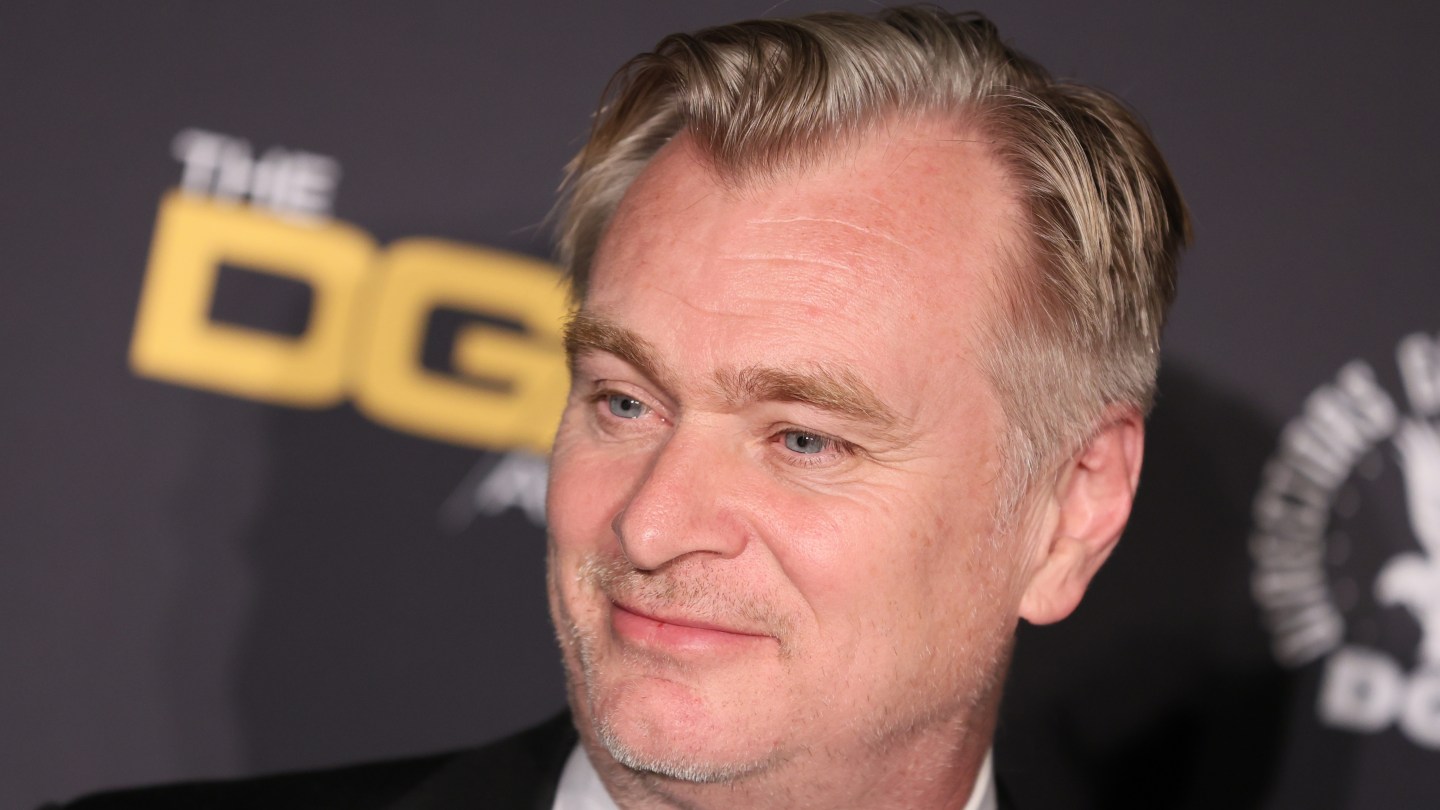


Christopher Nolan is no stranger to tough jobs. This is the film director who crashed a real Boeing 747 into a set for Tenet and flipped an 18-wheeler in the middle of Chicago for The Dark Knight. But even by his standards, the leadership role he recently assumed in Hollywood is daunting.
In September Nolan was elected to serve as president of the Hollywood directors’ union. He took the helm of the 19,500-member Directors Guild of America at an increasingly fraught time for Hollywood and its workers. Production in the U.S. has slowed considerably. Generative AI, and/or the hype around it, is threatening jobs. One Hollywood giant (Netflix) is attempting to swallow another (Warner Bros.).
Nolan, one of Hollywood’s most powerful directors after churning out mind-bending hits like Oppenheimer and Inception, could have left the headaches of worker advocacy during a period of painful transformation to others. But instead he felt it was time to step up.
“All of these changes over the last 10-15 years particularly, and the last five years in particular, they pose enormous challenges,” Nolan told a small group of reporters at the DGA headquarters in L.A. on Jan. 29. “It seemed to me that I’d have something to bring to the table in terms of trying to help represent the members through what is a turbulent period.”
During Nolan’s first interview about the role, he shed light on his approach to labor negotiations, AI and corporate consolidation, all while emphasizing that one of his top focus areas is boosting employment in the industry.
Nolan said early on that he wants to explore the gap between consumer spending on entertainment and industry jobs with employers. Consumer investment in members’ work has been “extremely stable,” he argued, all the while in 2024, the union saw a 35 percent decrease in employment in television and an 8 to 12 percent downturn in film. The DGA does not yet have figures for 2025.
“How do you reconcile those things?” Nolan asked. “What’s happening to the investment? Why aren’t we reinvesting in the consumer? … We need to look at how the new models have created this disconnect.”
The DGA is tackling the downturn in work in part by lobbying to boost domestic production. After advocating for expanded production credits in California and New York, the union is now pushing for a federal tax incentive, a stackable 25 percent federal rebate that could be combined with state rebates. Rep. Laura Friedman and Sen. Adam Schiff have been involved in the campaign and Nolan said there has been a “growing groundswell of interest” in the idea.
Jobs will also be a key issue during the union’s 2026 labor negotiations with studios and streamers, he said. Those discussions are expected to begin on May 11, after SAG-AFTRA and the Writers Guild of America initiate their own negotiations. Nolan would not discuss specific proposals but noted that lack of employment in the union was “very troubling.”
One downstream effect of the lack of work has been that the DGA has had to dip into reserves for its health plan, which is funded in part by employer contributions when members work. The health plan’s problems have been exacerbated by healthcare inflation.
“Healthcare costs have gone up enormously in this country and it’s one of the reasons for the last government shutdown,” Nolan said. “Everybody’s aware of that and we’ll do our part, but the employers are going to have to step up and do theirs” by raising contribution rates in upcoming negotiations, he said.
The union will also be focused on generative AI in the upcoming negotiations. In its 2023 contract, the DGA negotiated twice-yearly check-ins with studios and streamers about their use of the technology and mandatory consultation with directors before companies use generative AI for creative purposes. But Nolan said he wants the labor group to have a presence in shaping how these tools are used in the future. The union also wants to regulate how members’ work could be manipulated by AI if, say, Paramount strikes a deal with Showrunner to allow viewers to create new episodes of their favorite shows.
Nolan is optimistic but wary of the deal that Disney struck with OpenAI in December. Licensing is a step in the right direction, he argues, but the unions need to see “how that’s going to be paid through to the union members.”
Companies will earn the support of unions in their generative AI deals “when they’ve shown how creators are going to benefit from those kind of licensing opportunities,” Nolan added.
As The Hollywood Reporter has reported, the labor negotiating group for studios and streamers has weighed proposing longer-than-usual deals to unions this year. The Alliance of Motion Picture and Television Producers has considered putting forward five-year deals rather than the typical three-year pacts. While not nixing the idea entirely, Nolan said he didn’t think it was “in any way a realistic proposal.”
He asked, “If we had agreed to a five-year contract in March of 2020, where would we be now?”
This year’s labor negotiations will take place against a backdrop of profound uncertainty about the future of the business amid corporate consolidation. After Paramount completed a merger with Skydance in 2025, Netflix is attempting to purchase Warner Bros., a proposed transaction about which the DGA has previously expressed concern.
Nolan says the union has met with Netflix and a competing suitor for Warner Bros., Paramount, to discuss these potential corporate marriages. He wants “meaningful commitments” on how these combined companies would be run and how members would be affected. He called it a “very worrying time for the industry.”
Those who are familiar with Nolan’s work might wonder whether he is concerned about the historic studio loosening its commitment to theatrical distribution if it is absorbed by the famously theater-allergic Netflix. “I think the theatrical window becomes a sort of easily graspable symbol of whether Warner Brothers would be run as a theatrical distributor or whether it would be folded in as a streamer,” he said. The director, who released nine of his films with Warner Bros., is typically laser-focused on the theatrical experience and popularized shooting on Imax cameras. (The Odyssey, the film Nolan is releasing this year, shot entirely with Imax cameras.)
Theatrical windows are certainly one component of the DGA’s concern — the union prefers a 60-day theatrical window. “I think the theatrical window becomes a sort of easily graspable symbol of whether Warner Bros. would be run as a theatrical distributor or whether it would be folded in as a streamer,” Nolan said. But a larger issue is how any combined Warner Bros. entity would act as a buyer, seller and exhibitor. And a further rub, again, is jobs.
“A merger is going to mean loss of jobs. It’s going to mean consolidation. I mean, we all know that, and we can all look at the history to see that,” Nolan said. “Our interest right now is in trying to get to grips with how can we try and ameliorate some of these concerns.”
Read the full article here