
“Beauty has no boundaries, no rules, no colour. Beauty is like a religion.”
Those words belong to Valentino creative director Alessandro Michele, who had them printed to open his newest creation, Specula Mundi, a pink-coated book of photographs by Mark Bothwick featuring Michele’s couture collection of the same name presented in Paris in January. The collection broke free from traditional runway rules to be reconfigured by Michele through the use of a Kaiserpanorama, a round wooden structure that gained prominence in the 19th and early-20th centuries as a precursor to filmed entertainment. It allowed a group of people to peer through windows to view slides or photographs at the same time.
Specula Mundi translates to mirror of the world, and the reflection Valentino has forever displayed centered on beauty. It’s why Michele opened the show with a voiceover of house founder Valentino Garavani from Matt Tyrnauer’s 2008 documentary Valentino: The Last Emperor: “And I was dreaming, dreaming about movie stars, dreaming about everything beautiful in the world.” Beauty and movie stars are embedded in Valentino’s house codes.
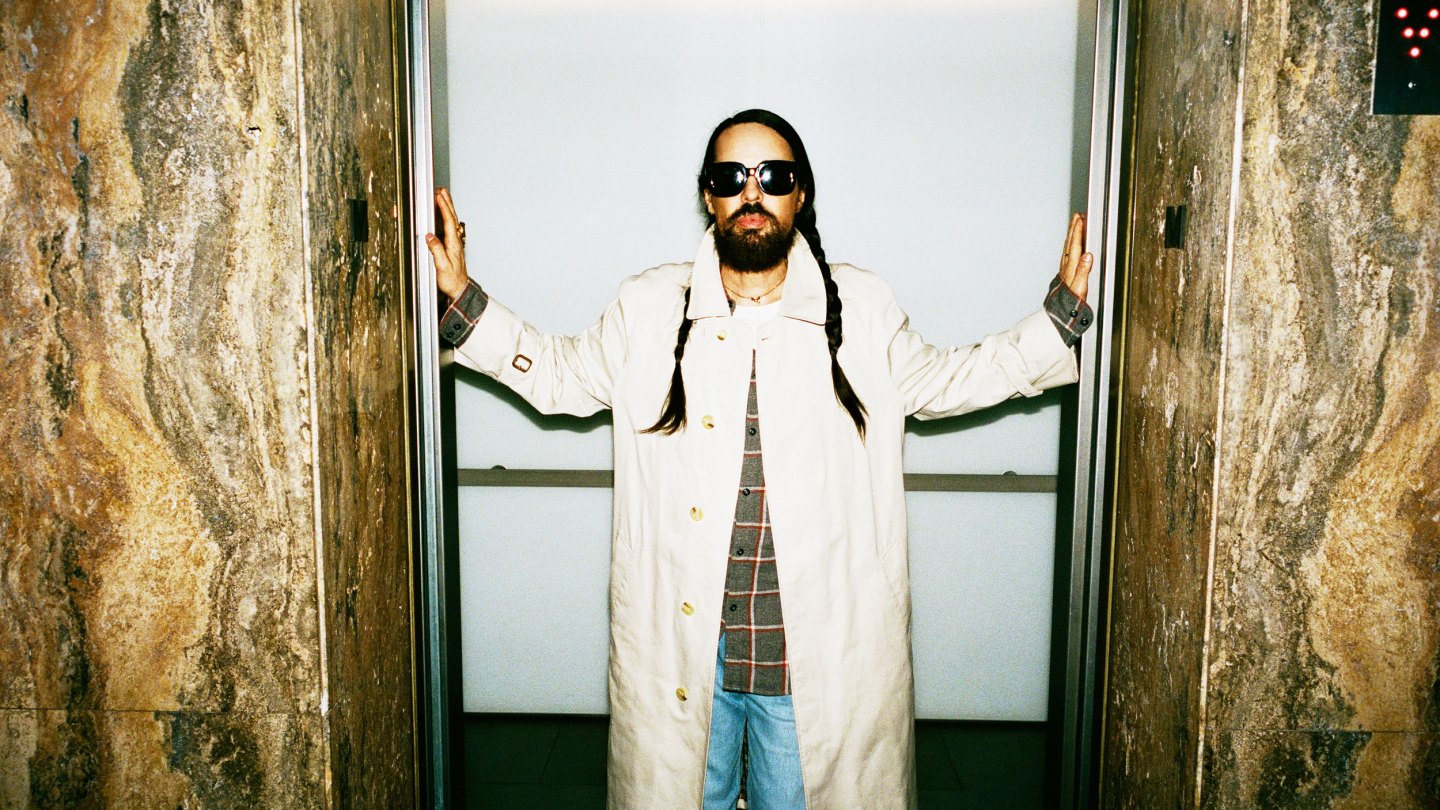
So, it was no surprise that Michele jetted to Los Angeles from Italy for a book launch party held inside the Marciano Art Foundation on Wilshire Boulevard. He loves L.A. for many reasons from the obvious (energy, museums, movie stars) to the less obvious (the light and the weather help him snap out of slight jet lag). And he’s been known to host a starry event or two during his days leading iconic fashion houses — Michele famously shut down Hollywood Boulevard for Gucci’s Love Parade back in 2021 — but Tuesday night’s soiree was the only one featuring a custom Kaiserpanorama positioned in the center of the foundation’s main floor.
Before the first guests peeked through the windows to Michele’s world, the veteran designer sat down with The Hollywood Reporter in a second-floor conference room to discuss carrying on Valentino’s storied history with Hollywood, the first film he fell in love with as a child and seeing his favorite couture creation on the Oscars red carpet thanks to Anne Hathaway.
Congratulations on the book, it’s so beautiful. Why did you decide to open the book with that quote?
We made this book to try to speak another language, to make relevant the idea of couture. That quote is like a poem; it’s about beauty, it’s about life, it’s about passion. It’s a mutual work of many, many, many people. It’s a way to dream. Beauty is such a complicated word. It’s very hard to define what beauty means. I was quoting beauty as something that you follow as a blind human being. We may not know why we are here, why we are living but why we are alive, why we are breathing but I just felt that beauty could be a mission from the very beginning. To follow beauty means many things. With Mark, we let people touch this beauty and see it from many sides. He’s the best, by the way, to do it. He makes poems [with his work].
You have described him as a poet, and his work like poetry. It’s such a unique and special way to describe a photographer. Can you share more on how you see his work this way?
It’s like giving a camera to a shaman. He takes the moment and steers something to life. I like the way he tried to translate something as a line of a poem. He’s sometimes takes a picture and doesn’t look inside the camera. He has said, “I have something mysterious inside of me that I don’t know.” I like the way he’s in contact with a physical object and he uses his camera as a shaman, as a sensitive person. When given a subject or an object to photograph, he looks at it by sometimes turning it upside down, taking the inside on the outside. Couture is wrapping the body in something special, stunning and beautiful, and it helps define a personality. He doesn’t just take a picture — though he takes many hundreds, thousands of pictures — but he can spy the soul of things and find the hidden sides. We met a long time ago and have done many things together. He has said, “The emptiness is the window of freedom and it’s not just something you are missing but a space for who is looking at the picture.” I find that interesting.
The way the models are interacting with the couture in his photographs is extraordinary. I don’t think people are used to seeing couture being held and reshaped in that way. You said in an interview that you didn’t recognize all of the pieces in some of the photographs …
I feel that it’s all completely new. It was very fun because I was working on the collection in Paris and he was in the other room stealing the dresses. He was always waiting to have another piece and maybe waiting to steal an accessory like a hat. We did two different works completely. I would look at the pictures and ask “what is this dress?” because I didn’t recognize it. It was a very surreal way to look at the pieces. It’s beautiful.
You presented the collection in such a cinematic way, using the Kaiserpanorama. Was it important to host the book launch in Los Angeles with the collection’s references to cinema and the way in which you presented it?
I love Los Angeles. Hollywood and the movies are some of my biggest inspirations. I like the dream of Hollywood. I like the idea that here, in the middle of the desert, someone dreamt about something that didn’t exist. It’s so seductive. I love it. I came from the city of Rome, another scene that is very close to that environment. I grew up with my mom who worked in cinema in the 1960s, and as a little boy I watched old Hollywood movies. The collection is totally inspired from that age. The first time I came here was when I started at Gucci, and I spent a long time meeting people and loving the city. It’s a place where I feel very free. It’s a very creative place that is very meaningful for me. When we worked on the book, I thought it was the perfect place to present such an intimate work in a very private way. The [Marciano Art Foundation] gallery is amazing. I love art. I always try to use art as a conversation with my work in a very natural way that makes the conversation easy and natural.
What was the first movie you saw as a child that made you fall in love with cinema?
The first one that I watched a hundred times when I was young — really young, like maybe 5 years old — was The Wizard of Oz. It was so creepy and glittering and shining. It had such an interesting mix between Broadway and Hollywood. I was obsessed because I discovered how magical that world was. I watched so many movies because my mom knew everything about cinema. I have so many, many, many movies that I loved that it’s hard to pick one. But All About Eve is another one of my favorites. I love it.
I read that one of your first dreams was to be a costume designer, and I thought of that while looking at the collection as some of the pieces look like they could be characters in a movie. When you’re designing a collection, do you think of the looks in that way?
No. We went back and looked at memories through the eras, starting in 1915 and 1920 through 1980. It’s a mix between memories that are kind of blurred and foggy, like you have a picture in front of you. … Fashion is about character. It’s not just about clothes and fabric. A dress makes sense when you have a body, a brave inside. That’s why I like vintage, too, because it feels like someone lived in that dress.
Speaking of bringing a dress to life, some of the pieces from the couture collection have made their way to the red carpet, like Anne Hathaway at the Oscars and Odessa A’zion at the Vanity Fair Oscar party. Is there an ideal red carpet for you to see more of these dresses?
It’s beautiful when you see the dress on an actress because it changes again from when you made the dress. By the way, the dress [that Anne wore] is my favorite and I was very happy. It’s one of the most Hollywood dresses. It’s a black velvet with beautiful embroidery and it was painted by hands. It’s incredible and she is beautiful. Fashion is about life and it’s amazing when you see a dress on a red carpet. It’s part of Valentino’s magic that he made in his career. When you work on a dress with an actress or actor, you become almost like a costume designer. You respect their personality, and when they choose a beautiful dress that you made, it’s incredible.
I was going to ask if you had a favorite but I wasn’t sure if that was OK or if it’s hard to pick just one …
Yes, it is my favorite and I didn’t push the dress. They asked for that dress for the Oscars. It was incredible.
I wanted to ask another question about Anne Hathaway. I just saw The Devil Wears Prada 2 and there’s a moment in the film when her character gifts a Valentino bag to a friend. It’s a special moment. Have you seen it?
I knew about [the moment] but I haven’t seen it yet. I am going to see it.
You have a history working with Hollywood and celebrities and so does Valentino. What is your vision for this era at Valentino and how you will continue that tradition?
During the show, I used a quote from an interview he did in the 1970s [featured in Matt Tyrnauer’s documentary Valentino: The Last Emperor] talking about going to the cinema as a young boy and seeing a goddess. And he said, “I want to be a fashion designer. I want to make the dream.” This is something I share with him. I’m happy to be with a brand that has his roots in this world. I’m a different person to Valentino. I’m completely different, but we share this passion. What I want to do is always try to have a real relation in what I’m doing. What happened in the past at my last experience was to live and meet people. I love people and I love people who make beautiful work as artists, actors, singers. It’s beautiful when you share something real. Sometimes they are called ambassadors but I prefer to think about that relationship as friendships. It’s what I share with friends like Dakota [Johnson], and a long list. It’s beautiful when it’s real and they’re amazing and we respect each other.
May I ask about one of your new friends, Sombr? Why Sombr?
I saw him, met him and he was loving what I was doing. I was very curious about him. He’s young and I’m very fascinated by young artists. It’s a way to feel alive. He’s an incredible artist. He’s very elegant and it’s so easy to work with him. I thought it could be a beautiful way to have a real person in the campaign, so I just asked him to do it. I’m curious about new things. It’s a way to feel alive and young. I take myself as an ignorant person, almost, because it’s a way to discover new things and new people like him. He has such great energy and it’s beautiful.
We’re out of time but before you go downstairs for your party, may I ask what’s the best thing about having a party in Los Angeles?
Many things. Maybe because I’m a man, sometimes I’m loving to be nostalgic about places, and there is a beautiful nostalgia here that I don’t want to take as something that is gone. There is an emotional thing that belongs to this city, the light, and there is something beautiful about being here. I’m happy to come here again and meet new people, and to keep the nostalgia going while discovering what is new and what is going on in L.A. This place has a piece of my heart. That’s the beauty in the book.
Interview edited for length and clarity.
Read the full article here