






Following her justly acclaimed documentaries (The Mole Agent, The Eternal Memory) that play like dramas and a scripted feature inspired by actual events (In Her Place), Chilean director Maite Alberdi continues to blur, smudge and gleefully mess with the lines between fiction and fact in her latest, the by-turns highly comical and then suddenly moving A Child of My Own (Un hijo propio).
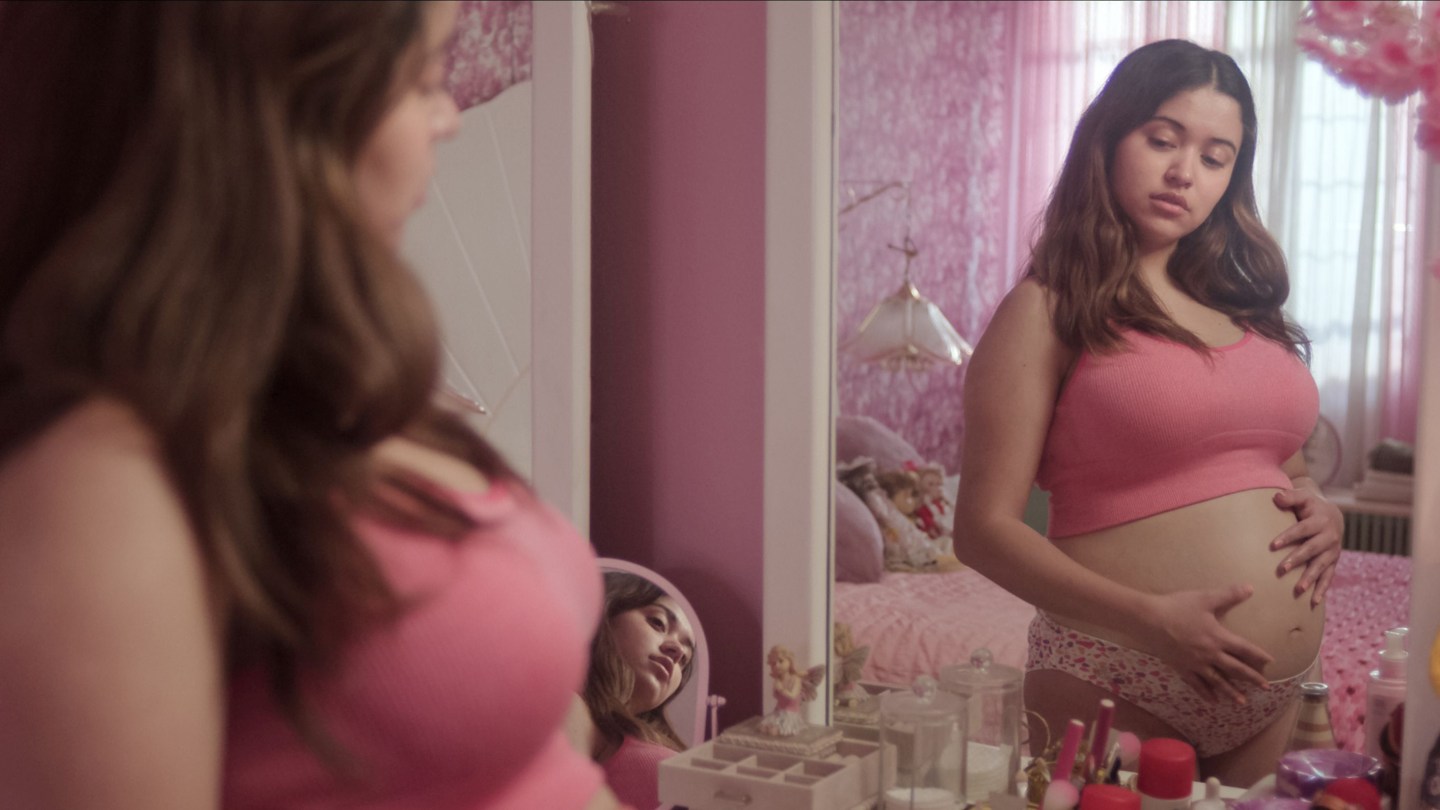
Revolving around a news story from the early 2000s that brings Alberdi north of the equator for her first Mexican-set feature, Child layers interviews with the actual participants in this strange tale with a scripted and performed re-enactment of the events. But don’t worry, this is nothing like the tacky reconstructions one often sees in made-for-TV docs to break up the monotony of talking heads telling the story, thanks in part to Alberdi’s deft narrative footwork. It helps that the cast is led by the immensely engaging Ana Celeste Montalvo Peña, who stars as Alejandra, a young hospital administrator who fakes a pregnancy and takes drastic measures to assuage her intense maternal longings. And also shut up all the pesky relatives who keep asking her about when she and husband Arturo (Armando Espitia) are going to start a family of their own.
A Child of My Own
The Bottom Line
A playful and touching blur of fiction and fact.
Venue: Berlin Film Festival (Berlinale Special Presentation)
Cast: Ana Celeste Montalvo Peña, Luisa Guzmán, Armando Espitia, Mayra Sérbulo, Casio Figueroa, Alejandro Porter, Mayra Batalla, Ángeles Cruz
Director: Maite Alberdi
Screenwriter: Julián Loyola, Esteban Student
1 hour 36 minutes
Recalling Kitty Green’s darker but similarly genre-tweaking doc Casting JonBenet, this starts with a flurry of edits showing different actors trying out for the role of Alejandra, nicknamed Aje, our complicated protagonist. Montalvo Peña’s audition gets across in just a few minutes Aje’s distinctive blend of perk, pluck and pastel-pink girlishness spiked with a generous dollop of disassociated delusionality. From there, the film goes into a mostly straightforwardly chronological account of how Aje and later Arturo get into the desperate situation they eventually find themselves in.
As (staged) footage unfurls of Aje and Arturo dancing at their wedding to “Unchained Melody” (we get to see the real thing later on), Aje explains how even at this, what should have been the happiest moment of her life, she sensed that Arturo’s mother didn’t think Aje was good enough for her son. A sly freeze frame reveals a scowling mother-in-law (Ángeles Cruz), looking very grumpy indeed. The confetti has barely settled before the extended family of aunties and cousins start asking when they’re going to produce a child. Unfortunately, poor Aje has two miscarriages in short succession, and eventually an OB-GYN at the hospital where Aje works warns her that she may never carry a child to full term.
Just after a third pregnancy also miscarries, Aje meets a young woman named Mayra in a hospital waiting room and the two get talking. A single mother of one child already and due around the time that Aje would have had her baby, Mayra is unhappily pregnant. She’s come to the hospital seeking an abortion, although she’d prefer to “give [the baby] away rather than throw it away.” Aje suggests that Mayra passes over her baby to her when the time comes, and Mayra implausibly agrees.
To keep the deception going, Aje starts eating for two, piling on the pounds, fortunately carrying a lot of her new extra weight in her midsection. Concerned that Arturo might figure out she’s not knocked up, she puts him off when he tries to get conjugal in bed (it could be bad for the baby, she says) and insists he doesn’t have to come to any of her pre-natal check-ups at the hospital. Armed with marabou-feather festooned pens, an in-depth knowledge of the hospital’s procedures and familiarity with staff on many wards, she manages to fake a hospital record for herself, obtain a fake ultrasound picture and generally keep the whole deception going until it all falls apart in a matter of days.
To reveal what happens exactly would spoil the film’s several canny surprises, but it’s worth noting that we get to spend considerable time in the last half hour with the real Aje and Arturo — at least enough time to appreciate how well the actors inhabited the characters. And yet there remains an ineffable quality, especially in Aje — a placid dreamy blankness, inimitable, touching in its naiveté, and a tragic flaw all at once.
DP Sergio Armstrong and his team ensure that the candy-colored palette pops just enough to suggest we’re not quite in the realm of reality at times, while frequent overhead shots and odd angles enhance the sense of discombobulation. Nevertheless, the documentary footage also has a polished sheen to it, minimizing the separation between fact and fiction in a way that feels respectful of the subjects, putting them on the same level as the dramatis personae.
Read the full article here