




“People are roses. Families are rosebushes. Rosebushes need pruning.”
With that ominous metaphor, Ed [Callum Turner] introduces us to the super-rich, and sordidly dysfunctional, family at the center of Rosebush Pruning, the new film from acclaimed Brazilian director Karim Aïnouz (Firebrand, Motel Destino).
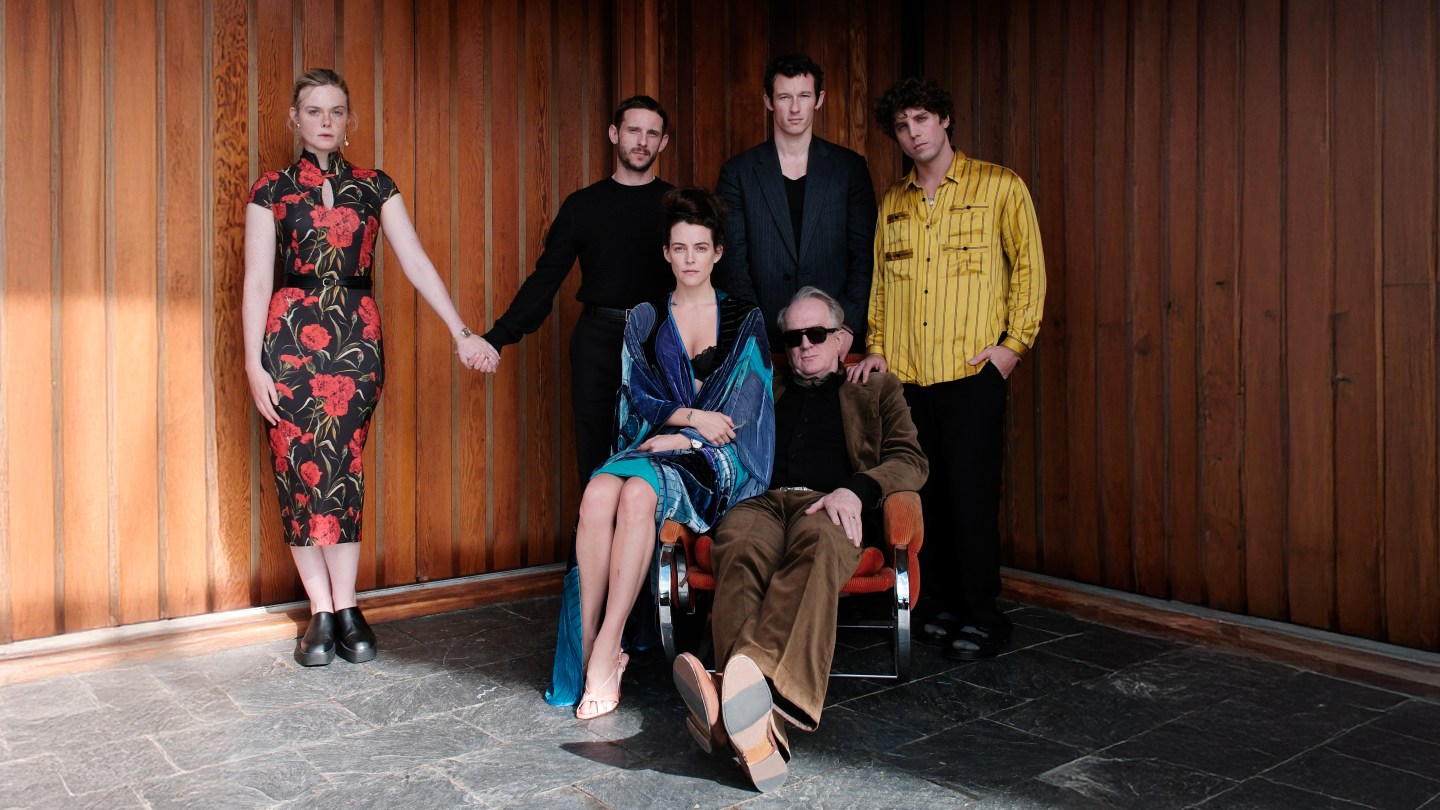
They’re a pretty nasty bunch. Younger siblings Anna [Riley Keough] and Robert [Lukas Gage] are incest-curious, borderline psychotics. Their father (played by Tracey Letts) is a blind, soft-spoken, abusive tyrant. Eldest brother Jack [Jamie Bell] seems almost normal, though there, too, are signs of deep trauma.
The American clan wallows in a life of pointless opulence in a Spanish villa, discussing designer clothes and snarking at servants and each other. But when Jack, the family lynchpin, announces he is moving in with his girlfriend, Martha [Elle Fanning], and Ed starts to unravel the truth surrounding the death of their mother [Pamela Anderson], things fall apart. The pruning is coming, and it will not be pretty.
This modern-day take on Marco Bellocchio‘s radical 1965 satire Fists in the Pocket, adapted by frequent Yorgos Lanthimos collaborator Efthimis Filippou (Kinds of Kindness, The Lobster), takes its shears to the superrich, going places where Triangle of Sadness or Saltburn fear to tread.
Aïnouz spoke to The Hollywood Reporter ahead of Rosebush Pruning‘s world premiere in Berlin, about the film’s pandemic-era origins, its savage take on privilege and patriarchy, and why he hopes his star-studded satire will “burn down the house.”
This is such an intense and crazy movie. Where did the initial spark come from that exploded into this film?
It came from different places. We began writing the script during the pandemic. I was really interested in doing a movie that was contained. And I’ve made many movies about families, but I never really made one about a privileged, white family. I thought it would be interesting to have an ensemble piece taking place mainly in one house and talking about a subject I’d never talked about.
The other thing that came to my mind was I’ve made quite a few films with female protagonists, and I thought it would be interesting to shift the angle and talk about masculinity, about the father figure.
The producer on the film, Michael Weber, brought up Fists in the Pocket (1965), Marco Bellocchio’s beloved film from the 60s. [About a young man who plots the murders of the members of his privileged, dysfunctional family], and I thought: “Wow, that’s a really interesting setup. How do I translate that to today?” I used that film as a blueprint and with a few other inspirations, including Teorema (1968) from [Pier Paolo] Passolini and Killer Joe (2011), the [William] Friedkin film.
I changed the main character [from Fists in the Pocket] to a father, instead of a mother, to allow me to explore these themes of privilege, of patriarchy and of isolation, which is sort of the consequence of this family’s extreme wealth.
To give you a bigger context, I had made a movie in the U.K. a couple of years ago, Firebrand (2023) which was about Henry VIII, and I made a film a couple of years ago in Brazil about this toxic, poisonous male character, called Motel Destino (2024). For me, this film is part of that trilogy, of men who are really poisonous, but also very, very normal.
The film is also very funny, with a real dark vein of humor, of satire.
That came from trying to find how to talk about such a serious topic in a way that would still engage audiences. Everything I’ve told you so far is quite theoretical. The question was how do I make a movie that people will actually come and watch? My encounter with the screenwriter, Efthimis Filippou was really magic. We were introduced by our producer, Michael Weber, and viola!
It was [Filippou’s] proposition to do this as satire, something I’ve never done in my life. I thought it was really great to be able to talk about the themes we’re interested in, but from a perspective of humor, of irony and also of absurdity. I think the laughter was perhaps the only way that we can relate to certain themes. So it was coming from different places, but ultimately, I was really interested in looking at privilege, which is something that really haunts me when I think of the world we live in.
Funny enough, as time went by, the question of the absurd became so present in our daily lives, that it seemed a really great way to look at this, at this story of privilege.
Yeah, the film is crazy and extreme but no more than the headlines we read every day.
I was trying to not just do a critique of privilege, but also propose new possibilities. There is a cycle of violence, and sometimes violence can only end through violence. So we have the metaphor of pruning the rose bush, where if people are roses, families are rosebushes, and a rosebush needs pruning.
It’s funny. Just last night I was finishing the mix, retouching a few things. I won’t spoil anything but I found there’s a real sense of hope in the film as well and that, for me, was important. Because there’s been a series of movies and shows made in the last few years about the super-rich. Think of Parasite, Triangle of Sadness or The White Lotus. There’s almost a genre of films criticizing the accumulation of wealth.
But for me, it was really important here to bring the element of humor, of absurdity, and to offer something in the story that would break the cycle. Because this [wealth disparity] has become so naturalized, it’s taken for granted. I was really interested in asking with the film, how do we break the cycle?
Were there any political figures that inspired the blind, abusive, father character, played by Tracy Letts?
Well, I probably don’t need to name names. From the start, I was interested in chronicling these male characters that are all over the headlines. It’s almost like an autopsy of these guys, whether they are the president of the United States, the president of Russia or one of these über, über rich guys that are somehow running the world today. Tracy’s character doesn’t even have a name, he’s just “The Father.”
I made a movie in 2019 called Invisible Life, which was really about women and the condition of women. When I finished it, I felt: “Wow, I’m very familiar with female characters.” I was raised by a single mother, in a family of women only. Constructing and writing for female characters feels very familiar and very intimate. After I finished that film, I felt I wanted to know what’s on the other side. I wanted to know male characters, patriarchs, these people who actually exercise power.
So I made Firebrand and Motel Destino and now this film. I never planned this but these characters, these monsters, sort of imposed themselves on me. But Rosebush Pruning, it is something different. Unlike Firebrand, this is a very contemporary story. And Motel Destino is a very Brazilian expression of poisonous masculinity. Here, for the first time, I’m making film only with white people, and the question of whiteness, of the identity of whiteness in America, and of privilege, became important to me.
This film is part of my trilogy of monsters, flesh-and-blood monsters who are somehow also superheroes, since they run our world.
You have an incredibly stacked cast. Alongside Tracey Letts, you have Callum Turner, Jamie Bell, Riley Keough, Lukas Gage, Elle Fanning, and Pamela Anderson. Did you have them in mind from the start, or was it a matter of needed star power to get this very extreme movie made?
Listen, it was both. It was important that we did have a stellar cast. I was thinking of the star system as a strategy to get people to come and see the film. And then I was thinking of actors I’ve dreamt of working with.
I’m a huge fan of Tracy Letts, as a playwright and actor. I’ve been a huge fan of Jamie Bell for years, I think he’s had an extraordinary path as an actor. I’ve always wanted to work with Elle Fanning, she has something that is both masterful but yet quite fresh, with this very refined sense of humor I thought would be really interesting to bring to the screen.
Then there’s Callum. He has something I really adore, which is a sense of mystery. He performs in such a way that I never know what’s going to come next. He’s brilliant at that, and it feels so effortless. Lucas has always impressed me with his braveness in the roles he’s taken on, and I thought it was really important to have a cast that was fearless. Riley and I met because of this film. I knew her work before, and when I thought of the character of Anna, I knew I needed an actor who could bring a certain sense of being unhinged, but still very vulnerable and very relatable. Riley is the kind of actor that you fall in love at minute one, but she never stops surprising you.
For the character of the mother, I was always thinking of Gina Rowlands. I wanted an actress who feels free and unexpected. Pamela also has this kind of quality. I think it’s really beautiful to see she’s returning to acting again, and with a real sense of freedom.
The other thing that I needed to have an ensemble that was willing to spend a long time together, in Spain, rehearsing. So I needed actors willing to come and collaborate, like doing a play.
You shot this all on location, in Spain.
Yes, we all came to the house, and we rehearsed in costume. We rehearsed a lot of the scenes there in the movie, but also situations that are not in the movie. We had lots of like exercises where they would have lunch together, you know, like had nothing to do with the film or spending time together. For me, it was really important to create a sense of intimacy with this family. My first question when talking to the actors was: “Are you open to rehearsing? Are you up for taking these characters, which are so precisely written on the page, and make them feel lived in, alive?” That’s exactly what they brought to the film.
You referenced Fists in the Pocket as inspiration, and it seems as if the spirit of 60s cinema, of radical experimentation and political engagement is coming back. I think of a film like Oliver Laxe’s [Oscar nominated] Sirat, which feels very much like a 60s-era movie.
God, this is so good to hear. I think you really cracked a nut for me here. When I talk about Bellocchio and about what he was trying to do and what it meant at his time, beyond anything, I think there was a real sense of freshness and invention, of risk, you know? I think cinema has gotten to a place which is it’s so tricky, with the streamers and theatrical releases. Filmmaking has become mainly about risk management. But I just turned 60. I have nothing to lose. I want to play. I want to experiment. What really excited me about this movie was to bring the invention, the risk, the experimentation, the real sense of reinvention you had in the cinema of 60s. Those films really broke with the classic Hollywood way of storytelling.
Rosebush Pruning is a real international operation. It’s a Greek writer, a Brazilian-Algerian director, American, English and Spanish actors. With a Spanish crew and European producers. It’s a real terroir for experimentation. The energy you find in the film, is like Fists in the Pocket and many other films from that decade. I think it’s our time, you know? I think this is the time to burn down the house and build a new house.
Read the full article here