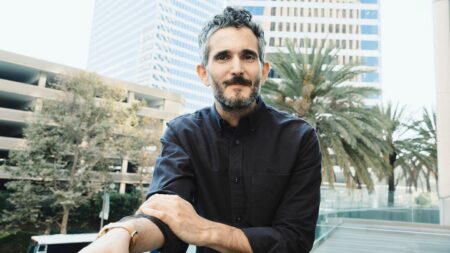




About a year ago, a Los Angeles man named Adam Ripp got a call from Irwin Mazur.
Mazur is the first manager of Billy Joel who had a famous falling out with the star. He was calling his pal Ripp, a filmmaker, with a piece of early Billy content — one he said he’d be free and clear to use.
The content was a long-lost extended interview that a 22-year-old pre-“Piano Man” Joel gave at the college radio station of Long Island’s C.W. Post in 1971 with Mazur at his side. The student who conducted the hour-long session, Ed Mann, was Mazur’s cousin. He recorded it himself, Mazur told Ripp, and so owned the masters and thus, it seemed, the rights. And now Ripp, who has his own contentious family connection to Joel, had both Mann and Mazur’s blessings to make a movie with it.
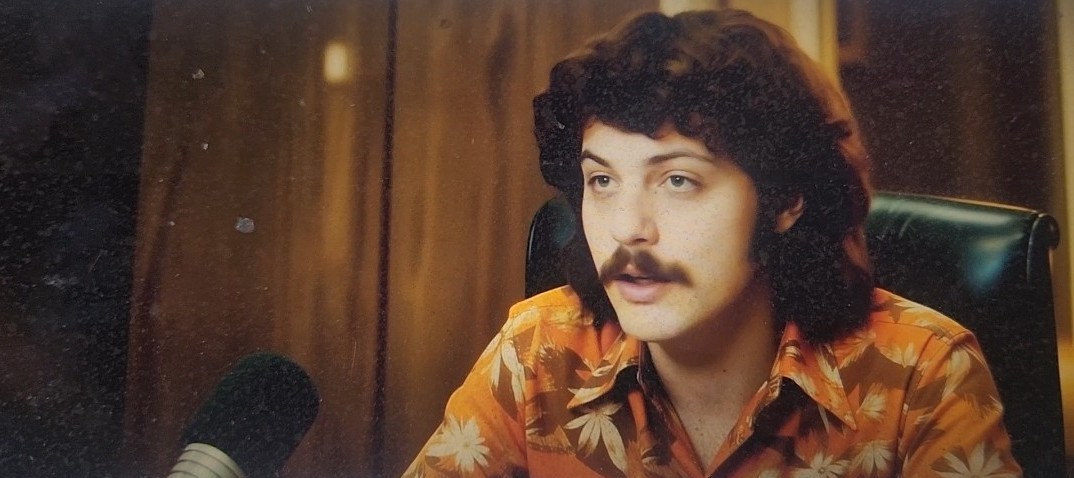
Ripp decided to do exactly that. But rather than simply use animation, talking heads or archival footage over the audio, he chose to go another way: he would use AI to re-create both Joel and the scene in the college-radio studio. So drawing off photos Mazur and others at the time took (and owned), he enlisted a Canadian AI company and had them trained on only those photos.
The result is a 20-minute artifact for which this writer, at least, struggles to find comparison: a young American icon as a machine imagined he looked and moved then, with the audio of the words he can and did say. Titled 1971: Billy Joel’s Lost Interview, the doc will premiere at the Long Island Music and Entertainment Hall of Fame on September 25 as part of the organization’s Music Documentary Film Festival and is seeking further distribution.
“There were many ways we could have gone, but the tools have gotten so good it seemed like a missed opportunity not to try to re-create Billy so we could really get a sense of how he moved and looked like,” Ripp told The Hollywood Reporter. (You can see a still from the film above and watch a teaser of the young AI-generated Joel below.)
Artistically, the film provides a head-spinning portrayal of what an artist we don’t have much candid early video of might have looked like. Culturally, it raises, in a surprisingly visceral way, that decidedly 2020’s-era question of who controls an artist’s legacy when anyone with an idea and access to some tools can have a say in it. (Though these people are not just anyone; more on that momentarily.)
Joel was not consulted on the project. A title card before the film states “This documentary is an independent historical work and is not endorsed by, affiliated with, or sponsored by Billy Joel. Legally, Ripp says he passed through every hoop to ensure that he was operating within the law, including by keeping a strict control on only owned photos for training data.
Whether the star feels the same way remains to be seen. And whether a judge potentially feels that way also remains to be seen; the courts are not yet settled on the very complicated instance of unauthorizedly messing with a celebrity likeness regardless of the inputs, especially in a case where a person is alive and eligible for a defamation claim.
Joel’s publicist, Claire Mercuri, declined to comment.
Ripp is no stranger to the Billyverse — or projects that the singer doesn’t approve of. He is the son of Joel’s early producer and label executive Artie Ripp and part of a group that has been seeking to reclaim Ripp and Mazur’s place in the Joel origin story. (The latter was noticeably absent from the HBO’s acclaimed four-hour doc And So It Goes doc last year, an omission that clearly sticks in the craw of the early collaborators.) Adam Ripp is also the screenwriter on Billy & Me, an unauthorized biopic about Mazur and Joel from the early days that the star via a rep has slammed as “legally and professionally misguided.”
Ripp admits that part of the goal here is to restore credit for Mazur and perhaps even to his own family name. But he says that such a goal is noble and overdue, with his family and Mazur a key part of the Joel legacy. (Joel broke with the Ripp-Mazur axis regarding disagreements, with one or both, on matters of contracts, money and a notorious fight over debut album Cold Spring Harbor, source of “She’s Got a Way” and the speed-smirk classic “Everybody Loves You Now,” for which Joel blamed Ripp for a production error that resulted in the album being released at the wrong playing speed.)
The younger Ripp notes that he would listen to demos of new Joel cuts as a child, gleefully ripping the vinyl from its sleeve as it arrived at his Mulholland Drive house; Joel even played concerts in his living room, he said. (Joel lived nearby in a house Mazur set up for him.) And, in any event, Ripp adds, he is a massive fan of Billy Joel and just wants to give fans a taste of something they couldn’t otherwise have. “This is just a piece of music history that we would never get to experience,” he says of his movie. But some Billy Joel fans, among plenty of others, might ask whether you can appropriate a star’s likeness to achieve that aim. The case goes notably past the unauthorized biopic, a Hollywood mainstay, to the far more charged place of digitally breathing life into someone without their permission.
AI aside, the interview itself is filled with gems — Joel describing his homelessness not long before; Joel describing his hope as he prepares to move to Los Angeles (the high cost of homeownership in the New York suburbs is the reason); Joel talking about the very modest success of his debut Cold Spring Harbor and what he plans to put on the new record that will become Piano Man; Joel enjoyably riffing on how The Beatles borrowed from Little Richard and Beethoven from Mozart; Joel describing his alternate plans if music doesn’t pan out (buy a boat and become a fisherman); and, most ironically, Joel describing Madison Square Garden concerts as a “ripoff” because of the venue’s size and saying he would never play there. (He ended up with a decade-long residency, of course at a radically reconfigured arena).
Watching 1971 one gets almost a kind of spinoff episode of the early part of And So It Goes: the young musician pitched between fame and anonymity and his state of mind as he clocks that fragility. Humble but quietly confident — he deflects Mann’s pointed question about what happens if he fails by saying “you never think if you can’t make it, you just think if you can’t take it,” referring to industry politics — the piece will surely engage Joel completists. But it also may well appeal to those who just want to understand the psyche of emerging celebrities (or at least the psyche of an emerging celebrity in the pre-social media world of the 1970s when fame happened in nightclubs).
How much consumers will even get to watch the movie is an open question. Ripp notes that he also is in talks with the Rock & Roll Hall of Fame to include it in the museum’s archives. Streamers could be intrigued by a potential acquisition but also shy away given the star’s lack of involvement or the deepfake components. At least one film festival, Ripp says, rejected the movie on the latter grounds.
The LI festival’s executive director, Tom Needham, said he felt the film worth showing. “We recognize that AI in entertainment is a topic that will generate discussion and different viewpoints,” he said in a statement. But “this film demonstrates how technology, when used thoughtfully, can help us reconnect with important moments in music history.” He said that he hopes “people will experience it with curiosity and an open mind.” (The plea is similar to what Steven Soderbergh has said about his John Lennon AI doc project, which centers on its own rare interview and has similar vibes.)
Mann, who kickstarted all this by pulling the interview from his drawer and sending it to Mazur, says his thinking on the project has evolved to the point that he now believes it is an important undertaking. “Initially I thought ’this is cute,’ said the former college-radio host, who interviewed musicians from Curtis Mayfield and Kenny Loggins at the show before going on to a career in the family car dealership business with some occasional acting. “But as it developed and transformed [in the AI shaping process] I thought ’this is really cool.’ And now I think we really have something.”
Ripp says he knows there will be haters — movies made without star cooperation are provocative even without AI reconstructions. But he believes that people will see past that to the purity of his motives. “We are just trying to honor the legacy of Billy Joel,” he said.
Read the full article here