





Peak TV may be in the past, but if you need proof that there’s still too much darned television for any human to keep track of, allow me to offer this point of evidence: Premiering on Tuesday, June 30, is a Zorro television series featuring an Oscar-winning actor as the iconic swashbuckler, a role played by stars including Douglas Fairbanks, Tyrone Power, Alain Delon, Antonio Banderas and, well, George Hamilton.
So there’s an eight-episode Zorro series now available for streaming, and chances are good that you’re wholly unaware of the show, much less of the fact that it premiered on European television in 2024.
Zorro
The Bottom Line
A mostly appealing throwback.
Airdate: Tuesday, June 30 (MHz)
Cast: Jean Dujardin, Audrey Dana, Salvatore Ficarra, Eric Elmosnino, Gregory Gadebois
Creators: Benjamin Charbit and Noé Debré
To be fair, Zorro is premiering on MHz, a service that is either already your favorite streamer because you love Nordic noir and MHz is to Nordic noir what Acorn and sometimes BritBox are to cozy British murder mysteries, or a streamer you’ve never heard of before, which means I’m just doing my job here. Zorro. MHz. Nordic noir.
And no, Zorro has not been reinterpreted as Nordic noir. This is not the ultra-gritty, ultra-realistic, ultra-grown-up version of Zorro that Starz or MGM+ might have produced, or might still produce since Zorro‘s greatest creative attribute at the moment is that the bones of the character created by Johnston McCulley are in the public domain. So it’s a Zorro free-for-all, or at least it could be.
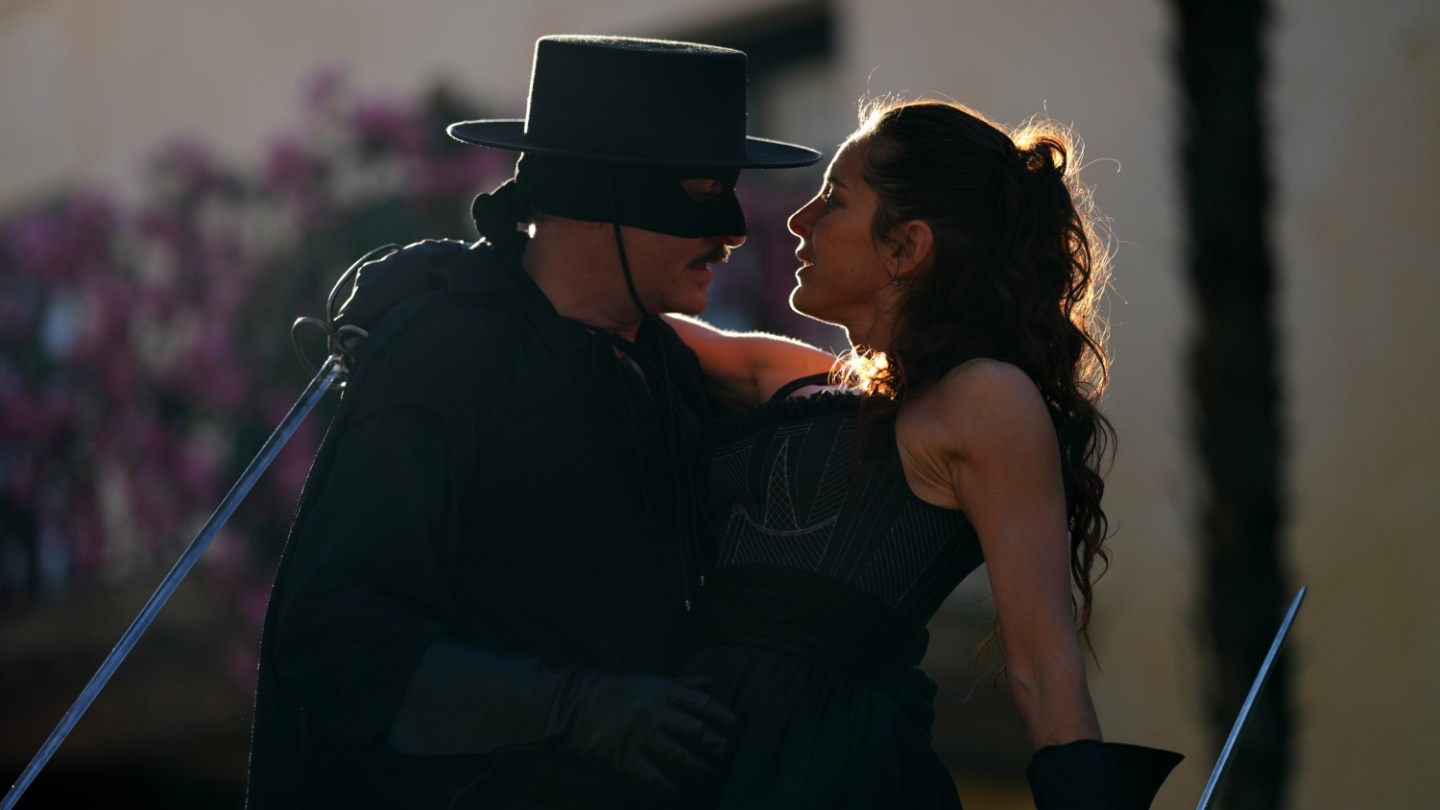
As for this Zorro, which has aired on outlets including Belgium’s RTL TVI, France’s France 2 and the international version of Paramount+ but not the domestic version? It’s a surprisingly quirky, light-on-its-feet adaptation, courtesy of Benjamin Charbit and Noé Debré. Yes, there are fights with swords and bodices that are ripped, but this Zorro is finally much more of a romantic farce than an action drama, befitting star Jean Dujardin‘s particular blend of goofy suavity.
Oh! Sorry. I forgot to mention. The Oscar-winning actor playing Zorro is Jean Dujardin, whose run of awards accolades for The Artist remains one of those peculiar head-scratchers. Seriously, go and look at nominations and winners for the 84th Academy Awards and tell me that wasn’t a strange, strange year.
Anyway, Zorro has enough charm to make it a totally painless eight-episode binge, without being exciting or funny enough to be mandatory viewing.
Dujardin plays Don Diego de la Vega, son of the mayor (André Dussollier’s Alejandro) of Los Angeles pueblo, circa 1821. Diego is the big-hearted and good-natured owner of a small hacienda and husband to Doña Gabriella (Audrey Dana). They’ve been married for a long time, and while they’re still in love, the romance has lost its heat and they’re both a little glum about never having had children.
When Diego’s father dies — he comes back as a comic ghost — Diego ascends to mayor, where it’s immediately clear that though he’s a good man, he’s too gentle for the ruthless demands of the job. Soon, a local businessman (Éric Elmosnino’s Don Emmanuel) is running roughshod over the community, basically enslaving the indigenous population to build a casino.
Somebody needs to stop Don Emmanuel, but who?
Clearly, I forgot to mention the important detail that 20 years earlier, Diego was the masked vigilante known as Zorro, but he put away his sword and mask and trademark Cordovan hat. The only person who knows Diego’s secret is Bernardo (Salvatore Ficarra), his mute manservant. Bernardo has maintained Diego’s Zorro cave for just such a moment, and soon Zorro is leaping back into the fray, upsetting Emmanuel, as well as the local lawman (Grégory Gadebois’s Sergeant) who tried and failed to bring Zorro to justice decades earlier.
And as for Gabriella, she’s highly aroused by the dashing stranger, who seems to have everything her husband lacks — even if he still has her husband’s mustache and jawline, which you might mistakenly think would be discernible beneath a limited mask. The silliness of that aspect of the story is baked into this interpretation, with several very meta acknowledgments.
Diego returns to being Zorro for the right reasons — wealthy casino owners who deny the humanity of the economically disadvantaged are bad, just in case you were unsure — but his vigilante aspirations spill over into a romantic game of the sort you will quickly recognize from texts as varied as a dozen Shakespeare rom-coms, Cyrano de Bergerac and True Lies. Men who trick their wives into outside romantic assignations ultimately need to be taught a lesson, and Diego de la Vega is no exception.
There’s probably a conversation to be had about how odd and frequently off-putting it is to have French actors, speaking in French, playing Spaniards and reciting Spanish location names and titles in French accents while executing familiar French farce on a streaming service I still think of as being heavily populated by Scandinavians. But no more or less so than a show about Russian cosmonauts created by Americans and starring a bunch of British actors for an American streaming service (Apple’s Star City).
Zorro is a wholly inauthentic show, but it’s an inauthentic show by design. The Spanish locations are meant to resemble the staged locations from earlier Zorro films more than actual Southern California locations in the early 19th century. There’s a perfectly worthy retelling of this story that approaches Los Angeles 1821 like Chinatown, one that delves deeply into the traditions of the people indigenous to the land as well as the early attempts to bring fresh water to this desert. But this version of Zorro leans instead into broad comedy and an even broader vintage aesthetic including day-for-night shooting and a general soft-focus haze.
It’s not a revisionist Zorro. It’s the sort of Zorro you’d expect from a series based on a character created by a guy from Peoria and inspired by The Scarlet Pimpernel to a greater degree and possibly apocryphal Mexican bandit Joaquín Murrieta to a lesser degree.
Of course, the Zorro you might be expecting would probably have a little more adventure than this Zorro, which goes through long spells in which it seemingly forgets that it’s supposed to be a rousing yarn. Yes, Diego rides around on a horse named Tornado and he’s capable of dueling five to 10 authorities if they’re inept enough. But the middle of the season gets thoroughly bogged down in what happens when Diego sets his loving, if slightly bored, wife up to have an affair with a man she doesn’t know is him, committing fully to the farce and dragging it out to an extreme that will probably amuse fans of that genre.
I’m not the biggest fan of this type of farce, because it’s almost impossible, from a 2026 context, to give the initially duped heroine enough agency to respond with the irritation the circumstance demands. Though to the credit of the series and especially Dana’s feisty performance, Zorro makes some effort.
It helps, too, that Dujardin, whose credits tended toward comedy before The Artist (which was also a comedy, I guess), is the right leading man for this approach. He can be hunky one moment and very silly the next, and provided you don’t require either bumbling Diego or dashing Zorro to be 100 percent convincing — Kevin Kline in The Pirates of Penzance is an unreachable ideal, but this Diego/Zorro is meant to be two decades past that peak — he mugs likably throughout. Dujardin and Dana have fine chemistry, but Dujardin’s best chemistry is with Ficarra, an Italian comic with exaggerated features and a love for the zanier aspects of the story.
The series’ greatest dramatic conflict is Diego’s internal struggle and the question of whether he’s doing something truly cruel to his wife, which leaves Zorro’s primary adversaries slightly adrift, though both Elmosnino and Gadebois thrive when the story remembers them at all. Elmosnino is very funny in an episode in which Emmanuel’s ultimate revenge on Zorro is attempting to make him famous in an unexpected way, while Gadebois adds actual notes of poignancy when his character realizes that Zorro was the only thing giving his life purpose.
As he proved in The Artist, Dujardin is a throwback performer and, in Zorro, he has an old-fashioned vehicle to anchor. But “old-fashioned” can sometimes mean that a project isn’t precisely tailored for a modern audience, and Zorro may suffer a little from being too farcical for audiences who would prefer derring-do and being more devoted to homage than is likely to appeal to younger viewers without the same adoration of the classics. Still, it’s a series that would offer some light, family-friendly — there’s more chaste sex than violence or menace or adult language — entertainment to an audience that may not know this Zorro or MHz even exist.
Now you know. The rest is up to you!
Read the full article here