






Many of us in America have a utopian idea of Denmark, perhaps for good reason: It ranks quite high on indexes of happiness and social infrastructure and civil rights. But, of course, any nation has its painful eras, one of which is conjured up in May el-Toukhy’s post-WWII drama Woman Unknown. The film is an effectively dark portrait of open wounds left by Nazi occupation, the past terribly coming to bear on what is meant to be a time of great relief and celebration. It is also a sharp, despondent look at the many compromises women of the past — and no doubt the present — have had to make in order to keep their heads above water.
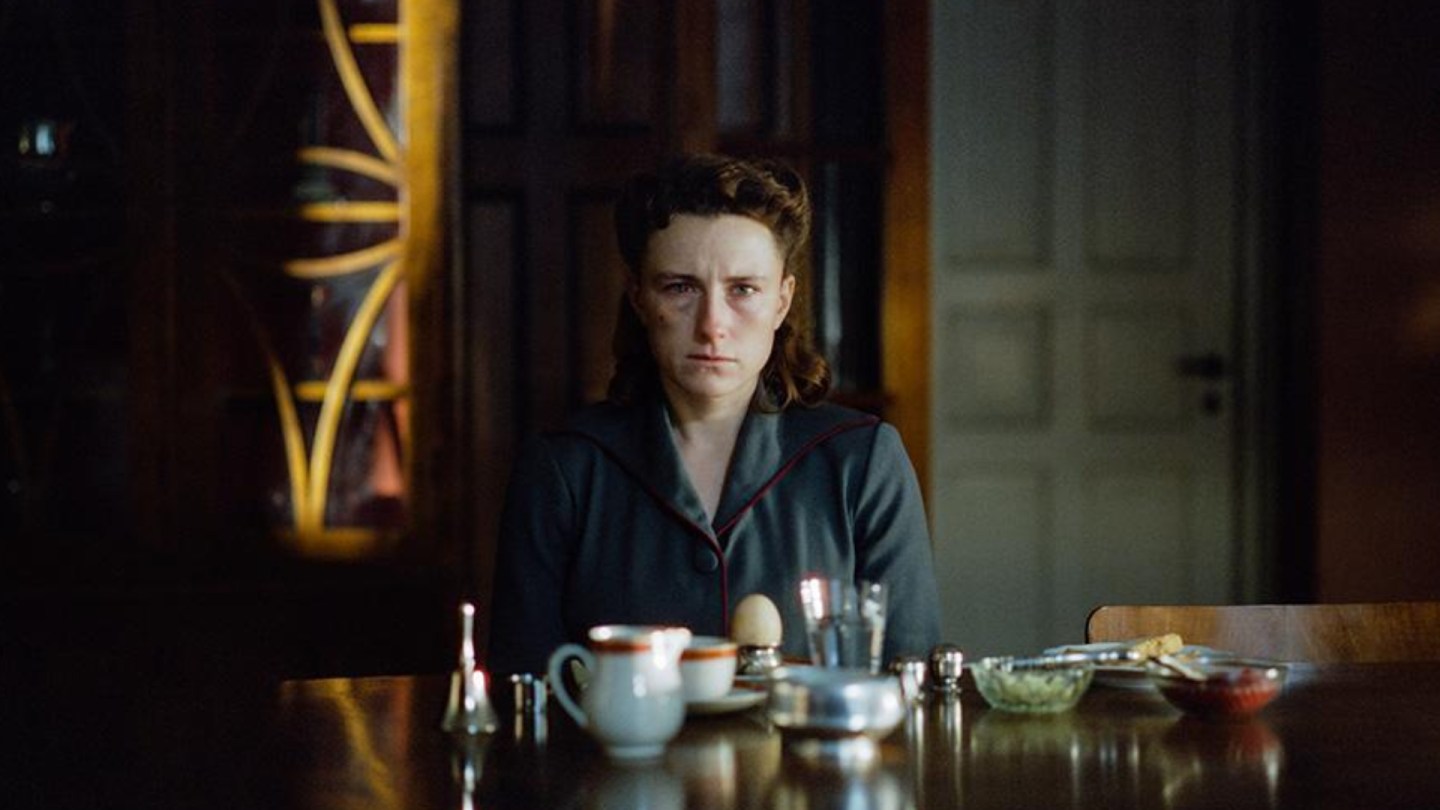
Mathilde Arcel plays Marie, a maid in a stately, spacious Copenhagen apartment owned by a clothing industrialist. Marie is also sleeping with that master of the house, buttoned-up widower Christian (Carsten Bjørnlund), but not in any sordid or scandalous manner: The two are engaged to be married, and Marie is biding her final days as a member of the staff before she makes the grand leap into the upper class. If there is any strife about this reversal of fortune among the other domestics, it is largely kept quiet. Marie seems to be living some kind of Cinderella story, albeit one told in el-Toukhy’s somber, worried tones.
Woman Unknown
The Bottom Line
A solemn character study of a woman stuck in limbo.
Venue: Venice Film Festival (Competition)
Cast: Mathilde Arcel, Christian Bjørnlund, Thorbjørn Hedegaard, Marina Bouras
Director: May el-Toukhy
Writers: May el-Toukhy, Maren Louise Käehne
2 hours 4 minutes
There is something guarded about Marie, a furtiveness in her eyes as she goes about the business of tending to Christian’s young daughter, running errands in preparation for her wedding (at which she’ll wear Christian’s dead wife’s dress), and satisfying the sexual needs of a man who is all at once her betrothed, her employer, and her landlord. At least some of Marie’s hauntedness is understood as a feeling shared by an entire country, a collective trauma inflicted by years of restrictive occupation. Those times were uniquely harsh to women, their sexuality leveraged, coopted and bartered by both sides of the conflict as a currency of possession and resistance.
At several points in the film, we see women publicly shamed in the streets, their heads shaved and swastikas painted on their naked bodies as retribution for their intimate relationships with German soldiers. We can assume that, at least in some of those cases, the women involved were not granted much agency in choosing their sexual partners. The threat of violence loomed constantly over them, a kind of mass coercion that put women in an impossible situation, forced to betray the resistance in some way, or to dangerously deny the demands of a brutal oppressor who dangled before them a perverse sort of security.
El-Toukhy draws a short, insistent line between that subjugation and the position in which Marie has found herself after the war. Yes, she is the chosen girl of the man in charge, but what freedom has that really granted her? How much control over her destiny has she really had for the better part of a decade?
Those questions become quite urgent with the reemergence of a man from Marie’s past, Karl (Thorbjørn Hedegaard), a ragged but still boyish former resistance fighter who looks at Marie with an unsettling mix of malice and longing. It seems that Marie has fled something that has now, with a sense of dreadful inexorability, caught up with her. Woman Unknown mines some suspense from this development, but el-Toukhy has not set out to make an outright thriller. She keeps things at a slow and steady burn, closing the walls in on Marie as she recklessly seeks a way out.
Arcel plays this mounting alarm with understatement, only occasionally letting the strain of Marie’s circumstances flicker across her face. There is a crucial slant to the character‘s moral stance — not necessarily because of her past, but certainly because of a dire decision she makes in the present — that Arcel and el-Toukhy hold in shadowy ambiguity. Neither wholly selfish monster nor merely determined survivor, Marie is perhaps best read as an emblem of what can happen when someone’s very being is commodified into a political and personal object, something to be appraised, to be lost or won, valorized or tarnished.
Though Marie is the focus, at points el-Toukhy shrewdly shifts the film’s inquiry toward the noble captains of industry, like Christian, who loudly reflect on their principled opposition but, in the war years, weathered Nazi occupation with perhaps suspicious ease. Who collaborated and who didn’t is maybe not as black and white as some figures in the film insist, and the post-war reckoning’s absolute judgment seems largely reserved for people below Christian’s station. Perhaps there is some synecdoche here for the controversial policies of the whole of the Danish government during the war, a tentative cooperation that kept Denmark relatively unharmed but came, some critics argue, at the cost of complicity.
Marie is thus caught between those worlds, tenuously ascending to higher status while still laden with all the weight of what it was to be anonymous and powerless. Woman Unknown is an intriguing exploration of that tension, handsomely captured by Jasper Spanning’s elegant cinematography and made all the more evocative by composer Mikkel Hess’s ominous score. El-Toukhy — whose 2019 contemporary drama Queen of Hearts is worth seeking out — is an intelligent and inquisitive filmmaker, here successfully staging both an engrossing character study and a damning but sensitive consideration of national history.
The film’s tempo may be a tad deliberate for some audiences, but those in the mood for a gloomy rummaging through the grand mess of a terrible war will find plenty to savor. And they will perhaps see some relevance to today, as institutions yet again make concessions to sinister forces striking the poses of purity. What will we have to contend with when all of this is over? And who will be made, fairly or quite likely not, to shoulder the blame?
Read the full article here