
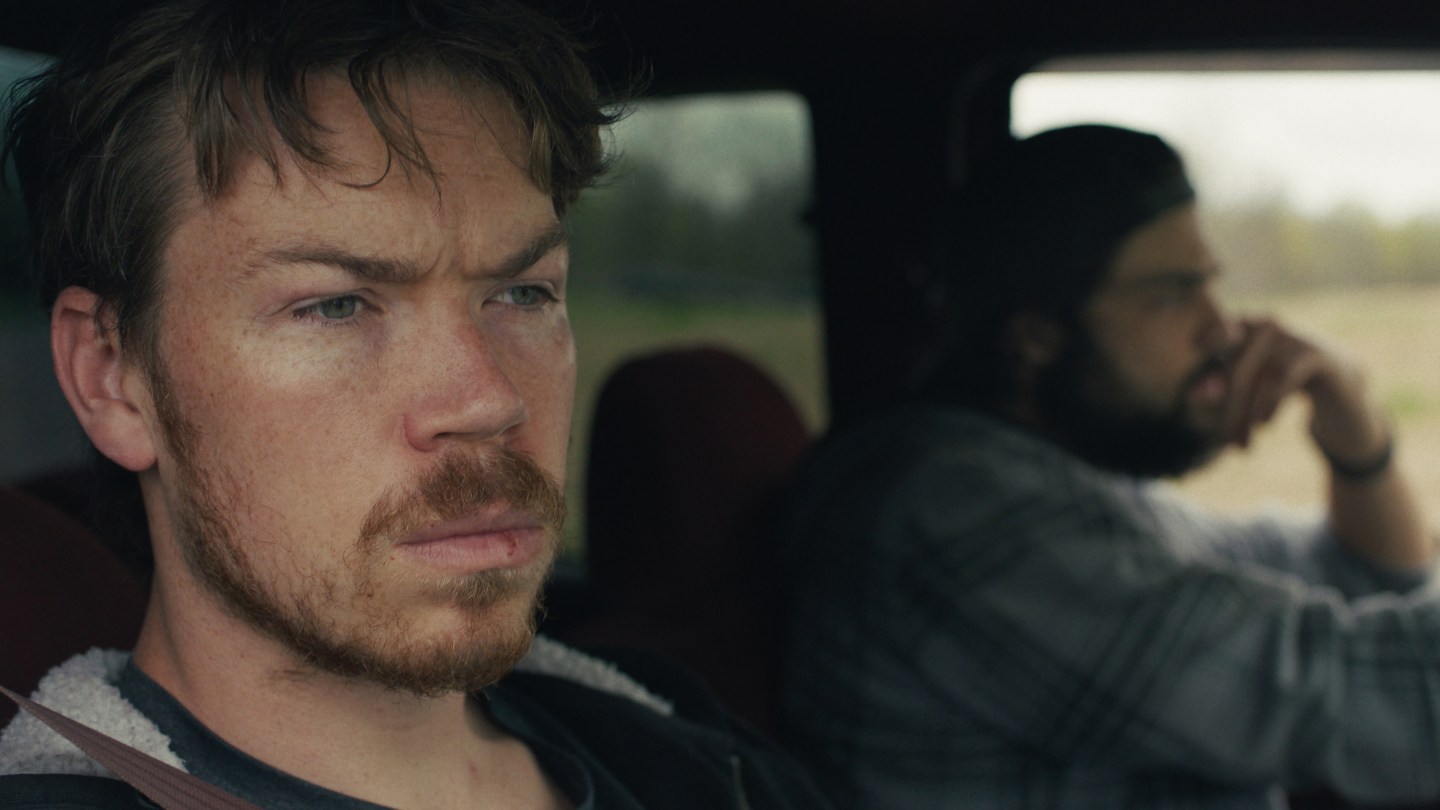


Adam Meeks is living a dream Sundance experience — long before he arrived in Utah.
The Brooklyn-based writer-director and graduate of NYU’s Tisch School of the Arts made his feature directorial debut on the indie drama Union County and promptly received what could be the best news of his career thus far: He got into the final Sundance Film Festival in Park City. Union County is adapted from his own short film of the same name (which had a world premiere in Berlin) and follows a young man, Cody Parsons, through a county-mandated drug court program in rural Ohio as he walks a winding path of recovery amid the opioid epidemic.
Addiction, and the opioid crisis, has been well-documented on screen but Meeks and his Union County team bring something fresh to the genre courtesy of the real-life participants of the Ohio drug court and its presiding judge, all of whom appear throughout. He’s also got something new in Will Poulter, who stars as Cody opposite Noah Centineo and a cast of many first-timers and non-actors. Poulter isn’t exactly new to the genre, however, as he starred in Hulu’s critically-acclaimed Dopesick, but Union County finds him hopping the fence from playing a Big Pharma executive in the former to a man struggling to stay on the straight and narrow in the latter.
Ahead of Sunday’s Sundance world premiere of Union County, Meeks and Poulter joined The Hollywood Reporter on Zoom for a joint interview to discuss the process of embedding in the drug court program, the bond they formed while filming and how they both struggle to receive compliments.
Adam, your debut got into Sundance for the final festival in Park City. That’s got to feel good …
MEEKS It feels amazing. We’ve talked about this as a best case scenario for this movie before we started shooting, so it’s a dream come true for sure.
What it was like to get the call or email?
POULTER It was a call. I knew that we would get a call on a certain day but I missed the call because I was in a meeting. Then I got a text from someone that said, “Hey, I’m at Sundance. Call me.” I called him back knowing what it would be but I wanted to confirm. I put him on speakerphone and my fiancé was listening. As soon as we got confirmation, I looked over and saw her jumping up and down in the kitchen. It was a very surreal, special day.
Will, when did he call to tell you the good news?
POULTER We had a FaceTime and I was in Chicago at the time. It was just wonderful. Adam and I had spoken about Sundance as a North Star or best case scenario for the movie. I’m super proud of him and everyone who came together to make it.
You’re a producer on this movie, too. Why did you take on that role and what did you learn about yourself as a producer?
POULTER I will say that I was really fortunate to be allowed a space or a role of that nature in the making of the film, having had little to no experience of producing in the formal sense. One of the biggest things I learned was what good, collaborative, encouraging, thoughtful producing looks like from the producers who were already on board. That includes Ley Line Entertainment, Seaview Productions and all the individual producers [Brad Becker-Parton, Martha Gregory, Stephanie Roush, Faye Tsakas, Sean Weiner, Tim Headington, Theresa Steele Page, Ellyn Daniels and Will O’Connor]. We really had a really wonderful group of people shepherding this thing. I came on at a point when the project had already lived a certain life and had an impact that went beyond its size as a short film. The short Adam made really is what stole my heart and inspired me to want to be involved as an actor and producer.
Let’s talk about that. This project started as a short and it really got traction when you moved back to Ohio where you came from. What happened?
MEEKS I’m from Central Ohio, and my immediate family left when I was six. For all of my formative years — as a teenager and through college and after — I didn’t really know the place beyond going back for family reunions every year or two. When my grandmother got sick in 2016, that’s when I started hearing through friends and family about how people were struggling with addiction amid an opioid epidemic in the area where I’m from. Everybody knows everybody around there, and through my uncle, I got introduced to a judge who ran a drug court. I was so blown away by what I found because it was a counter narrative to what most people see regarding overdose statistics and death. I sat in drug court meetings and saw all these people getting back on their feet. I saw a community that showed up for one another across an 18-month very holistic, very robust infrastructure that helped people get on their feet. It was real, and it blew me away. I made friends with folks who were in recovery and on the path. I made friends with the folks on the staff who were running the program, and the movie emerged organically out of these relationships and out of this real space.
What happened when you made the short?
MEEKS I felt like there was more to tell. I felt like I had unfinished business in Union County, Ohio, and so I went back in and started writing the feature and developing it. I found an other folks who might be interested in playing versions of themselves, and it just built up over the years. When Will and Noah came on that really helped cement the kind of collaboration I wanted to do with the community. Will was so committed to that kind of filmmaking process for the movie. The opportunity to have Will in the lead role working alongside one of our main actors, Annette Deao, who worked as the program director of the drug court, made it so that we were all pursuing this enthusiastically together.
What was your response when you read the script, Will?
POULTER The short spoke to the fact that the representation of this community was made with a certain level of respect and dignity that you just couldn’t get away from. In that sense, it separated itself from some of the narratives around addiction, which I think to Adam’s point, can sometimes focus a little bit on what are obviously often quite damning statistics and negative outcomes. But this highlighted the progress that’s being made and it draws attention to a program that is dignifying and humanizing. It was too special to ignore or not want to be a part of. Adam was truly at the helm and has always integrated himself with a lot of respect and reverence for the community, setting an example we could all follow.
I hope this sentiment is shared by the community, but it never felt like we were descending upon or infiltrating. We asked for permission and they were kind enough to welcome us in. The trust had been established by Adam and his producing team before Noah and I even got there or before we broadened it to become a filmmaking group. Laying down those foundations of respect and trust was so key in creating something in a truly collaborative spirit. What it meant as an actor is that I could stand on very steady ground.
I know “method” can sometimes be a word that people don’t always like to talk about but I read that you stayed in character through most of the days while filming?
POULTER I don’t know. It’s hard to say. The means by which we made this was so unique, and there were very few reminders of the fact that we were even a traditional film crew or that we were on a film set. We were all immersed in it, and it really felt like the division between cast and crew and real life members of the community was so permeable. It became so easily traversed just because the communication between everyone at all times was so strong. Adam set such a great example for us all to follow that it made the acting challenge easier. Pivotal to that is the organic love I have for Noah as well. We play brothers by way of the foster care system and that also felt very natural and real. Having that kind of built-in brotherhood made things easier, too.
Is that brotherhood something you carried over from Warfare?
POULTER I think so, yeah. It definitely helped inform our onscreen relationship. There are so many amazing performances in the whole cast. Every day, I was continuously blown away by what everyone brought to it because they all came with such reverence and respect for the material, and the subconscious, quiet and nonetheless present awareness of the subject matter and the the fact that the drug court recovery program is at the center of the film. The people within that community are at the center of the film, and that’s bigger than any one performance or even the notion of performance. Technically, this is Annette’s first feature, and I did scenes with her that are more real than anything I’ve ever done. I feel so privileged to have had that opportunity.
Adam, if you could go back to the day before you started shooting and give yourself some advice or words of wisdom about what was to come, what would you say?
MEEKS There were a lot of unknowns in the movie by design. It needed to be open to the reality and the present-tenseness of what was happening that day in the courtroom or that day in a sober support meeting. I would encourage myself to embrace and lean in as much as possible to the unknowns. The stuff that I’m most moved by and proud of are things that weren’t on the page. The moments that came from collaborations with folks or moments that came from the generosity of spirit of someone who is in recovery and wanted to share a story on a certain day. Also, with Will, there was a moment at the end of week one when I realized that he knew his character better than I did. All of these things are a gift and what you hope for as a filmmaker. It emerged beyond me.
Will, have you had an experience like that when you felt you knew a character better than the writer?
POULTER I don’t know whether I did but one thing I can sincerely say is that I was very lucky with Adam. He and I very quickly struck up a great collaborative spirit. We kind of finished each other’s sentences after our first Zoom. We were both very aligned in terms of how we wanted to tell the story, represent the community, spend time there and also represent Cody as just one person among a great number of people in recovery in this place. I felt like we both knew him as well as each other. Whenever you have a director who knows your character as well as you do, it’s such a gift because your touchstone for any questions or queries is right there. We were each other’s right-hand, left-hand person.
Will, it’s not your first time diving deep into addiction as subject matter for a project. You starred in Dopesick which also focused on the opioid epidemic. What have you learned about addiction?
POULTER I was very fortunate to read Beth Macy’s Dopesick and be part of Danny Strong’s adaptation, and I learned a lot about addiction. One thing Dopesick did is it encouraged people to reframe their understanding of what addiction looks like and what an addict is, and to some extent, how hard the recovery process is. What’s really interesting about Union County is it asks the audience, I hope, to reframe some of their understandings around addiction and recovery. What I hope it does more than anything else, and maybe we didn’t have as much of an opportunity to do this in Dopesick, is to think about alternative programs [like drug court] and to think about how we treat addicts.
What’s your hope, Adam?
MEEKS I remember being on the first Zoom with Will and we found that we shared a belief that stigma is one of the biggest issues surrounding addiction. I don’t think there’s a better medium for affecting a cultural conversation than cinema. My hope is that by opening a film set in a room full of folks dealing with drug addiction that people can hopefully learn to care for and love them, and that can have a large impact by challenging our assumptions about people and help demonstrate paths forward.
Will, your films Son of Rambow and Grassland went to Sundance. Any favorite memories from Sundance?
POULTER I feel like my career started at Sundance because Son of Rambow was accepted. It’s so cool to get to come back 20 years later. I have a really lovely memory as a kid when the director, Garth Jennings and his producer, [Nick Goldsmith], were carrying rolls of film off a plane to go to this place called Sundance which in my 12-year-old brain was a place maybe not even on this planet. “That sounds like a magical place,” I said. It did end up being a magical place. In 2015, I saw this genuine community organically talking more about artistry, creativity and the work and less about the extraneous variables and things that don’t feel so in contact with film and filmmaking. Sundance was just full of people talking about all the amazing things they’d seen, and that felt special. I’m excited to go back to that environment again.
Any advice for Adam?
POULTER I have no advice. It’s been one-way traffic mostly with Adam giving me advice. Adam doesn’t need any advice from me. But I will take this opportunity to say, Adam, I’m so proud of you. I’m very, very grateful to have had someone of his talent trust me with something so dear to him that he poured so much of his heart and soul into. It’s not a trust that I take for granted. I’m really, really excited for people to see this film and be moved and impacted and shaped by it because I think we made it in the hope that it would do that.
That was beautiful, Will. Adam, anything for Will?
POULTER My advice is let me give you a compliment.
Is he bad with compliments?
MEEKS We both are, honestly. If I give Will a compliment, he’ll be like, “Well, I don’t know about that. It’s nice for you to say.” And then if he gives me a compliment, I’ll be like, “No, but the thing is that …” My advice is let people compliment you on a stunning performance and I hope you feel really proud of yourself. I’ve said this to Will already and to a number of folks including Will and Noah especially, but with the careers they both have had, it was a big leap of faith to work with a first-time feature director. A big ambition for me in going through this journey with them was to do it justice in the hope that they would feel proud of the thing we made together and that they would stand by it. It’s really, really meaningful that we made it here and I hope that we can celebrate the win of making the thing we set out to make.
Read the full article here