






The World Cup may currently be dominating TV screens, but this Emmy season, America’s Culinary Cup also did its fair share of captivating audiences.
“I’m happy to say that even though it’s a first-season show, we had a 96 percent retention rate,” host and creator Padma Lakshmi tells The Hollywood Reporter.
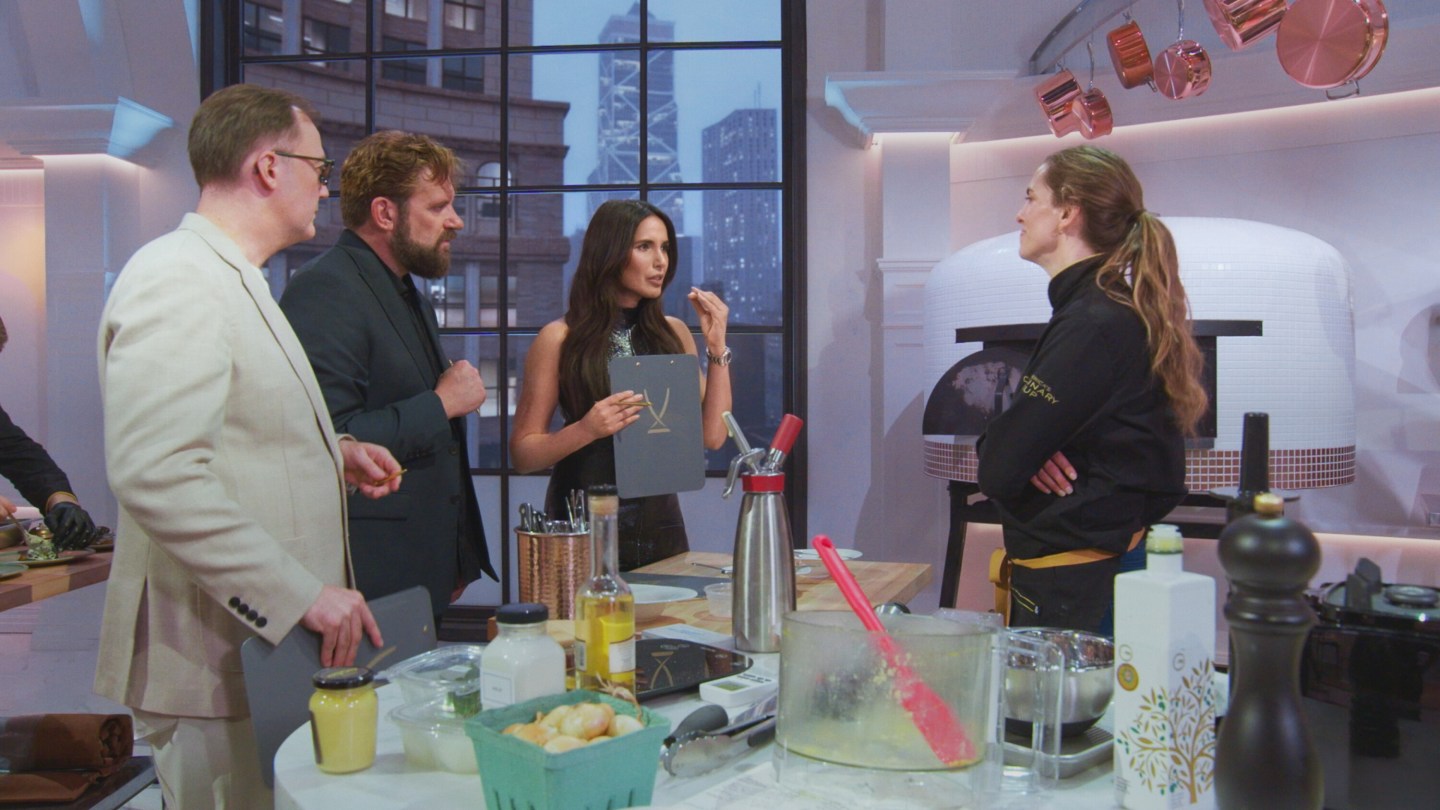
The CBS cooking competition was guided by culinary commandments that a starting group of 16 chef contestants attempted to obey to the best of their ability each episode for the chance of winning a grand prize of $1 million. Chef and restaurateurs Wylie Dufresne and Michael Cimarusti, along with Lakshmi, were the ultimate judges of how well each participant stayed loyal to each of the core pillars of cooking being tested, from sauces and sustainability to flavors and world cuisine.
“The most exciting aspects of my job on America’s Culinary Cup were not in front of the camera at all. That was 10 percent of my job and the least interesting,” says Lakshmi. “It’s interesting to taste their food, but we’ve seen me do that a lot before, so it’s fine, I can opine. But what was most stimulating to me was to develop the challenges and say, ‘Okay, how are we going to make every episode different?’” adds the former Top Chef host. “Well, we’re going to do that with a framework of these 10 culinary principles that every world-renowned chef should master: meat, vegetables, innovation, consistency. That is the framework that gives our show structure. But beyond that, no two episodes are alike.”
Below, Lakshmi talks about the extensive details that went into crafting a new type of cooking reality competition in an already oversaturated genre of TV — from the set design to choosing not to sequester contestants — and why she says, “I left that set thinking, ‘Whatever other people think, I made the best show I knew how.’”
How long had you been thinking about creating your own show before taking the plunge?
I wasn’t thinking about creating this kind of show at all and CBS came to me and said they really wanted it and I kind of said no for a long time. And then about a year and a half before we were on, I thought, “This is dumb. I should take this opportunity,” because as you know, our business is shrinking. Our whole industry is contracting and here was this big juicy network being like, “Please create something for us.” So that’s really what made me come back to the genre. I must say CBS and Amy Reisenbach, and my two executives who helped develop the show, Mitch Graham and Gloria Medel, they were fantastic and really, really helpful. It was a very supportive experience. I think that’s also because I didn’t have to shop it around. I was creating it for one network, so I knew who my audience was. I knew the brand. I even knew the time slot.
In what ways did you want to distinguish America’s Culinary Cup from other cooking competition shows?
The market is already very crowded with food competition shows, and it’s crowded with shows that have been on for a really long time and are very beloved, as well as new shows that are on streamers. So the challenge was to create something that felt fresh and modern and markedly different. And I think we did that, as hard as it was to do. I knew that I didn’t want something that was predictable and that’s why the show really has no format, which is strange for a competition show or a reality show, but I see this more as a high-end contest of cooking — like a game show, but very serious; something akin to a sporting event: Wimbledon, the Olympics, that’s how I wanted it to be. I wanted to strip it down.
What aspects of the show did you spend the most time developing?
Casting was very important and there were a lot of people who contributed to that. The final 16 [contestants] that you saw walk into that kitchen, I did not choose because I’m judging also. I approved several dozen contestants that I thought would be a good pool to pick from, and then I recused myself and people in my production company, my producing partner, the execs at CBS, the showrunner who we hired, all these people picked the final 16 and I didn’t know who they were until I got to set, which is how I wanted it to be so that I would come in with a blank slate.
The other thing that I spent the most time developing is the set. The set was really important to me because I didn’t want it to look like any other show — never mind a cooking show, I didn’t want it to look like any other non-scripted show that you saw on TV — and that, too, I think we achieved. It was a big risk because if you watch the show, there are no neon lights, there are no colorful walls or velvet. There’s nothing on the walls, even. It’s very, very minimal and almost austere. It’s a very high-end kitchen, but it is quite spartan and almost Japanese in its minimalism, and that was very purposeful. I wanted the chefs to have a clean, orderly place that was as close to a Michelin-starred restaurant as possible. I also wanted them to all have their own space. I didn’t want them to fight for stoves or ovens or counter space. If you see all the other shows, you know that the stoves are way back over there and then they’ve got to run and chop over here and they’ve got to fight for equipment or they’ve got to fight for the best ingredients, and I didn’t want any of that because that’s not what you’re going to have in a high-caliber, top-of-the-top competition of any kind. You’re not going to ask Picasso to come [compete] and give him a rickety easel. You’re not going to ask Serena Williams to come and have her fight with Coco Gauff for the racket. So I wanted this to be enticing for chefs. I wanted them to feel respected and taken care of and supported in their pursuit of excellence.
What sort of feedback were you hoping for from audiences once the show premiered?
I didn’t know if people would be bored by the set because it’s not busy, it’s not colorful. It’s basically alabaster and cream marble, but they really like the set. If you notice, the set has no corners; the actual kitchen is an oval. It’s like a coliseum or an arena, and I really wanted it to feel like that. Also, I wanted the chefs to be able to concentrate on their creativity and their execution. Neuroarchitecture is a thing I heard of recently — I didn’t know it was a thing, but I’m very interested in neuroscience — and research shows that people are more creative in irregular spaces or non-rectangular spaces. So that was very purposeful, but I was really taking a risk there. People have given really great feedback. They love the kitchen. They love how elegant it looks. I think they were surprised by how different it felt. And a lot of the changes that we made are very meaningful to the cast and crew but may or may not be noticed by the audience. For instance, one big change that I made from all the other shows, at least the ones I know, is that we don’t sequester our chefs.
Why’d you make that decision?
Because I wanted them to be treated like human beings, and beyond that, like captains of their industry. This goes back to our north star of what supports these chefs the most. I didn’t want to put adults in a room with four bunk beds. What if one guy snores, then nobody gets sleep, and their nerves are jagged and roughed up. And if somebody wanted their family to come visit them because they had a small child, or whatever the reason, I wanted them to be able to do that. We provide living spaces for them. But once they get off set, they can do whatever they want. They can go out to dinner; they can have their family stay with them; one chef did. They can do whatever they want. They want to stay up all night. That’s up to them. I just wanted to make sure I gave them the parameters of support, whatever you needed to get your game on for the next day.
What were set days really like? Some of those challenges were like five or six hours long, and that’s not even getting into production.
Yeah, the molecular gastronomy challenge was definitely the hardest to not only film, but to eat all that food — that was 40 dishes we wound up eating — and also to edit. We didn’t need to do five hours. We could have done three hours because it’s only a 42-minute show, and it’s on a network, so it’s not like you get six [extra] minutes because you need it. We really had to be nimble about how to edit the show so that the audience could follow along, and we weren’t leaving any key element of it out, but we were still fitting the 42 minutes. So that’s why it’s very kind of nonstop and feels so frenetic because it was. In the room, in the editing bay, in the version that everyone has seen on TV.
You were in L.A. just a few days ago with some of the chefs, including the season one winner, Cara Stadler. How have they said the show impacted them since airing?
I was in L.A. last week for an Emmy For Your Consideration event — and I hope we get nominated; I have no idea if we will — but it was wonderful to talk to them. I had gone to Chicago and I saw Beverly [Kim] and Diana Dávila a few weeks before that, but this was the first time that I had more than one chef together, and it was really moving. Keith [Corbin] said the one thing he appreciated was that we never told them what to cook. We always gave them a range of things. Obviously, for the meat challenge, you have to be cooking meat. For the vegetable challenge, you have to cook three kinds of vegetables. But he said, “There’s really nowhere to hide. You either know how to carve meat, or you don’t. You either know how to make a sauce, or you don’t.” But beyond that, he said all of the things he cooked felt like his food. Nobody on this show says, “Oh, I just want to cook my food,” because you’re cooking it from day one. And you can see that in the diversity of dishes. You have Katie Button always cooking Spanish food. You have Buddha [Lo] and Matt [Peters] doing very French-influenced food. You have Diana doing Mexican food, Michael [Díaz de León] doing Latin, mostly Mexican food. You have Beverly, Cara and Emily [Yuen] doing Asian-accented food. So the pantry became really important too. I’m someone who also loves using ingredients from all different ethnicities. My cooking is really based on living in New York and eating all over the world. So it was important to make sure that they had all these ingredients, and they didn’t want for anything, whether it’s corn husks or gochujang.
Listening to your feedback in each episode, it was clear you don’t play about seasoning.
We’re not giving a million dollars for just using some oregano. (Laughs.) But also, it’s about having restraint. In Chris [Morgan]’s case, everything he makes is really delicious. And he’s obviously got knowledge and command of many different ethnicities; it was just getting him to not put everything on the plate necessarily just because you have this great pantry, which is very inspiring.
Is the hope to have international offshoots of the show?
Yes. The reason I named it America’s Culinary Cup is because I really hope that there’s an Italy’s Culinary Cup, France’s Culinary Cup, Argentina’s Culinary Cup, Kenya’s Culinary Cup. We’ve already got interest internationally, actually. I can’t say which countries because I don’t want to jinx it, but that’s very exciting.
Is there anything specific you have in mind for season two if you get renewed?
I think the principles probably would stay the same. I just think we would change the order and change all the challenges to keep our chefs guessing. This was a first-season show. I am indebted to the chefs who had faith enough to come on because they don’t know what they’re getting themselves into. So the chefs are the stars of our show and, thank God, they trusted us to say okay to participate. I think it’ll be easier because now you know what you’re getting. You know the quality of the show. You’ve seen an example of a whole season.
You mentioned wanting an Emmy nomination for this show. You’ve been nominated a career total of 17 times as either a host or executive producer. How bad do you want a win?
When we had this FYC event last week, it was really gratifying because for the first time, I was able to hear my peers in the industry give me their feedback, and they were really specific in the things they noticed and that made me feel really good. I don’t live in Hollywood. I live in New York, so I don’t really hang out with other people who are in the industry. So that felt really good. At this point, I just want people to love the show. I want the audience to really take something away, learn something. And it would mean having the blessing of my peers, and that would be great, but I just hope the fans like it.
I hope that this show also illustrates the future of food television. And that we don’t need a lot of those old tropes and tricks of reality television, of pitting people against each other, of taking away their equipment or forcing them to be under some duress. That this is the next wave of reality television, where we have it be a quest to be the best of the best, whatever that is.
Read the full article here