
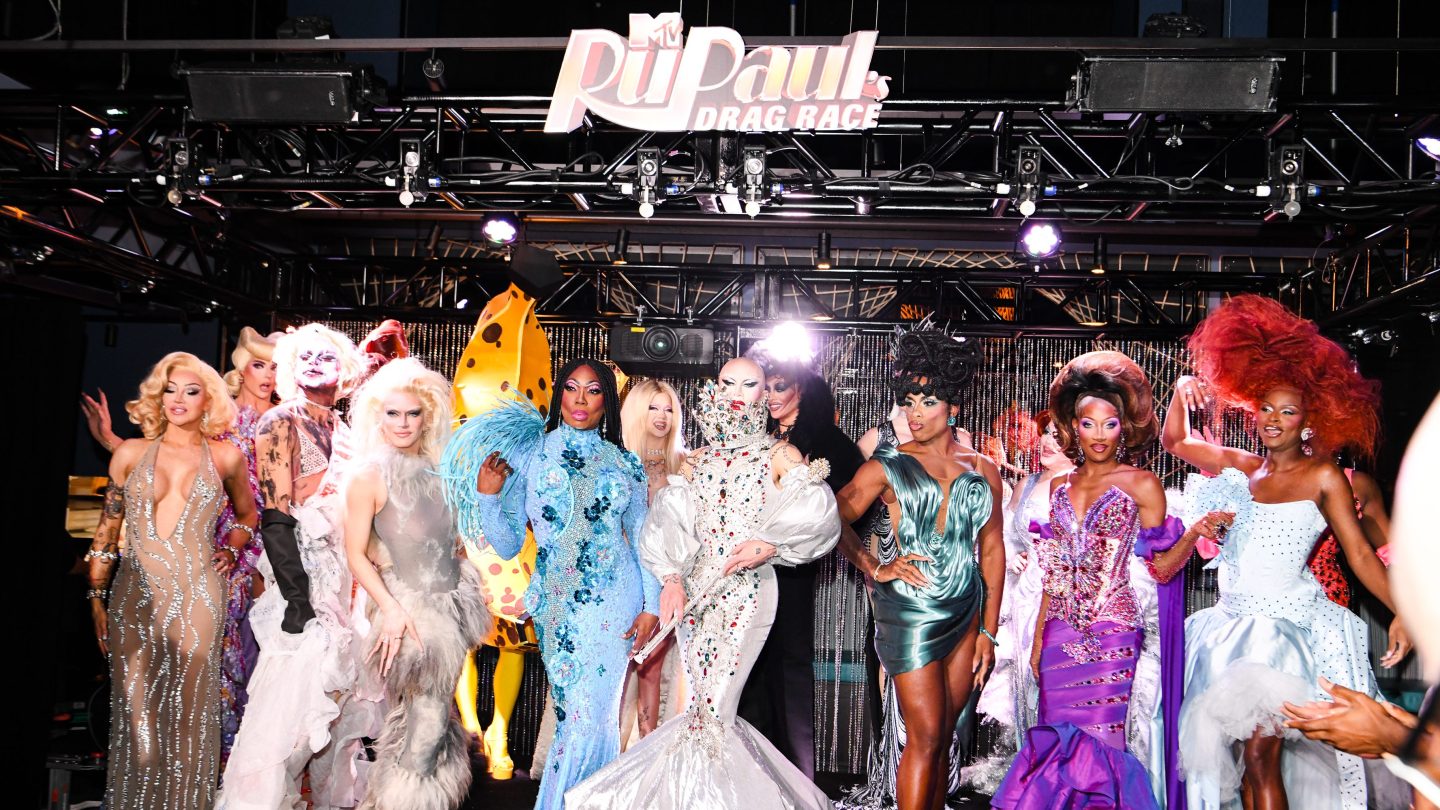


RuPaul’s Drag Race has kicked off its eighteenth installment, crawling closer and closer to a milestone 20th season.
Premiering almost 17 years ago, the series has gone through plenty of changes as the franchise worked out its now polished structure: a batch of drag artists compete in weekly challenges; one queen earns a win for their performance; two queens land in the “bottom” of the competition and perform against one another in a lip sync for their life; and the winner of said lip sync stays in the running for the title of America’s Next Drag Superstar.
It’s a tried and true format that has remained steadfast over all 18 seasons, its three varying network homes and a plethora of international spinoffs. But in the early days of RuPaul’s Drag Race, before they snatched up 29 Emmy Awards, there was no preexisting framework for queens to reference going into the competition. They simply went into things blind, as all first-season reality TV contestants do.
“When we started, we had no blueprint,” season one winner BeBe Zahara Benet tells The Hollywood Reporter. “We were going in with our full potential of who we are. There wasn’t anybody before us to see how to deal with [being] part of a platform or a show like that. Everything you saw, it was just authentic. It was real and it was pure.”
Nowadays, competitors know they’re filming a TV show and that their careers will receive a boost from extra screentime. That’s not necessarily a negative — plenty of beloved reality TV moments are somewhat fabricated. But that doesn’t mean viewers aren’t catching onto the inauthenticity that overproduced moments create, especially in the context of the show being a competitive series.
“I think a lot of times now, people go in [to Drag Race] with a bit more planning than they need, because they think, ‘I need to be this character. I need to play this role. I need to create this persona,’” BeBe adds. “It’s not necessarily authentic to who they are.”
Season 11 champion Yvie Oddly argues that fundamentally, “the competition itself really hasn’t drastically changed that much.” Of course, Drag Race has implemented minor format shifts over the years, “but the heart of the competition is really the same thing.”
The production of RuPaul’s Drag Race on a TV level has undoubtedly heightened. Take season one for example, which notably implements a glossy look that viewers have dubbed the “Vaseline filter.” Nowadays, the quality is noticeably pristine, further pointing toward a growth in resources that comes after years on air.
“A lot of [it is] money (laughs),” BeBe points out. “Let’s not even talk about just the artistry, but just even production. To see the amount that is going into producing the show, and how much people are actually spending to be on the show, it’s like, wow, to me.”
BeBe’s not wrong — the opportunity to appear on the world’s largest Emmy-winning drag competition show, combined with the production level increasing each year, has created an expectation for how queens should present themselves on the series. Season 13 competitor Gottmik revealed she spent $20,000 on her runway package for the show, while Plastique Tiara allegedly spent somewhere around $250,000 preparing her looks for RuPaul’s Drag Race All Stars season nine.
The demands of competing on RuPaul’s Drag Race have become a conversation in the show’s orbit, one that, unfortunately, doesn’t have a clear solution. The standards expected of drag performers have intensified over the past 17 years, and that raised standard comes with a few pros and cons.
“Through the years, drag queens have been incrementally causing each other to step up their game,” Jinkx Monsoon, winner of season five and All Stars season seven, explains to THR. “I think of the way I do drag today versus the way I did drag 15 years ago when I started — it’s a whole different world.”
Season nine aired in 2017, and Sasha Velour says she’s certainly noticed a contrast when it comes to the show’s fashion standards, a shift she noticed beginning around the time of her installment.
“So many queens brought the most incredible fashion on the show, and that was not something that happened so much in the nine years that came before me,” the winner says. “I look back on some of those costumes and was like, oh, we could never get away with that now.”
Aquaria, season 10 winner, echoes Velour’s thoughts, pinpointing a change in runway standards around 2017-2018.
“Whether it was season nine, but particularly season 10, particularly me, I feel like I was the teeny straw that broke the camel’s back of runway production or the expectation for how you’re supposed to come into the game. The drag scene globally was changing, but especially in terms of television, it was really elevating,” Aquaria notes. “I think a lot of the fingers point back to me, that era and that season in particular. Not even just me, a lot of the queens on my season thought about what they were bringing into the competition. It quickly snowballed from there.”
Looking back, season eight victor Bob the Drag Queen recognizes the natural change in the show over the years, and ponders if the slate of crowned winners would still be the same.
“I feel like, to be honest, a lot of us who won Drag Race back in the day, maybe we wouldn’t win Drag Race now,” Bob says. “Maybe some of those people who couldn’t win Drag Race back then could actually win it now.”
One of the upsides of entering the pressure cooker that is RuPaul’s Drag Race is that competitors undergo a branding master class. With each new installment, season 13 champion Symone explains “the kids have to be much more aware of their brands and what lane they want to go in after the show,” noting that a wide array of learned experience brooded by competing in the series’ challenges diversifies the contestants’ post-show opportunities.
“You’re able to be on TV and do acting or Broadway or tour and do music. The lanes are so much more diverse now,” Symone adds. “You’ve always had to be a jack of all trades when it comes to drag, but now you really have to brand yourself, but also be able to do more than one thing.”
A trending contrast in modern seasons of RuPaul’s Drag Race is the cast’s youthful age. It’s a point Bianca Del Rio (“Everybody’s fucking young!”), Bob the Drag Queen (“They’re a lot younger”) and Sasha Colby all reference to THR, one that viewers have critiqued of the show’s casting for leaving out a valuable sector of the drag community — old school drag queens.
Last year, with season 17, the eldest contestant, Lexi Love, was 33. Compare that to 10 seasons prior, when Tempest DuJour competed on season seven at 47. (The average age of season 17 was 24, whereas season seven’s average was 30.)
In response to audience feedback, season 18 features an array of age groups in its cast, with the oldest competitor being 38, signifying RuPaul’s Drag Race’s willingness to apply criticism to better represent the wider drag community.
Still, even as a plethora of young queens — referred to as “baby queens” — have been cast in recent years, season 15 champion Colby asserts this factoid signifies the positive effect of the art form becoming more accessible.
“They’re just getting younger and starting off so much sooner. I think that’s the really great power of how mainstream Drag Race and drag in general has become,” she says. “Because of the show, it’s allowing people, queer kids and aspiring artists to find their voices a lot quicker. I love how drag is definitely a lot more accessible.”
Bianca, the oldest ever crowned queen from the show, jokes it’s “wild to look at it from this perspective” over a decade after she won the sixth installment in 2014. With 2026 marking her 30th year as a professional drag queen, she’s admittedly “amazed by the popularity of drag” and how the show has continued to excel despite rocky political waters.
“The levels [drag has] gone, the opportunities it’s given me — I’m just amazed by all of it,” Bianca says. “In this world, even though things are somewhat upside down politically, in other areas I go, ‘Drag Race is really thriving,’ which is something I didn’t expect to see in my lifetime, in my career or 11 years ago when I did the show.”
Another change in RuPaul’s Drag Race has nothing to do with the show, but more so to do with its prominence in pop culture.
“The only difference between the old era and new era is, I would say, what Drag Race means to the people and the culture, what it represents, what getting on the show represents, and how the industry works,” season 11’s Yvie says. Velour reiterates this sentiment, adding that the show has positively expanded the mainstream reach of drag.
“A beautiful impact of the show [is] the fact that straight people, families, people who maybe had a bit of curiosity but no connection to the world of drag, or even to queer and trans people in real life, have been able to fall in love with the art and see us as the real, complex, full people that we are,” Velour notes.
And with so many eyes on the series comes a brand-new world of opportunities for the competing queens. Jinkx Monsoon is a Broadway darling. Bob the Drag Queen toured the world with Madonna and is a New York Times best-selling author. Bianca Del Rio has changed the drag comedy scene with her solo headlining tours. There’s truly no limit to what a drag queen can or can’t do anymore, and RuPaul’s Drag Race influenced this.
“By putting [drag] on television and making it mainstream in the way it has become in the last 18 years, it shows that we have grown this from what it was into something even bigger than I think any drag queen thought it could be,” Jinkx says. “It used to be that being a drag queen was a good way to kill your career. (Laughs). But now, you can make it anywhere as a drag performer, and I think that’s the way it should be. We’re just people with talents, and we choose to do it in certain costumes. It’s no different from Orville Peck wearing a mask, or Cher wearing a billion wigs in her lifetime. We all do drag a little bit, just some of us are better at it.”
With the arrival of season 18, one thing is for certain: to stand out from the shiny pack of RuPaul’s Drag Race alumni, the new batch of RuGirls must possess a little more than RuPaul’s recommended charisma, uniqueness, nerve and talent.
“In this new era, you have to really surprise everyone,” season 14 victor Willow Pill says. “Everyone feels like they’ve seen it all at this point, so I think you have to be even more ingenious at being creative, versatile and shocking, and having this level of drag that is so well-rounded and outstanding.”
Willow adds, “I think the winners of the original nine seasons of Drag Race were all just icons and really incredible at what they do. This new era is about adding new layers and levels to what drag is all about.”
Season 18 of RuPaul’s Drag Race premiered Friday on MTV. Read THR’s full feature with the show’s winners here.
Read the full article here