





Vicky Krieps can already guess the headline.
“They love that story of ‘Vicky turning away from Hollywood,’” the European actress giggles to The Hollywood Reporter.
I frantically make a mental note to try and resist going with this — obviously successful, but hackneyed — angle, and quickly discover that the offbeat and slightly anarchic Krieps is much, much more fascinating than her rebuking of entertainment’s most exclusive club.
The half-Luxembourgish, half-German star is referring to her 2017 breakout performance in Paul Thomas Anderson’s Phantom Thread, in which she played the young muse of Daniel Day-Lewis’ haute couture dressmaker. “I got the email for Phantom Thread and I didn’t read the director, who’s producing, I just scrolled down to the PDF [script] because that’s what it’s about,” Krieps remembers. “It was not the full script, and I thought it was a student who didn’t yet have a script and was looking for an actress to write with, which is very funny, because it turned out to be Paul Thomas Anderson.”
After ascertaining the project was not from an aspiring filmmaker but one of the greatest of his generation, she signed on, made the film and premiered it in New York in December that year. It would land six Academy Award nominations. And so ensued the awards-circuit circus: A relatively unknown, 34-year-old Krieps was thrust into the limelight, shaking hands with top producers and directors keen to ensnare the hot new talent. Her response? Decline them all and head back to Europe. Her reasoning couldn’t be more sound.
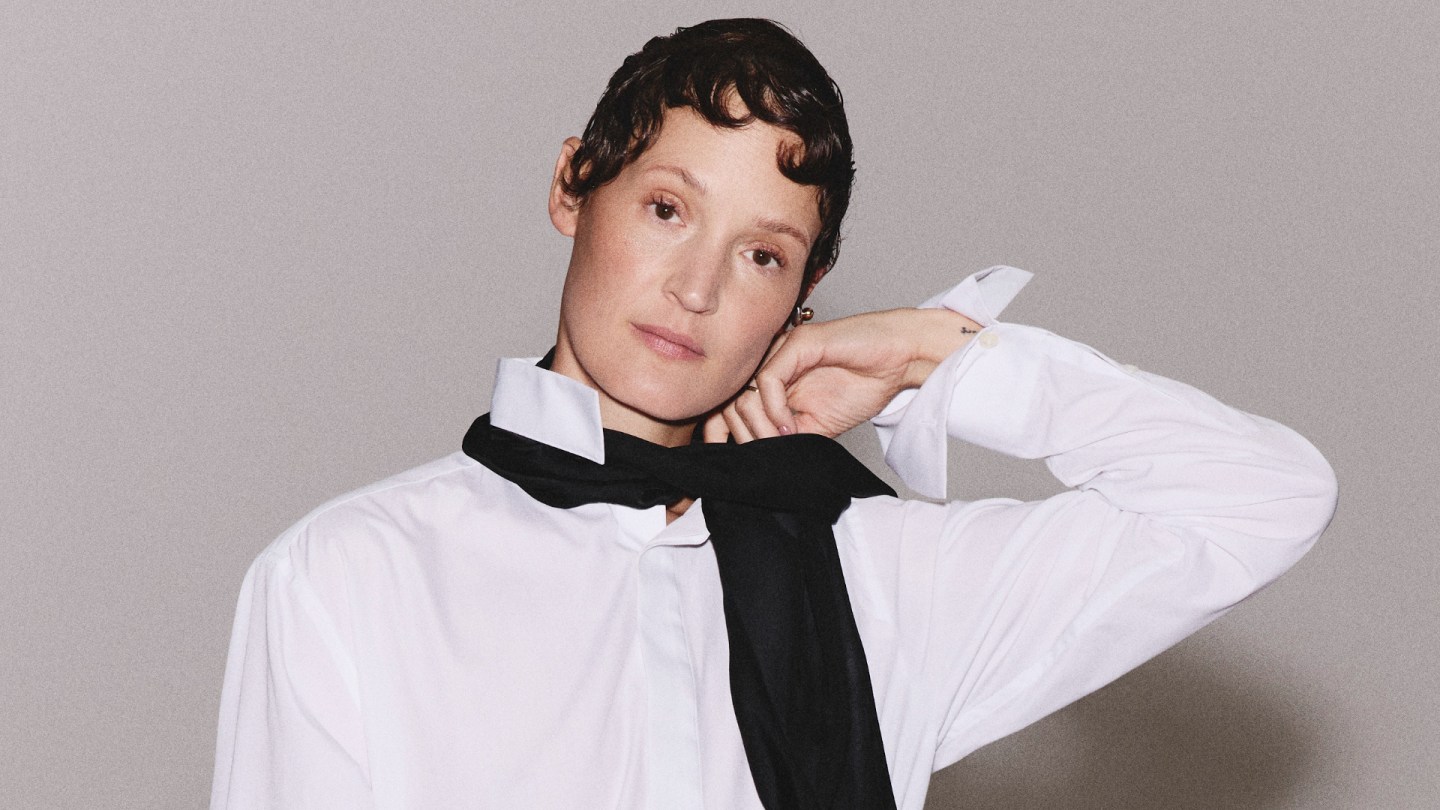
“I did need a break, but I think every normal human being would need a break after [that],” says Krieps, rocking a pixie cut all the way from the South of France, where she’s currently shooting Bradley Cooper‘s Ocean’s Eleven prequel (we’ll get into that later). “Coming out and going to the Oscars… I didn’t come from this kind of fame. No one in my family or surroundings is famous. So you need a break just to process, and that’s what I did. But that was mainly because I had two little children, and when you’re a mother and you have kids, I think your instincts can be much stronger.”
She has been adamant about taking career pauses “from very early on,” but still chuckles remembering the whirlwind few months with Phantom Thread. (And let it be known: Krieps is overjoyed to see the success PTA has accrued since. She actually narrated the Oscar-winning Two People Exchanging Saliva and collected the gold statuette before his slew of awards began rolling in at the March ceremony. Krieps stuck her tongue out at him while on stage.)
She continues about that period promoting the film: “I don’t know if you’ve heard this, but an actor ‘has a moment,’” says Krieps. “They’d say, ‘She’s having a moment!’ So what I did is I consciously passed on my moment. But I never really turned my back on Hollywood in the sense that I don’t like it. It was just a natural reaction to the press and the events.”
She references Lena Dunham’s recently released memoir Famesick, a revelatory piece of work that underscores the long-term impacts of trapping young women in showbiz.
And while Krieps by no means left the U.S. film industry behind, she did go back and honor her roots with nearly a decade of arthouse projects: Germany’s 3 Days in Quiberon (2018), the Cannes-premiering Bergman Island (2021) and Marie Kreutzer’s 2022 period drama Corsage among them. She has enjoyed a happy balance since Phantom Thread, deftly straddling both the American and European film industries.
But Krieps is teeing up an insanely busy run after last year’s performance in Jim Jarmusch’s Golden Lion-winning Father, Mother, Sister, Brother. With the untitled Ocean‘s film, as well as The Idiots, The Joy of Sex and the hotly anticipated Monster: The Lizzie Borden Story premiering on Netflix Thursday, Krieps’ next stretch of respite admittedly feels rather a long way off.
Over Zoom, the actress appears pretty fired up about what’s ahead. She has an infectious energy and a tendency to make some glorious off-the-cuff remarks about her career and fellow creatives (a journalist’s dream). This is a woman who knows herself, and her work with Ryan Murphy‘s Monster franchise is testament to that. “The Ed Gein series came to my surprise, because I hadn’t really done any TV, so I didn’t have much experience,” she recalls about connecting with bona fide TV mogul Murphy. “I felt it was very fun and almost freeing to be acting in this world of Ryan Murphy. I did feel like I’m part of a troupe,” she continues. “It has this vibe of old music halls — you feel like you’re part of something very colorful and very bold and unapologetic.”
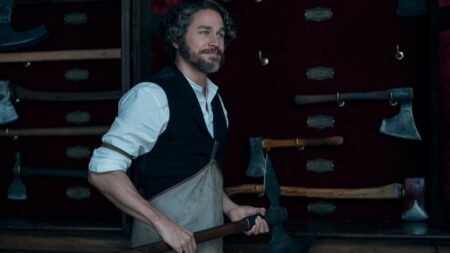
With The Lizzie Borden Story, set to chronicle the real-life trial and acquittal of an American woman who, in the 19th century, was accused of killing her father and stepmother with an axe in Fall River, Massachusetts, Krieps was immediately intrigued by a promise of freshness. “[Murphy] said, ‘I’m doing something and I’m very excited because this is the first season about women, and I want this to be very feminist and represent a female perspective on things,’” she says. Though she wasn’t aware of Borden’s tale, she heard Murphy’s pitch: “‘It’s a woman who we don’t know if she did it or not. But if she did, she got away with it and got the money. And there’s one theory that she didn’t do it alone. This is why I’m coming to you,’” he said.
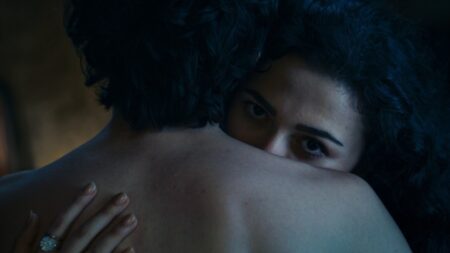
Krieps has two roles. One is Bridget “Maggie” Sullivan, the Borden family’s maid. The other is Elizabeth Báthory, based on the Hungarian noblewoman alleged to have killed and tortured girls and women from 1590 to 1610 (and who, Murphy fans will recall, inspired Lady Gaga’s blood-drinking countess in American Horror Story: Hotel). The chance to depict stories about women and their emancipation was, as Krieps puts it very British-ly, “right up my street.” She tells THR: “There’s a punk component because these women misbehave, and they’re not good women. This is something we haven’t watched a lot in the cinema, and definitely not on TV. Women who misbehave and get away with it and celebrate life, celebrate themselves and their own sexuality and their own love, and this is what this series is going to bring to people.”
Is it fair to say Krieps enjoys playing women who misbehave? “Of course,” she smiles. “And the female emancipation, it really ties in [with Krieps’ filmography]. I tend to make very intuitive decisions in my career, so something comes to me, and I immediately know: ‘Yes.’ But I can’t tell you exactly why. It’s not rational — it’s intuitive and instinctive, and it feels like, ‘Yes, I want to eat this meal.’ But when I look back, all my movies kind of belong to the same alignment,” she nods. “This one as well — it’s [another] pearl in my necklace.”
Krieps can’t help but respect Murphy for the unshackled nature with which his female characters are imbued. Underneath it all, though, is a genuine goal: “to reach people with a message.” Krieps says it is trying to show how the world would look if women were just as reckless and rich as men: “What if women wouldn’t apologize? What if women just went for it? We live in a world where it’s become more and more difficult and more and more important to put these messages in our work, because movies [and TV] do reach people. That’s why I would always do them, and I would fight for them until the very end of my life. I am a film soldier and independent film has become very difficult to survive, but I am very aware my movies don’t reach a lot of people.”
She’ll have far less trouble accumulating eyeballs with Monster on Netflix, especially following Murphy’s Glee and American Horror Story success. His signature fusion of gore and glamor has caught him some flak over the years, most prominently around the romanticization of harrowing true crime events. Krieps is unbothered by this — all she remembers is the first time Murphy reached out to her about the role in the Ed Gein series. Krieps played the notorious wife of a Nazi concentration camp commander, Ilsa Koch, who was said to torture prisoners and make household objects out of human skin.
“My first email to him was a very polite no,” Krieps says. “I feel very honored, but with my history — my grandfather went to a concentration camp; he was not Jewish, but he went for [the] resistance — I said, ‘I don’t think I can do this.’ I said, ‘What if someone is not taking it seriously? What if we’re on a shooting day, on the set of a concentration camp, and I can see someone in the corner of my eye scrolling on Instagram?’” She was concerned she might be unable to temper her disapproval at any show of apathy. “‘I don’t know if I will run over to the person and kick them, because it’s so close to me and it’s so serious to me that I don’t know if I can do a make-believe on that subject,’” she told Murphy.
But the pair of them talked. They came to agree that it’s important to show audiences the monster. “Because when we show the monster,” she says, “we also show that we could be the monster… It’s tricky to portray a murderer. It is tricky to portray a dictator. It’s also tricky to portray these beautiful, thin women, and then every woman thinks she has to be thin and beautiful,” she adds about the film industry’s perpetuation of beauty standards. “But what I saw in the Menendez brothers’ story, in Dahmer… is showing the human being that the monster is usually not the person you think it is. You have to look much more closely, and society will only learn from all of this.”
Krieps hopes audiences are reflective when they watch The Lizzie Borden Story. It is the first of many projects she’ll be promoting over the next few months, though she’s admittedly still reeling from working with her ultimate hero, Jarmusch, on the aforementioned Father, Mother, Sister, Brother. “That was the highlight of my career,” Krieps beams. “If people asked me after Phantom Thread, ‘What would you want to achieve?’ I would say, ‘There’s one person, I really like Jim Jarmusch.’” Luckily, the shoot surpassed expectations. “He’s the artist, the visionary, the poet, but also the human… I feel in many ways he’s sadly one of the last remaining— I call them lighthouses.” Patti Smith and Dolly Parton, Krieps adds, are some of her lighthouses.
Jarmusch is not the only director to have invigorated Krieps in recent months. Bradley Cooper’s Ocean’s Eleven prequel, also starring Cooper himself, Margot Robbie, George MacKay, Wagner Moura, Monica Barbaro, Josh Gad and Omar Sy, has been a real shot of joy in the arm. “It’s never happened to be in my life that [I’ve had] such a big cast made up of genuinely good and nice human beings,” says Krieps about its wholesomeness.
Cooper “improvises the whole time,” and everyone feels wonderfully free, artistically. In fact, “none of us have ever improvised so much,” according to Krieps, whose days at the moment are spent with MacKay, Moura and Sy. The final project will be a sun-soaked adventure, accented by Monte Carlo’s stunning architecture and some exquisite costume work. “And by the way,” Krieps says. “Bradley Cooper is an insanely talented director.”
Then there is The Idiot(s), the Telluride-premiering, unhinged portrait of love about Fyodor Dostoevsky (Johnny Flynn) and his great love of the time, Anna (Aimee Lou Wood). Malgorzata Szumowska and Michal Englert’s drama is now London Film Festival bound, and Krieps says it is maybe the most fun she’s ever had on a set. “The Idiot(s) was actually crazy,” she says. “This was improvising, but in an absurd way, where you could suddenly take off your costume and leave the room and come back in dressed as a bear.” In what is the highest compliment Krieps has paid across the entire, talent-heavy call, she says Flynn might be the best actor she’s ever worked with.
Up ahead is Andy Garcia’s Diamond and Sharon Maguire’s love-triangle comedy The Joy of Sex with Julianne Moore, Colin Firth, Laura Linney and David Tennant. On top of that, Krieps is hoping to broaden her skillset with the release of an album. “I’ve been doing songs for every character that I’ve [played],” she says. “It’s part of my process to stay sane. These songs are recorded and have been with me for two years now. I’m not in a hurry, but I think I’m finally ready, and I’m going to release them,” she tells THR.
Her enthusiasm has percolated through our conversation, and I leave feeling chirpier. Krieps has, it would appear, quietly got the measure of both Hollywood and Europe’s entertainment industry. She acknowledges the unease with which we’re all navigating the current climate, and in true punk fashion, defies the pessimists. “I feel it’s my duty to be a utopist,” adds Krieps. “I see the darkness, and I always believe in the light. I will always try to mirror the lighthouses.”
Monster: The Lizzie Borden Story is now streaming on Netflix. Read THR‘s show coverage.
Read the full article here