



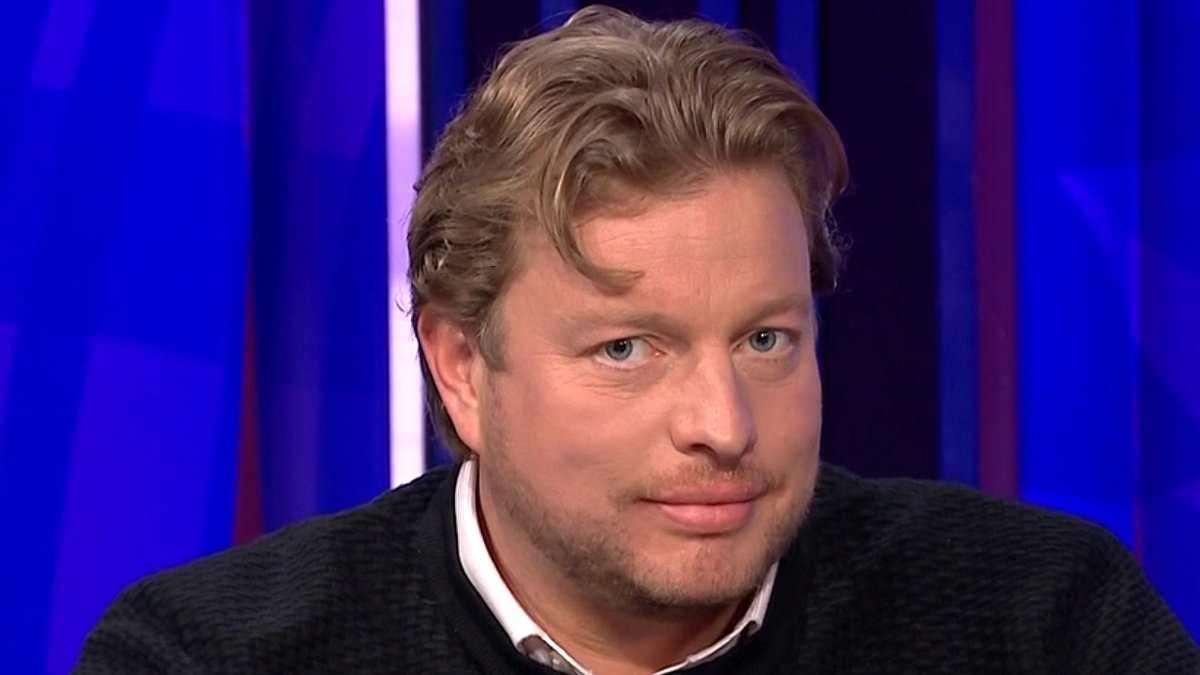

Thomas Skinner has doubled down on claims that he was paid £2,000 for his appearance on the hit BBC show Question Time.
The former Apprentice star and businessman, 35, joined host Fiona Bruce on Thursday to discuss the current affairs alongside justice minister Jake Richards, former security minister Tom Tugendhat and the Liberal Democrats’ Layla Moran.
The TV personality, who last appeared on the BBC as a contestant on Strictly Come Dancing in 2025, took part in the debate as the programme aired from Clacton-on-Sea.
He previously claimed he received a whopping £2,000 fee for appearing on the show – a figure the BBC has reportedly disputed, insisting panellists are typically paid £150.
Now in a new statement to The Sun, Thomas said: ‘My understanding of the fee came directly from my management, who informed me that I would be paid £2,000 for attending.
He continued: ‘I’m a big fan of Question Time and really enjoyed being part of the show.
Thomas Skinner has doubled down on claims that he was paid £2,000 for his appearance on the hit BBC show Question Time
The former Apprentice star and businessman, 35, joined host Fiona Bruce on Thursday to discuss the current affairs alongside justice minister Jake Richards, former security minister Tom Tugendhat and the Liberal Democrats’ Layla Moran
‘At the same time, it is work for me, and with three kids, I have to treat these opportunities as part of my job.’
DailyMail has contacted the BBC for comment.
It comes after Thomas admitted his main motivation for appearing on the programme was the pay cheque.
Taking to X to address his appearance, he wrote: ‘I’m not there representing any party. I’m there because it pays £2,000 and I like watching Question Time….
‘I’ve been asked probably 9 or 10 times to attend over the last 4 or 5 years. So I decided to give it a go. And I really enjoyed it.’
However, the BBC swiftly denied his claims, with a spokesperson stating: ‘Question Time offers a fee of £150 to panellists who aren’t politicians,’ according to The Sun.
It comes after Thomas and host Fiona, 61, had a back and forth as the panel was quizzed around the ongoing debate about social media addiction earlier this week.
It followed news this week that Meta and Google were found liable for a woman’s social media addiction and ordered to pay her $3million (£2.2m) in damages.
He previously claimed he received a whopping £2,000 fee for appearing on the show – a figure the BBC has reportedly disputed, insisting panellists are typically paid £150
Now in a new statement to The Sun, Thomas said: ‘My understanding of the fee came directly from my management, who informed me that I would be paid £2,000 for attending,’
Thomas, who regularly shares videos with his 536,000 followers on TikTok, which include him eating breakfast at his favourite café, hit out against the dangers of social media usage among young people.
Admitting he makes money from posting on platforms including Instagram and TikTok, the media personality insisted his platform was about ‘spreading a bit of positivity and a bit of love’.
But Fiona didn’t hold back in confronting him on his use of the platforms, suggesting that he too was part of the problem young people face with social media usage.
She said: ‘You are benefiting from social media, you make part of your living that way and, part of the reason you are able to do so is because of the addictive algorithms that will push people towards your .
‘It is giving you a platform, and job opportunities come your way because of it. In the nicest possible way, you are part of the problem.’
Fiona, who has hosted the programme since 2019, added: ‘How can you on the one hand say “people shouldn’t be doing it so much” but, on the other hand, you are benefiting from it?’
However, Thomas insisted: ‘It’s bad. It’s bad when people sit on their phone all day. I’ve seen it myself.
‘I’ve done it myself, I sometimes know I’ve got to be up in four hours and I’ve sat there and I’ve scrolled my brains through, watching absolute nonsense.’
He added: ‘I don’t know if anyone has seen my videos, but my videos are mainly of me in a cafe called Deano’s Cafe in new Spitalfields Market, saying “Good morning you lovely people”, showing what I’ve got for breakfast and going, “bosh”.
‘There’s a time and a place… if you’ve got kids, as parents you should say, “listen, kids, you can have it an hour in the evening” or whatever you want to do.’
Other panellists stepped in to defend Thomas, with one arguing that his clips ‘do not drive the worst of the algorithm’ online.
Layla chimed in: ‘The ones that are are the ones promoting hate, that are purposefully putting people against each other, people are posting things that are not true and purposefully there to incite other people.
It comes after Thomas and host Fiona, 61, had a back and forth as the panel was quizzed around the ongoing debate about social media addiction earlier this week
Meta CEO and Chairman Mark Zuckerberg (centre) leaves the Los Angeles Superior Court after testifying in the landmark social media addiction trial on February 18, 2026
‘What we’ve got to do now is recognise that this is harming society, is making people not believe each other, fewer and fewer people believe what they see anywhere, the BBC included.
‘We’ve got to now get to a point where these companies are held to account.’
It comes after Meta and Google were found liable for a woman’s social media addiction and have been ordered to pay her £2.2million.
The first-of-its-kind lawsuit saw the plaintiff, a 20-year-old referred to only as Kaley, accuse the tech giants of hooking her to their platforms.
Kaley started using YouTube at six, downloading the app on her iPod Touch to watch videos about lip gloss and an online kids game. She joined Instagram at nine after getting around a block her mother had put in place to keep her off the platform.
After more than 40 hours of deliberation across nine days, California jurors decided the tech giants were negligent in the design or operation of their platforms.
The jury also decided each company’s negligence was a substantial factor in causing harm to Kaley, who alleged her use of social media as a child addicted her to the technology and exacerbated her mental health struggles.
Jurors also found that both companies knew or should have known their services posed a danger to minors, that they failed to adequately warn users of that danger and that a reasonable platform operator would have done so.
Jurors assigned Meta 70 percent of the responsibility for Kaley’s harm – a $2.1million (£1.5m) share of the compensatory award – and YouTube the remaining 30 percent, or $900,000 (£675,000).
Meta and Google-owned YouTube were the two remaining defendants in Kaley’s social media addiction case after TikTok and Snap each settled before the trial began.
Jurors listened to about a month of lawyers’ arguments, testimony and evidence, and they heard from Kaley, as well as Meta leaders Mark Zuckerberg and Adam Mosseri. YouTube’s CEO, Neal Mohan, was not called in to testify.
Kaley told jurors that her near-constant social media use ‘really affected my self-worth,’ saying the apps led her to abandon hobbies, struggle to make friends and constantly measure herself against others.
In closing arguments, plaintiff attorney Mark Lanier cast the case as a story of corporate greed. He argued that features on the apps were engineered to drive compulsive use among young people.
But the tech giants maintained throughout the trial that Kaley’s mental health struggles had nothing to do with their platforms.
Meta lawyer Paul Schmidt highlighted her turbulent relationship with her mother, playing jurors a recording that appeared to capture her mother yelling and cursing at her.
YouTube disputed how much time Kaley actually spent on its platform, with its attorney telling the court that usage records showed she averaged little more than a minute a day on the very features her lawyers called addictive.
The jury completely sided with Kaley in the case and rejected all arguments made by the defence.
Read the full article here