






What is a National Monument? Who gazettes them? How many national monuments are there in Singapore? To date, the Preservation of Sites and Monuments, a division of National Heritage Board, has identified and gazetted 77 buildings, structures and sites of national significance as an integral part of Singapore’s built heritage.
In this edition, we put under the magnifying glass one of the oldest Catholic churches on our Little Red Dot, St Joseph’s Church.
Location

St Joseph’s Church was the 51st building to be gazetted as a National Monument. Located near other National Monuments such as Maghain Aboth Synagogue, Church of Saints Peter and Paul, and Cathedral of the Good Shepherd, the MRT stations nearest to St Joseph’s Church are Bras Basah, Bencoolen and Bugis.
Significant dates
Dates built:
- Dec 14, 1851- June 9, 1853: The old St Joseph’s Church was built by the Portuguese Mission
- 1906-June 30, 1912: The current St Joseph’s Church was constructed
Milestones:
Aug 21, 1904: The foundation stone for the current church was laid
1906: The old St Joseph’s Church was demolished
2017-2022: St Joseph’s Church underwent an extensive renovation
Date gazetted: Jan 14, 2005

History
St Joseph’s Church on Victoria Street was once the centre of the Portuguese Mission in Singapore and is among the country’s oldest Catholic churches. The mission was founded by Father Francisco da Silva Pinto e Maia, a Portuguese priest from the Congregation of the Missions who arrived from Macau in 1825.
In the early years, Mass was celebrated not in a church, but in the Beach Road home of former naval surgeon Jose d’Almeida Carvalho e Silva – on the very site where Raffles Hotel now stands.
Plans for a permanent church took shape in the mid-19th century. On Dec 14, 1851, Father Vicente de Santa Catarina laid the foundation stone for the Church of São Jose. Built through public donations from both Catholics and non-Catholics, along with a substantial contribution from King Ferdinand II of Portugal, the church was completed and blessed in 1853.
As the congregation expanded over time, the original building became too small. In August 1904, Bishop João Paulino de Azevedo e Castro of Macau laid the foundation stone for a new and larger church.
Construction only began in 1906 after the earlier church was demolished. The present structure was completed in 1912 and formally blessed on June 30 that year. At the same time, the former Portuguese Mission headquarters, today’s Parochial House, was also built within the church compound.

To preserve the church’s Portuguese identity, priests continued to be posted from Macau for many years. This arrangement eventually came to an end, and the final connection to the Portuguese Mission was severed when the last Portuguese rector, Benito de Sousa, concluded his service on Dec 31, 1999.
In 1981, the church officially came under the jurisdiction of the Archdiocese of Singapore. Today, it serves a diverse congregation, welcoming Catholics of all backgrounds alongside members of the Eurasian community.

Beyond religious duties, the Portuguese Mission was deeply involved in education. Alarmed by high illiteracy rates among children from poorer families, Father Jose Pedro Santa Anna de Cunha founded St Anna’s School in 1879, offering free education from a small house on Middle Road.
As enrolment increased, purpose-built school buildings were constructed within the church grounds in 1885. These later evolved into St Anthony’s Convent for girls and St Anthony’s Boys’ School. While the schools have since relocated, the original buildings still stand as reminders of the mission’s educational legacy.
The church has also long supported charitable causes, helping the needy through organisations such as the Society of St Vincent de Paul and the St Anthony Bread Fund. It even contributed to relief efforts following major events, including fundraising for victims of the Tiong Bahru fire in 1934.
Fun fact: During repainting works in 2007, workers uncovered original ornamental plaster details from the early 1900s hidden beneath layers of paint

Design and architecture
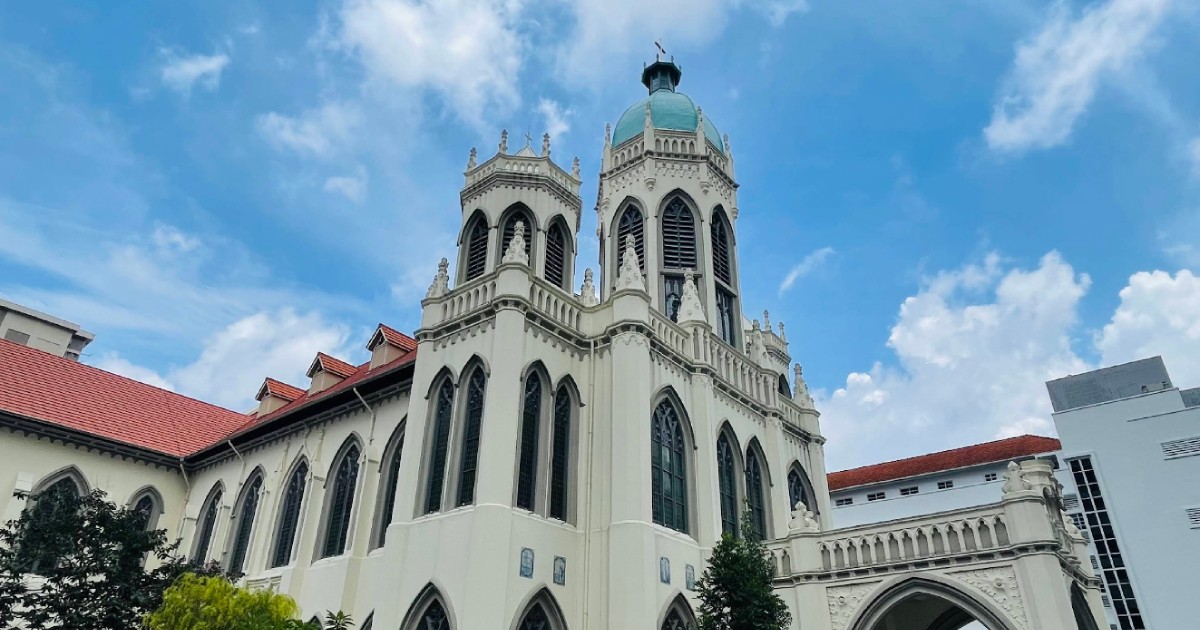
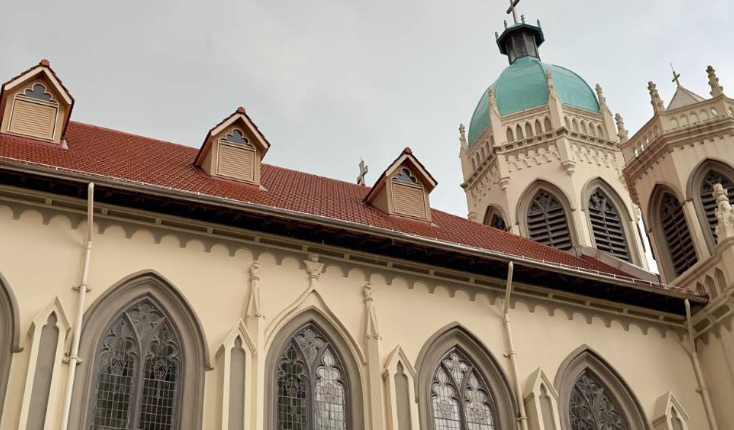
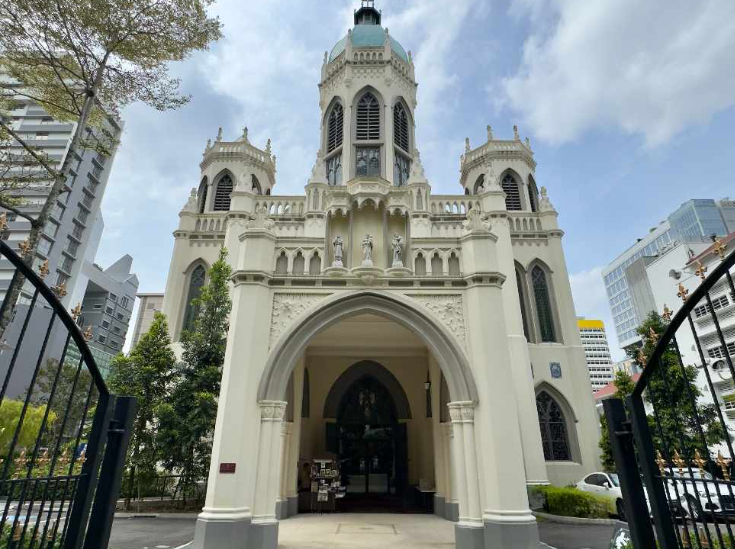
St Joseph’s Church was built in a Latin cross layout and designed in the Neo-Gothic style, best recognised through its pointed, lance-shaped arches framing the doorways and windows. Rising above the church is an octagonal belfry, topped with a dome and crowned by a cross, flanked on both sides by two smaller, dome-like towers that give the building its distinctive silhouette.
The front façade is adorned with traditional Portuguese blue-and-white ceramic tiles, known as azulejo. These were added in 1950 to mark the visit of the Pilgrim Statue of Our Lady of Fatima from Rome. The tile panels depict scenes from the 1917 apparitions of the Virgin Mary in Fatima, Portugal, adding a strong visual link to the church’s Portuguese roots.
Inside, the sanctuary centres on a marble high altar where a statue of St Joseph, the church’s patron saint, is enshrined. Surrounding the interior are altars and pedestals bearing statues of Jesus, the Virgin Mary, and various saints, creating a richly layered devotional space.
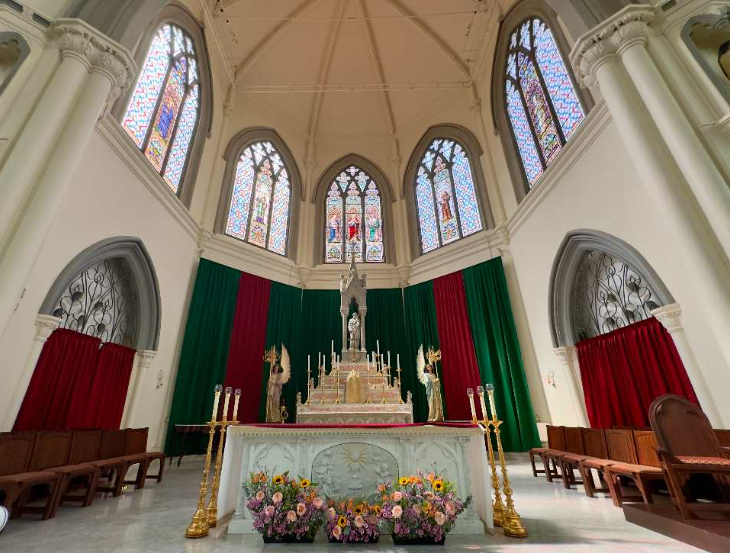

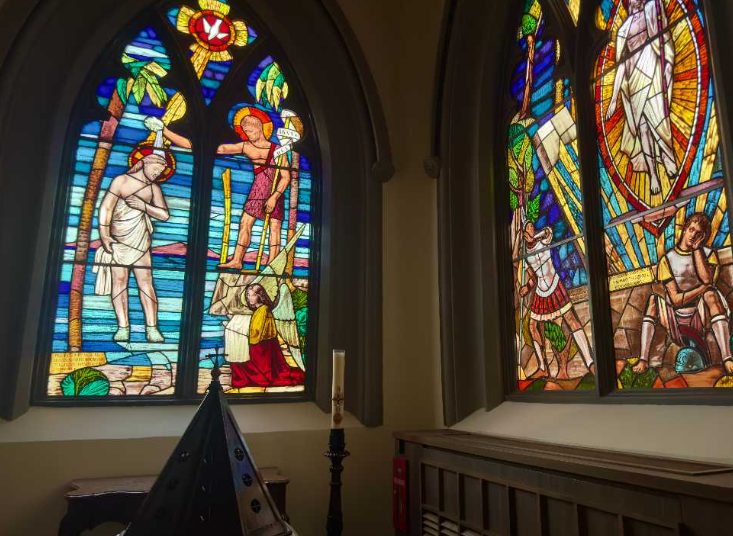
Light filters into the church through an impressive array of stained and coloured glass windows, a hallmark of Neo-Gothic architecture. In fact, St Joseph’s Church houses one of the largest collections of religious stained-glass windows in Singapore.
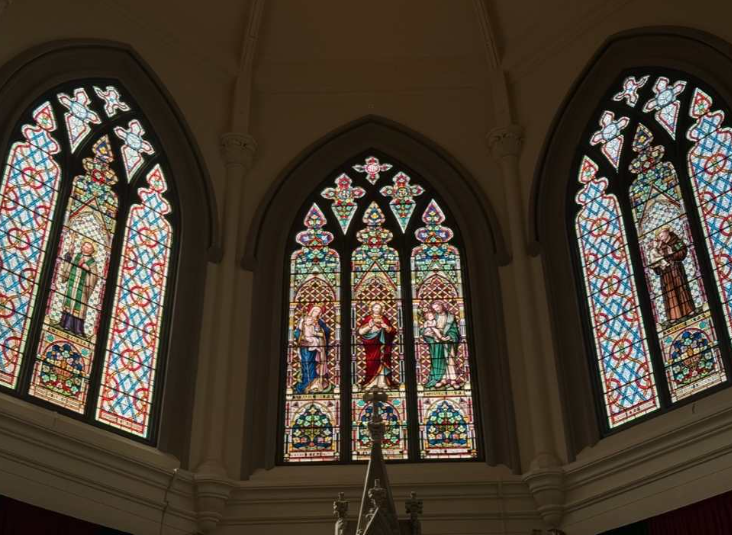
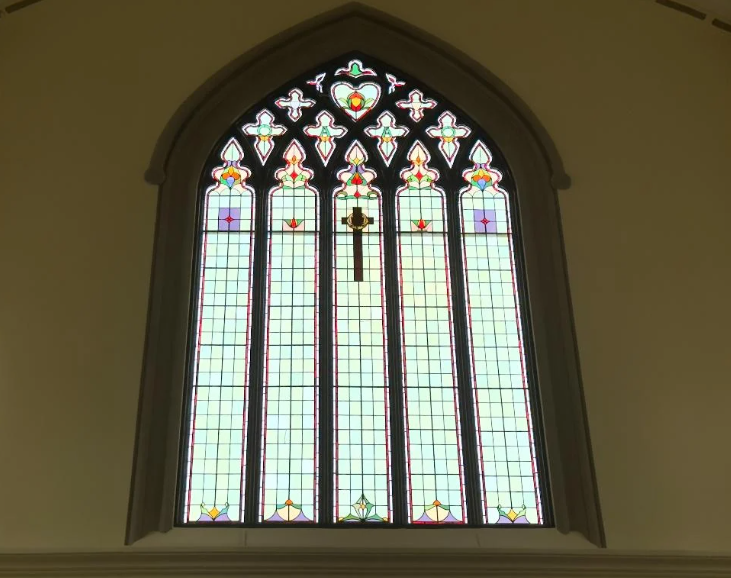


These striking windows were crafted by Jules Dobbelaere, a renowned Belgian stained-glass artist widely regarded as one of the finest of his era. He was also responsible for the equally celebrated windows at the Former Convent of the Holy Infant Jesus Chapel, further cementing his legacy in Singapore’s religious architecture.
Opening hours
Regular visiting hours are 10am to 7.30pm on weekdays, and 9am to 7pm on weekends.
Admission
Entry is free.
[[nid:726942]]
This article was first published in Wonderwall.sg.
Read the full article here