





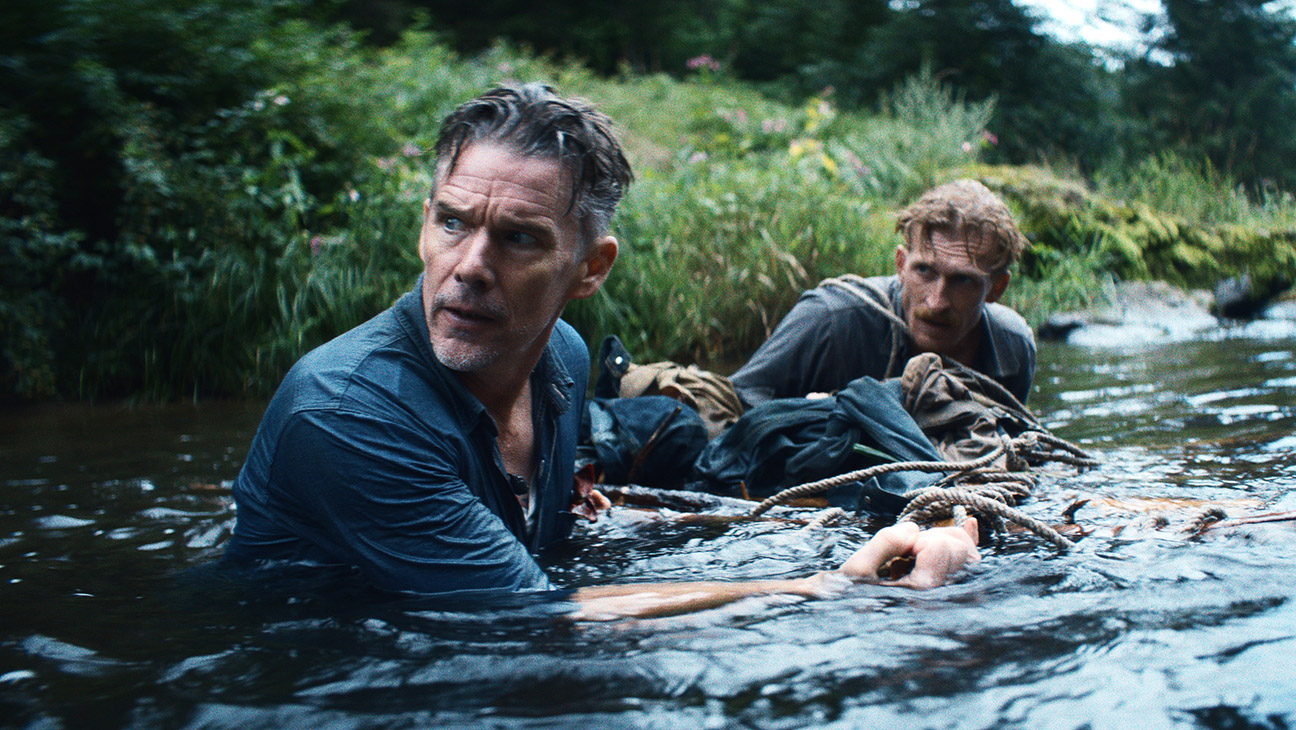


An original saga with novelistic roots in Great Depression Americana and classic Westerns, Padraic McKinley’s first feature, The Weight, in theory has a lot going for it — a vivid evocation of the rugged Oregon wilderness in 1933, an atmospheric score, a pair of leads with the requisite gravitas in Ethan Hawke and Russell Crowe, playing driven men on different sides of the law. The director also sticks some creditable influences on his mood board, William Friedkin’s Sorcerer being the most obvious of them. Aiming to emulate the introspective action-adventure survival thrillers of the 1970s is no bad place to start.
But grit, rawness and dirty-realist poetry can be elusive elements to conjure, even in a production that cultivates those qualities with a rough-and-ready feel for the scrappy, sweaty storytelling of another era. Ironically, despite such juicy elements as gold, greed and survival, The Weight lacks weight. For a high-stakes drama that throws a small band of desperate, downtrodden men into an environment of ruthless thugs and crooks in authority positions, requiring considerable stamina and wiles just to stay alive, it’s absorbing but seldom genuinely gripping.
The Weight
The Bottom Line
Well-acted but murky and underpowered.
Venue: Sundance Film Festival (Premieres)
Cast: Ethan Hawke, Russell Crowe, Julia Jones, Austin Amelio, Avi Nash, Sam Hazeldine, Lucas Lynggaard Tonnesen, George Burgess, Avy Berry, Alec Newman, Cameron Brady
Director: Padraic McKinley
Screenwriters: Matthew Booi, Shelby Gaines
1 hour 53 minutes
The movie’s strongest asset is the charismatic Hawke in a role tailor-made for his weathered screen persona, soulful depths and naturalistic less-is-more approach. (Hawke this month scored his fifth Oscar nomination, shockingly his first for lead actor, in Blue Moon). Julia Jones also impresses as an Indigenous runaway from a harsh school where she was being trained for domestic work and presumably abused.
Hawke plays Samuel Murphy, a widowed father struggling to provide for his young daughter Penny (Avy Berry) and shield her from the harsher realities of the time. When they come home from church to find an eviction notice on their door and their possessions stacked up on the tenement landing, Murphy places himself in danger to keep a roof over their heads. A violent altercation ensues and he’s arrested for the “crime” of self-defense.
Murphy is sent to a Deschutes County convict labor camp run by shady Warden Clancy (Crowe), charged with clearing rocky terrain for construction. A war hero with a knack for mechanical ingenuity, Murphy gains Clancy’s favor when he rigs a way to dislodge a stubborn boulder and offers to get the warden’s glitchy car running again.
Played by Crowe with a glint in his eye that marks him as a corrupt, opportunistic man, Clancy’s detailed familiarity with Murphy’s history includes the knowledge that Penny, who became a ward of the state when her father was imprisoned, will be put up for adoption before his release. That’s unless his sentence is commuted, something Clancy has the power to do if Murphy helps him out with a secret assignment.
Mines along the Oregon Trail are being shut down and all gold will be confiscated by the FDR government to help combat the Great Depression. Clancy and his accomplices have a plan to remove a substantial haul of gold bars and have them illegally transported across treacherous terrain to a safe pickup point, a journey that will take six days. Clancy tells Murphy to choose three fellow prisoners he trusts to provide the necessary manual labor in exchange for their early release.
Clancy prepares Murphy for the worst by informing him that people will cheat, lie and kill for gold, while the armed men (Sam Hazeldine and Jeffrey Lee Hallman) accompanying Murphy’s group warn them that if even one bar of gold is unaccounted for, they will be shot. When Jones’ character Anna escapes the school, she tags along with the men for her safety. But while she cooks and tends to wounds with Native plant remedies, she makes it clear with steely-eyed defiance that she will not be anyone’s plaything.
This all sounds like the setup for the kind of tense action-adventure — old-fashioned in the positive sense — that would have landed right in the wheelhouse of John Boorman, John Huston or any number of revered filmmakers of the past known for depicting human conflict in nature. It’s a big reach for editor turned director McKinley, who brings too little dimension to most of the characters and too little suspense to the hazardous journey.
That’s no fault of the actors, including Austin Amelio as the wiry Rankin, the cagiest of Murphy’s group and the cause of much friction and betrayal; Avi Nash as Singh, who proves himself valuable and rises above the occasional anti-immigrant slurs and side-eye; and Lucas Lynggaard Tonnesen as Olson, a tender young Scandinavian family man whose arc brings a resonant element of tragedy.
McKinley acquits himself capably enough with the few complex action set pieces, notably when a tattered rope bridge across a deep gorge requires enterprising thinking and physical endangerment of Murphy. The big sculptural score by co-screenwriter Shelby Gaines and his brother Latham — with passages of clanging, droning, rattling mechanical sound that could be modern or from a century ago — is effective in sequences like that one.
While most of the men are focused on their freedom or monetary gain, Murphy’s sole purpose is to be reunited with his daughter before she disappears into the system. He’s an honorable man in a milieu in which honesty is in short supply, and Hawke gives him a rich, melancholy interiority without making him a saint. There’s gorgeous understatement, too, in Murphy’s warm rapport with Anna, suggesting just the faintest flickers of mutual romantic attraction.
The climactic scenes get a little chaotic, with deaths and double-crosses and even a redemption before the story circles back to Clancy. But although The Weight is low on excitement, it ends on an affecting note that makes you wish the sluggish movie had been given more lucid storytelling, as well as more dramatic and emotional power. In that respect it suffers by comparison with last year’s Train Dreams, which has some overlap in period, geography and themes but far more visual and narrative eloquence.
Read the full article here