
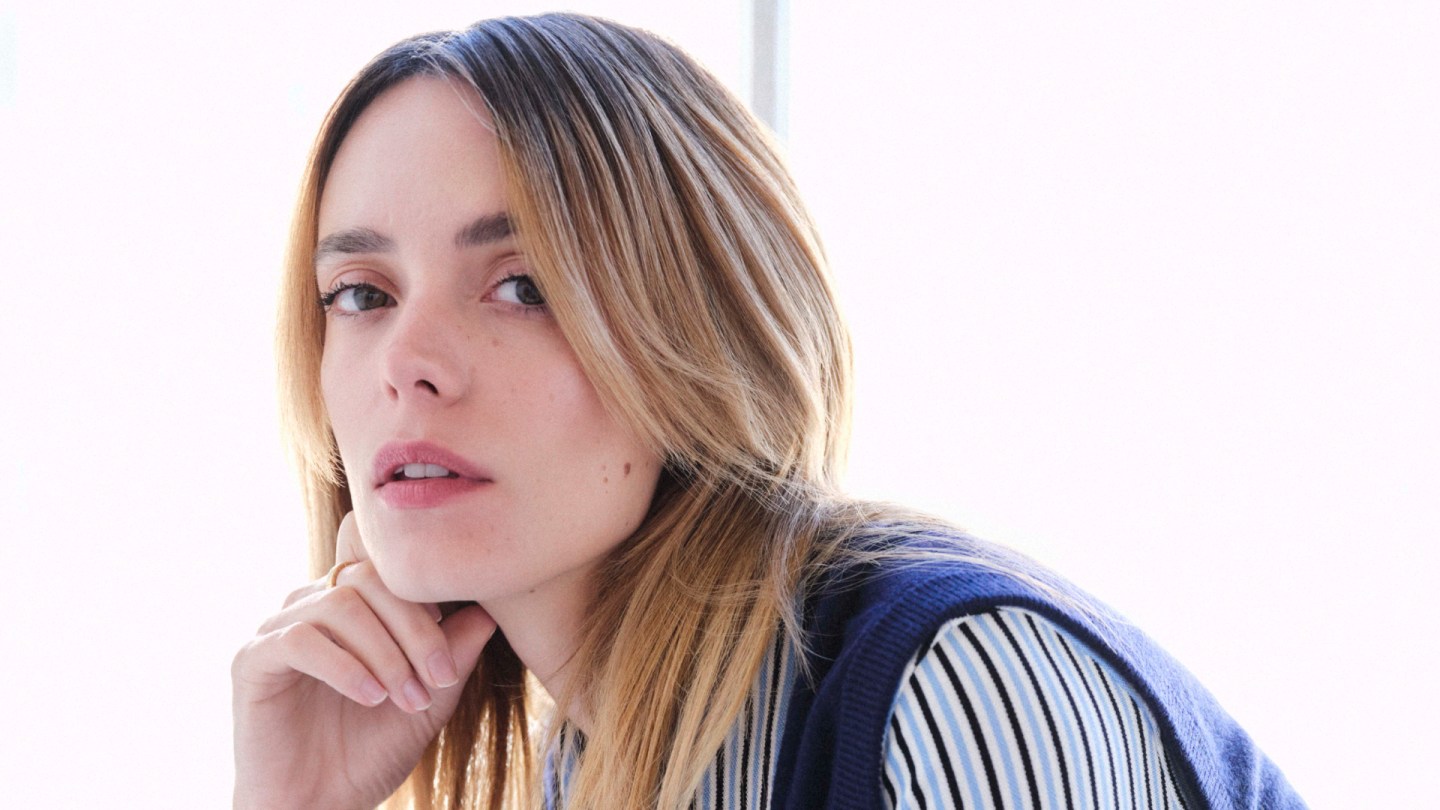


Stacy Martin’s been on the Corbet-Fastvold train longer than any of us.
The half-English, half-French actress starred in Brady Corbet‘s first feature film, The Childhood of a Leader, a decade ago. The coming-of-age psychological drama was co-written with his partner, Mona Fastvold, who has co-authored each of Corbet’s three movies. The latest of which, you might recall, was the Oscar-winning historical epic The Brutalist.
Martin, too, had a key role in The Brutalist: She played Maggie Van Buren, daughter of Guy Pearce’s wealthy, snobbish businessman. It makes her a regular fixture on the call sheet of independent cinema’s hottest new power couple — from Childhood of a Leader to Vox Lux and the Adrien Brody-starring architectural drama, Martin’s been privy to the inner workings of Corbet’s “going to war” mentality and Fastvold’s more “nurturing” approach for some years now.
“They’re very complimentary, and you can feel it in the script,” Martin tells The Hollywood Reporter about working with the duo. “There’s push and pulls and you see similarities, but then you also see differences… When they talk, they talk about the same things,” she says, “and they could talk to each other for hours, because they’re so in sync on that.”
Martin got to bear witness to their creative genius again while shooting Fastvold’s directorial debut, co-written with Corbet and out Dec. 25 in the U.S., Searchlight’s The Testament of Ann Lee. Led by Amanda Seyfried, the film follows the female founder of the religious Shaker movement in the 18th century, all the way from the sect’s origins in Manchester, England to their swaying worshippers in Massachusetts.
Martin stars as Jane Wardley who, with her husband James, preached radical religious ideas to Ann and her family that would go on to inspire the Shaking Quakers, characterized by their erratic dancing and, well — shaking. “You latch on to tiny bits of information,” Martin says about trying to uncover who the real-life Jane Wardley was. “We know that she existed… But we don’t really know how she felt or why it was so important for her to really stand her ground. We didn’t know much about her relationship with her husband. It’s fascinating because you’re delving for clues, being a detective.”
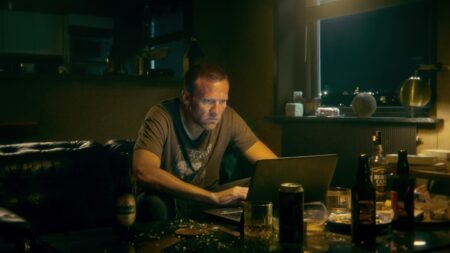
That’s not all Martin’s got in the pipeline. Premiering at the Berlinale in February was Jan-Ole Gerster’s mystery-drama Islands, about a British tennis coach (Sam Riley) living abroad at a resort on the island of Fuerteventura. When a young married couple (Jack Farthing and Martin) come to stay with their son, Riley’s character soon finds himself embroiled in a dramatic missing persons case.
Elsewhere, the actress is part of a star-studded ensemble for Working Title’s Sense and Sensibility adaptation arriving next year, led by Daisy Edgar-Jones and George MacKay. Georgia Oakley directs the period piece with Martin as the calculating Fanny Dashwood. She’ll also play English fashion designer and socialite Daphne Guinness in Alex Marx’s upcoming The Queen of Fashion, alongside the likes of Andrea Riseborough, Richard E. Grant, Dane DeHaan, Fionn O’Shea, Emily Beecham, Ncuti Gatwa, Miranda Richardson and Michelle Dockery.
Below, Martin talks to THR about The Testament of Ann Lee and the exciting year that awaits her. She discusses why Fastvold’s first foray in the director’s chair is, “at its core, a very feminist film” and how she refined that not-so-easy-to-tackle Mancunian accent. She also dives into Sense and Sensibility, The Queen of Fashion and which scripts are piquing her interest now she’s had her cinematic taste validated by the critical acclaim piled on Corbet and Fastvold: “I just love playing characters that are as confusing as possible.”
Hi Stacy. This is certainly not the first time you’ve worked with Mona, but how did you come aboard The Testament?
Actually, it is the first time I’ve worked with Mona as a director! I worked with Brady, obviously, and she’s worked on all of the scripts. We’d been talking about it for a long time, and we weren’t quite sure how that would come to fruition. Then she was talking about this crazy story, and what strikes me the most was just how little people knew about it, and how much poetry and art was within that community. For me, in terms of just when you look at religious movements, art sometimes doesn’t have a strong place. I just love the musicality of it and how Mona was talking about it. And I thought, ‘Well, if there’s anything for me in it, where I can really do something quite different, I’d love to be involved.’
We spoke about it and and we talked about Jane, and I just loved the idea of playing this character who’s at the very beginning of someone’s inspiration. I think we’ve all had those people in our lives that spark us to become who we are today or who inspire us, and sometimes it’s negative and sometimes it’s positive. For me, Jane was a real opportunity to show that female roles can inspire other female leaders. There’s this weird thing going on that [people think] women are very competitive and there’s not enough space for more than one, which I think is absurd. But I really liked the fact that it was these two women who saw something within each other and gave each other what they needed.
It’s really interesting, because as Mona and Amanda have said, this is a deeply feminist film in lots of ways and that was what really attracted Mona to this figure of Ann Lee. How much did you know about her? Were you surprised to know about her life and what she achieved?
Absolutely. I think that’s the joy of filmmaking and storytelling. I’d love to think that I know a lot of things, but I’m also always really curious to learn. And I think what Ann Lee did for a specific time within that community — I mean, obviously it had its pitfalls, the fact that there are only two or three remaining in the world [today] — but what they tried to represent: This idea of community, this idea of equality, and especially at a time where civil war was going on and racism was very strong. I think it was extremely modern for its time.
It’s probably a good film to get out into the world now, when it feels like we’re so in need of strong female leaders.
Yeah, I agree. What’s exciting about this film is, at its core, it’s a very feminist film. But I do find it is so watchable by many audiences, because it has so many elements that are exciting in terms of the dancing and the singing, and there’s a lot of huge, quite tongue-in-cheek in moments. Then it’s quite dramatic in other moments. There’s all these action sequences, almost, because the movement [and] the physicality and the camera is so pacey. I think it’s exciting because it inscribes feminism as a norm in storytelling. I think we’ve normalized the male gaze in cinema for so long that we barely see it. This is a really beautiful film. It is a female gaze and feminist film, but it’s not. I think it’s done in a very weirdly subtle way. Because I know the film is not subtle, but I think the message of it is very elegant.
Was Jane a real person?
Yeah. The Wardleys were real. There are a few mentions of them when you do a bit of research, and it’s quite fascinating, because you just latch on to tiny bits of information. Then you have to build because there’s only so much that you can [find out], especially at that time — unless it was someone writing about themselves. With information or how things were recorded, it’s very factual. Yes, we know that she existed. We know that they didn’t go to Massachusetts, we know that they had certain benefactors, but we don’t really know how she felt or why it was so important for her to really stand her ground. We didn’t know much about her relationship with her husband. It’s fascinating because you’re delving for clues, being a detective.
How much of it was your interpretation of Jane?
This was so long ago, so there are no pictures of her. We don’t have any reference point for her. So that gave me a lot of freedom, and definitely didn’t stress me out as much as, [for example], I recently played Daphne Guinness in a film called The Queen of Fashion and she’s very much real. She’s very much still around, she’s very striking and she talks a certain way, and that’s a whole different exercise… Whereas with Jane, the only thing that we could really latch on to was […] the line about [how] her and her husband don’t touch each other. I can’t remember what it is exactly, but they don’t touch each other “like little lambs” or something. We found that in some writing.
It’s those little nuggets that you have to take and run with.
And Mona, she’s such a brilliant writer as well that it’s also about what each character can give to one another. I think Jane was there to give Ann the confidence and the strength that she can be a leader and to follow her instincts and to follow her beliefs. For me, that was a big tow for Jane because she’s also someone who’s very maternal, and she’s someone who wants to get people together. She has this wonderful, loving husband, and they’re a bit kooky. At that time, that kind of couple didn’t really exist. But I think they created a community for people to really just be truthful in who they were, and [Ann Lee] really saw that and respected it and wanted to take it further.
What was it like tackling that Manchester accent? It’s probably not the Manchester accent that we know today, right?
Well, that’s the thing. We worked with [dialect coach] Tanera Marshall and she’s so wonderful. She worked with us on The Brutalist. Obviously, how on earth do people talk in Manchester in the 1700s? We listened to the earliest recording of the oldest person at the time from that area. And then it was a lot of mills, a lot of workers, so [Marshall] created this accent where we could locate all these people, but where we could also homogenize the film, as a sound. It’s sort of an interpretation of what would have been. I find accents incredibly hard, but they are also extremely helpful as a stepping stone for a character. That and costume, for me, are two things that I find really helped me get away from… me!
I was really impressed. And even with Amanda, who has to anchor the entire film and is coming at it from, arguably, a more difficult place than a Brit.
Oh, good. It’s so scary when people from Manchester or those areas [watch]. All of my northern friends, I was like, “I can’t be with you in the room!” But it’s amazing. I think Amanda loved the story so much, and loved the character so much. And I think her love for it really showed through her commitment. Because it isn’t easy. And there was dancing, there was singing, there was performance. And I think it’s also a testament — no pun intended — to her and Mona’s relationship. It’s incredible to see two women trust and push format and storytelling in this way. It isn’t easy, but it’s so exciting to see.
It’s amazing to see Mona take control. You were on set with Brady and Mona when he was directing and she was a co-writer on The Brutalist. What was her presence like then compared to The Testament, where she was really captain of the ship?
Listen, they write together, they have a child together, so there is a similarity in the tone of how they work, how they create their teams, and how they treat people and what’s important to them. For me, having known them for 10 years, it didn’t feel different, necessarily. What I would say is different is Mona has this very Jane Wardley element to her — she loves getting people together. And you can feel this sense of the mother, and not just a mother and children, but a mother who just encompasses and who cares and who nurtures. There’s something very specific, I think, about Mona in that sense. It’s quite delicate, and it’s really beautiful. And I’d say [with] Brady, you’re going to war. [Laughs.] I mean, it’s terrible stereotypes. It’s a different tonality, but at the same time, it’s not that different.
Sounds a little yin and yang.
Yeah, they’re very complimentary, and you can feel it in the script. There’s push and pulls and you see similarities, but then you also see differences. And I think that’s a really beautiful thing, that they can give each other the space to coexist together. When they talk, they talk about the same things, and they could talk to each other for hours, because they’re so in sync on that.
It must be so satisfying for you, as an actor who’s been witness to their genius for so long, to see them now getting the commercial success and critical love they deserve.
Yeah. I think I’ve always made decisions from the heart, and I’ve always made decisions through instinct. I’m very bad at making decisions because maybe it’s good for my career or it will help me pay more bills. I’ve been very fortunate to make decisions with people that I find really inspiring and and I think seeing Brady and Mona have, like you said, this recognition, it’s almost validation. For 10 years, we’ve been making these films, and we’ve been trying to create a community of artists that want to make films the way that they want to make them… The fact that it’s now being seen and that people love them, it refills the tank a little bit. And especially as an actor, I sometimes read things and I think, ‘Oh, why am I doing this? What’s the point?’ But then you do read beautiful scripts, and you think, ‘Okay, there’s hope in the
arts.’
I think we live in crazy times, and everything’s so up in the air, and everything is incredibly broad and tense, and art has a special place to tap into our emotional selves in a way that other things don’t. So it’s important. I think you see it with the films that come out, The Brutalist, The Testament of Ann Lee, but you see the scope of what films people start talking about and it’s so exciting. The fact that the Safdie brothers, for example, their films keep getting traction. These independent filmmakers are now operating on the table that studios used to run, and I love this medley of different styles of filmmaking.
It’s what we need. It’s what the culture needs.
Yeah, I think so. And I think it’s possible. For so long, they’ve existed so far away from each other, and it’s almost been one or the other. I think there’s a strange morphing because the way technology has evolved and the way people watch things has evolved, and it’s exciting. For example, I was in Sense Sensibility this year, directed by Georgia Oakley, who comes from an independent film background, but it was a Working Title film. And the two put together is a really exciting combination that might not have existed maybe five or 10 years ago. So I think there’s something happening which I’m excited about.
What can you say, if anything, about Sense and Sensibility?
Not much. [Laughs.] But what I can say is that I last read Sense and Sensibility when I was at school. Obviously Jane Austen is such a wonderful writer, and I was so amazed at how relatable this adaptation was without ever losing the core of what Jane Austen wrote. The script was really beautiful, the other actors were really incredible, and it’s going to really give this version, I think, a beautiful sensitivity to it. All these puns today!
For anyone who has loved Jane Austen or who’s loved the film or the TV series, it’s so within the same world and I think it really magnifies all of the beautiful detailing that the book had. I’m really excited about that.
Lastly, a couple of questions on Islands which premiered in Berlin earlier this year. Such a good crop of British talent. What led you to this project?
It was Jan-Ole, the director. He reached out to me, and we spoke a lot about it. And initially the part was a bit smaller, and I knew what he was going for, but I couldn’t quite feel it in the script. [But] every time we spoke about it, I was like, “This is really exciting,” and I thought there was such scope to play this character as someone who… you just never know where she is. She’s on such unsteady ground that as a viewer, you want to feel that, and you want to be uncertain about her the whole way. And he worked on the script a little bit, and then sent it to me, and I just was really excited.
Now I’ve been doing this for 10 years, I just love playing characters that are as confusing as possible. Or that have a quirkiness, or that you see them at a point in their lives that is in danger. I mean, especially in Anne’s case, her actions don’t make much sense, but they are based from survival, because she’s at such a low point in her life. Creating that and going through the genre of film noir was really fun because you can distort and amend the reality of how people see things.
There was this unexpectedness and this whiplash that I really enjoyed. And those questions over who is Anton’s real father… I was rooting for Tom!
Definitely. I think the great thing is treading the line on, “Is it him?” But I don’t even think she knows. I think that’s also the root of her going to that place. I don’t even think she knows if he’s still there, but for some reason at that time in her life, she felt something, and she needed to get back to it. Maybe she’ll get the answers that she needs. But I think the issue is that she goes back, [but] she goes back to another reality. She’s become another person. She has a family, she has a husband, and the answers she’s looking for… I think she didn’t quite go [with] the right questions. So it sort of spirals.
You want a resolution, but I think where the film has such grounding is that it also shows how truth is so malleable in a strange way. Your truth or my truth can be different. It doesn’t mean that one is better than the other. There’s scientific facts, of course — one plus one is one. But I think in terms of how we choose to live and what we do with our lives, it can just vary so much. Where the film is also really interesting is Jack Farthing’s character. He could have been played in such a horrible, cold and unemotional way. And I think what Jack did so well is that he is an idiot and he’s definitely an asshole at times, but there’s so much pain and you also have so much empathy that suddenly you’re looking for an evil in the story, and you can’t find it.
All of these projects: The Testament, Sense and Sensibility, Islands and the Queen of Fashion are so different.
They’re incredibly different, and I think it’s a wild world where you work with different people. I’ve been so lucky, because all of these are just so unique in their own style. I can talk about this, I’m very shy about it. But I did direct my first short film two months ago, so I’m in the edit room now.
Oh wow — that must have been so cool.
It’s taken me a long time to do it. I love working with directors so much that I never thought of being able to do it. And I’ve had this story in my mind, and it’s been an incredible journey of collaboration and creating a story. I had Diana Quick and Emily Beecham as my actresses, and it was really inspiring. So I’m really enjoying that. I’m hoping to be done soon, but I don’t want it to be done because I’m enjoying the process of it.
Would you like to direct a feature-length film one day?
If the story is right, yeah, of course. I’ve loved collaborating with people, and this is just another form of that. So definitely.
The Testament of Ann Lee is in U.S. theaters Dec. 25.
Read the full article here