



[The following story contains spoilers from the season two premiere of The Pitt, “7:00 a.m.”]
When The Pitt shared the opening footage of season two with viewers eager for a fresh glimpse of the hit medical drama, scenes of Noah Wyle’s Dr. Michael “Robby” Robinavitch riding a motorcycle to work were quickly met with variations of the same comment: Why isn’t Dr. Robby wearing a helmet?
Particularly for The Pitt, with Wyle and others on the show stressing accuracy, showing the main character doing something that many ER docs say they would never do was a surprise.
But, fear not, Pitt fans, all will be revealed.
Showrunner R. Scott Gemmill and executive producer John Wells say the choice to have Robby biking in a more dangerous way “was by design,” Gemmill says, and to show that he was doing something he shouldn’t be doing.
“It shouldn’t be how he is,” Gemmill tells The Hollywood Reporter. “Pennsylvania is a no helmet law state so you can ride without a helmet. And some people do. Robby shouldn’t, and it really goes to his mindset at the time. And we’ll see more of that as the episodes progress, in terms of maybe why he is doing what he’s doing.”
Showing Robby on his motorcycle was also a way of conveying what Wells and Gemmill have seen over their decades of writing about medicine, first on ER and now on The Pitt, that many emergency doctors and nurses are “adrenaline junkies.”
“It’s one of the things that they love about the ER: there’s this stuff coming at you,” Wells says. “ER docs are oftentimes also skydivers, base jumpers; they dive to ridiculously low depths in ice cold water for fun. They are climbers. It’s who they are. They like the thrill of it.”
The producers are also well aware of the hypocrisy in what emergency department staffers tell people to do and what they actually do, noting that another top no-no from emergency physicians and nurses is not to smoke.
“And when you go to an ER, there are a ton of [smokers] outside,” Wells says. “So there’s an awful lot of doing what I say, not as I do with ER physicians.”
Without giving away specifics, Wyle, who also serves as a writer, producer and director on this season, teases that there are some contradictions in how the characters appear at the start of the season and how they act later on.
“I think, in a perfect world, if we’ve done it appropriately, we spend the first half of the season with everybody coming in and projecting exactly what they want to project. They are presenting themselves as the people that they want to be perceived as being,” Wyle says. “And then, if we’re successful, the second half of the season takes everything that we’ve just described as positive or at face value and deconstructs it in a way that looks at it through a little bit more of a intense lens and sees it more as the pathology that really is.”
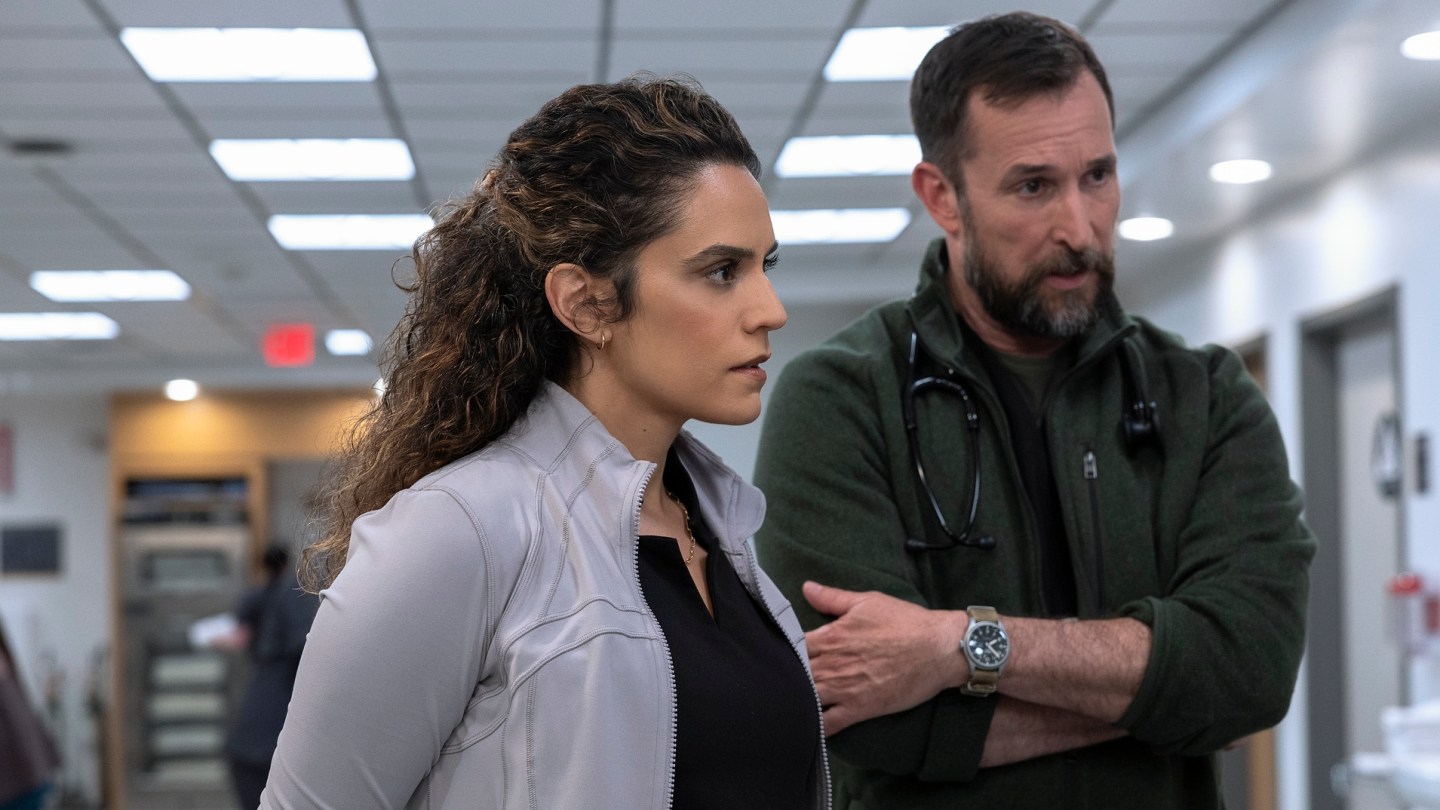
When Robby arrives at Pittsburgh Trauma Medical Center to start his July 4 shift, his last before a planned sabbatical, he quickly meets the new attending set to fill in for him while he’s away, Dr. Baran Al-Hashimi (Sepideh Moafi), who came in early and is full of ideas for changing how the emergency department operates, rapidly generating tension between the physicians.
“I think when they first meet each other, she’s been briefed. She knows what she’s walking into,” Moafi tells THR of what Dr. Al-Hashimi thinks of Robby. “Despite her prep, she’s still taken aback, I think, by the cowboy nature of the pit and his leadership style. It’s a bit more sort of a messy, chaotic, and by her definition, maybe a bit unprofessional. Like in the first trauma scene, the way they’re talking to each other, the way he relates to to the residents and interns. But ultimately, she’s fascinated by him. It’s somebody with a radically different approach. They are diametrically opposed in so many ways. And yet the goal is the same. It’s about the patients. It’s about delivering the best care and healing to the best to our abilities. So yeah, I think at first, it’s not like she’s a stranger to being questioned or challenged or undermined. I think most women in the workplace or in positions of power, in particular, are used to that. So she’s used to that, but she’s not used to this completely unpredictable, live-wire human being that she’s she’s interacting with. It’s kind of like, when they first meet, they’re two animals in the wild, who circle each other, sniff each other, and as time goes on, they sort of like come together and then are about to sort of jump on each other and then go apart. So it ebbs and flows, their dynamic.”
The character of Dr. Al-Hashimi, an AI proponent, Gemmell and Wells say, was created both to tackle the existential issue of how AI is affecting various industries and “to put a little more pressure on” Robby.
“it’s part of our lives now, and it’s encroaching in basically all aspects,” Gemmill says of AI. “And the emergency department is no different. And so we wanted to introduce it. We thought it might be fun to introduce it through a character who’s very tech-forward and thinks that this is a great thing for the emergency department and sort of create a little bit of conflict between her and someone like Robby, who’s much more old school and is, like some of us, a little reticent about what’s going to happen with AI, whereas she’s someone who’s embracing it. So it just creates a little more conflict between the two of them.”
Gemmill adds of the Robby-Dr. Al-Hashimi dynamic, “He’s used to being large and in charge. It’s his ER. And the thought of them bringing in another attending is going to create a little bit of awkwardness and possible friction, depending on their personality. And that personality is a little bit at odds with Robby at times. She’s much more sort of progressive and very AI forward, and he’s a little bit more conservative and old school. And that’s, that’s sort of how they approach the medicine as well. So it just was to add a little bit of a fly in the ointment to complicate what’s theoretically his last day for a while.”
Moafi says her role as Dr. Al-Hashimi has also made her “rethink” her view of AI.
“For doctors, they are overburdened, and there is a clear consequence, the suffering of the mental health for physicians, and that’s because there are too many patients and not enough time to care for patients,” she says. “And so if we’re able to delegate some responsibility, allow AI, with the supervision of nurses and doctors, to take over more of the admin responsibility, then the doctors can attend to their patients more effectively. I think 28 percent of a physician’s time is spent at the patient’s bedside. The rest of the time is admin, paperwork, all these things. So if we’re able to change that up a bit and increase time at the patient bedside, increase time for physicians to take care of their own lives, their mental health, I think everybody wins in that situation. So it seems a bit more radical, but the more you scratch past the surface of her approach, it’s actually deeply grounded in humanity. She just wants for people to be cared for more efficiently, both as the patients and the doctors.”
Specifically it was in reading Eric Topol’s Deep Medicine, about using AI in medicine, where Moafi says her feelings about AI “started to crack a bit.”
“I had harsh judgments towards towards AI, and that’s when I started to kind of rethink things,” she tells THR. “He discusses a number of studies, a number of cases where AI has caught a diagnosis, for example, that doctors have missed because of burnout, because we are human, and we draw from experiences that we know, that are familiar to us, and sometimes we let things slip through the cracks, and so that kind of changed my perspective.”
Beyond that, Moafi says, in addition to consulting with Gemmill and Wells about Dr. Al-Hashimi’s past and future, she “spoke to as many doctors as I could,” including shadowing one in an emergency room.
Though Dr. Al-Hashimi has a tense relationship with Robby, she has at least two fans in the pit, in former VA colleagues Dr. Samira Mohan (Supriya Ganesh) and Dr. Mel King (Taylor Dearden).
“They’re so aligned in the way they approach patients,” Ganesh says of her dynamic with Dr. Al-Hashimi. “I think she’s maybe even gotten a lot of inspiration as to what type of doctor she is from Dr Al-Hashimi”
“She’s calm, and she’s really good at words of affirmation,” Dearden says of Dr. Al-Hashimi. “And so when Mel needs encouragement, she’s there. I find also the way they write her [dialogue] is so succinct at all times, it’s the kind of person, like a professor, who really thinks about everything she says, but it comes out in such a way that is really giving a lot of ease to us, our characters.”
Season two also finds young physicians Samira, Mel and, now an official doctor after being a med student in season one, Whitaker (Gerran Howell) more confident in their work.
“I think Whitaker’s really stepped into his role,” Howell says. “He’s kind of shed a lot of the fear of that nightmare of a first shift, as you would kind of have to do to survive in that environment. Yeah, it’s a really cool time jump, because they’ve given me the opportunity to go from Whitaker in season one to now teaching [med students]. It’s kind of insane to me to be a teacher.”
For Dearden, that confidence comes from Mel no longer being “fumbly” or having her nerves or “first-day jitters” get in the way of her work as a doctor.
Now, she says, Mel has “more of a hold on everything — except for today, the day we see, of all days, being when all that confidence comes crashing down.”
And for Samira, she’s still affected by the “complicated moment” of season one’s Pitt Fest mass casualty incident.
“You’re a hero, but a really bad thing had to happen for you to be a hero, and it kind of makes you realize what is lacking in your life,” Ganesh says. “So I think there was a lot of bad that came from it, but I think one of the good things is that I think she feels like she could trust herself. At least at the start of the shift, you see that, whether that lasts, you can watch the rest of the season and see how she does.”
Gemmill, Wells and Wyle have all talked extensively about how they’ve consulted with experts to depict real-life issues affecting health-care workers, and this continues with season two, with the writer-producers already teasing exploring how mass layoffs and funding cuts as well as changes to Medicaid would affect the cases and characters on The Pitt.
In terms of filtering out which issues in medicine could be explored, Gemmill says it comes down to “finding these stories we want to tell, and then figuring out who are they best told through, and how are they going to affect that character.”
“And so the character arcs are really what we lay in first and then find the medicine often to fit around that, as opposed to just doing these big medical stories because they have to have something else going on within them to make them more than just a medical documentary,” he says. “So it’s really about how they affect the characters and are affected by the characters.”
One real-life non-medical issue that could affect The Pitt is the proposed Netflix deal to acquire Warner Bros., with The Pitt being produced by Warner Bros. Television and streaming on Warner Bros. Discovery’s HBO Max platform. After its Emmy-winning first season, The Pitt was just renewed for a third season ahead of season two’s premiere and has been characterized as a model of the type of programming now being developed as Max Originals.
When asked their thoughts on the deal, two days after it was announced last month, Wells, who has a long relationship with Warner Bros., says, “We make shows, and we’re hopeful that we will continue to be able to have whatever the distribution system is and that there will be people who want to make those shows. Do I personally have concerns? My concerns are about, will it be a reduction in the number of places that we can sell shows? And who will support shows? I’ve been at Warners a long time. This will be the fifth sale that I will have been around for, and we’re still making shows. We’ve been making shows the whole time. So the assumption is, as long as they let us make them, we’ll keep making them. But it’s a scary time in the businesses as a whole. Many, many people out of work and lot of uncertainty, and so, for all the people that we work with, we understand that everyone’s concerned. Whether this is the right merger or not is far beyond me to say but something was going to happen because of what’s happened with streaming.”
Wyle adds, “I have no idea what the ripple effect is going to be. I don’t know that anybody does really. It’s going to be a long transition process. It’s not going to happen overnight. I’m pretty sure that whoever is in charge will view The Pitt as a crown jewel worth maintaining, I hope. But we’re seeing seismic shifts in our industry. We’re seeing huge pillars fall. Giant sequoias are dropping around us in ways that we never thought we’d ever see, and that’s scary. And if you’re a sentimentalist or a historian, or a history buff, like I am, it’s kind of sad, but change is inevitable, and I believe that this consolidation is going to create a whole other industry as a result that’s going to be probably more grassroots, probably more democratically run, and it’ll find its own distribution system and its own way of supporting itself, and probably look a lot more like the early movie business back when it was invented, which would be exciting, interesting.”
HBO Max has been releasing new episodes of The Pitt weekly as opposed to dropping an entire season’s worth of episodes at once as Netflix has traditionally done for its series. And Wells and Wyle have expressed support for that rollout, which is more consistent with the cadence of a traditional, network series.
“I think it’s good for people to have anticipation and look forward to something,” Wells says. “I like the old-school approach well, and I think that audiences approach different shows in different ways. So I think for this show, for people to be able to kind of watch it on a weekly basis, talk about what they saw, the anticipation for it coming up. People want shows to be their show, you know, to be able to say, ‘This is what I watch. I have an appointment that I go and watch it.’ It’s always available. And there were plenty of people who caught up and streamed it once they had all been on the air. But there’s a large, sizable part of the audience that really wants to have that connection to it and look forward to it every week.”
New episodes of The Pitt drop Thursdays at 9 p.m. ET/6 p.m. PT on HBO Max ahead of the season finale on April 16.
Read the full article here