





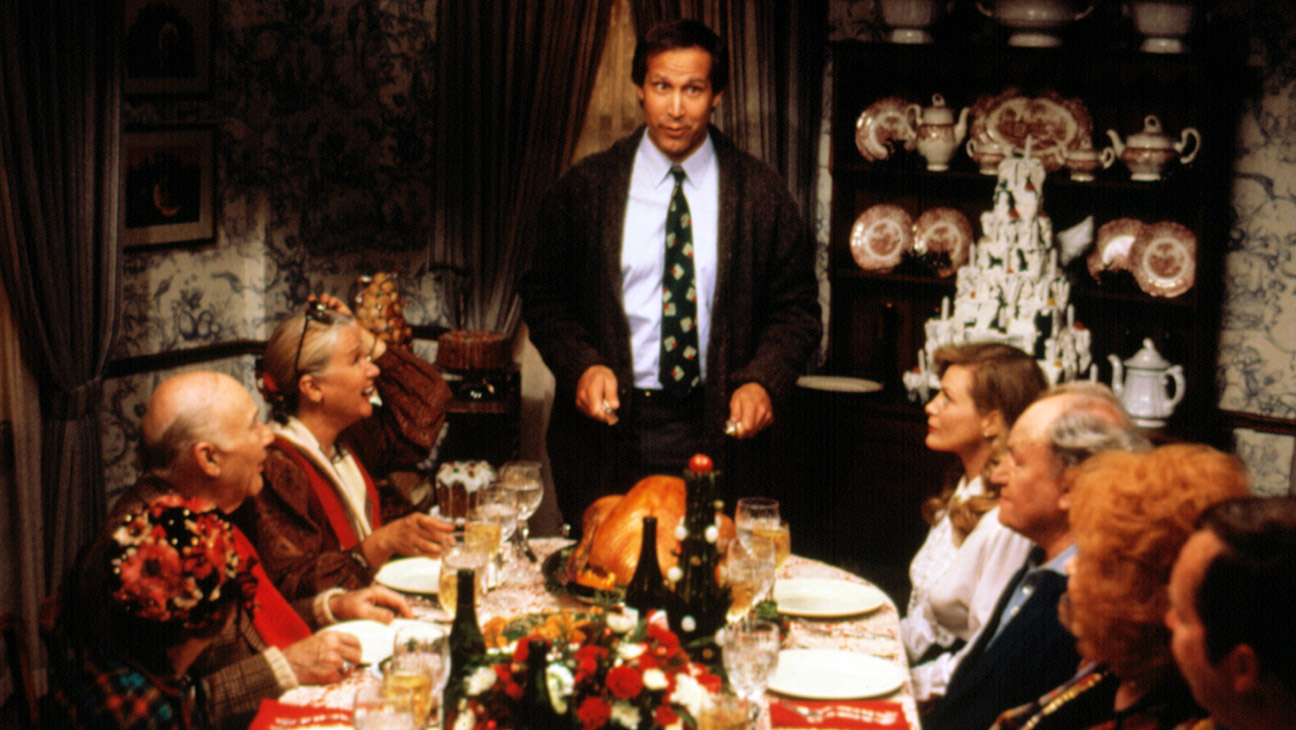


Picking a favorite line from National Lampoon’s Christmas Vacation is nearly impossible, so let’s just go with the one that struck me this year. Chevy Chase’s long-suffering Clark W. Griswold is grocery shopping with his sweet but repellent cousin-in-law Eddie, played by Randy Quaid. As they small-talk about work, Eddie asks, “Your company kill off all them people in India not long ago?” To which Clark replies, “No, we missed out on that one.” I’ve seen this movie easily dozens of times, and I’ve never before picked up on the casual horror of Eddie’s barely interested question or the way Clark reframes the slaughter as a missed opportunity. Next year, a different line will jump out at me. There’s a nearly endless supply.
John Hughes’s Vacation films are unique in his oeuvre as a screenwriter, in that the jokes take priority over the plot; by the end of the movie, it’s hard to believe that this won’t happen all over again next Christmas, next Easter, or at Rusty’s and Audrey’s future weddings. Christmas Vacation is Hughes’s highest-octane entry in the series, the most dense with jokes; even the setups are funny (“It’s a storm sewer. If it fills with gas I pity the person who lights a match within fifty feet of it.”) Of course, many of Hughes’s movies have great bits, especially Ferris Bueller’s Day Off and Planes, Trains, and Automobiles, but in none of them is the fundamental fabric of the movie made from jokes, so many of which are delightfully wicked. Christmas Vacation landed in theaters during the holiday season of 1989. A year later, a far more sweet-hearted Hughes-scripted Christmas movie, Home Alone, would become one of the highest-grossing comedies ever, sending his work in a different direction.
Of the three 1980s Vacation movies, which also include the original Vacation and the 1985 sequel, European Vacation, the Christmas installment is the only one that isn’t directed by a known quantity. And yet to take nothing away from the great John Landis and Amy Heckerling, journeyman director Jeremiah Chechik does the best job in bringing all of Hughes’s gags to brilliant visual life. The movie’s comedic timing is chronometer-certified, the shot framing expert, every little detail perfect, from Cousin Eddie’s square-bottomed black dickie showing through his white V-neck sweater to the array of differently wrapped but identically shaped presents crowding the table in the office of Clark’s boss. Much more than in the first two Vacation movies, Chechik draws on the heightened visual slapstick of Warner Bros. Looney Tunes shorts, in everything from the whoosh of flame that annihilates Clark’s self-felled Christmas tree, to the cannon-fire impact of the runaway squirrel crashing into Julia Louis Dreyfus’ chest.
Christmas Vacation has the best cast of the three original movies, but less appreciated is that it also represents an inflection point in the career of Chevy Chase. The SNL alum was on a good run, coming off of Fletch and Spies Like Us and a couple of Oscar hosting gigs, but his film career fell off a ladder after this movie thanks to a series of box-office flops and his unsuitability for manning a late-night desk As time continues to churn even recent history to oblivion, it’s increasingly clear that Chase owes any shot he has at immortality to John Hughes. Thanks to the enduring power of the TV holiday movie, Chase is likely to remain forever Clark W. Griswold, the last true family man, the guy who would cut a down-payment check he can’t cover to put in a backyard swimming pool in the mostly-cold Chicago suburbs as a Christmas surprise.
The role is easily the high watermark of Chase’s career, largely because he commits so completely to the bit and, at 45, retains the physical agility to pull off every pratfall. Also, evident for anyone looking closely or even not too closely, Clark Griswold — like many of Chase’s best characters — is kind of an asshole himself, and for all that Chase is able to find the character’s redeeming sweetness, the joy is mostly in watching him be a prick. The extremes to which Clark will go to try to make Christmas perfect for his family reveal betray near Walter White levels of self-delusion about his own selfishness, since virtually everything he does to make his family happy has nearly the opposite effect. Despite Clark’s protestations of just wanting a “good old-fashioned Griswold family Christmas,” in a parallel-world drama version of the movie, it’s no stretch to imagine him finally being forced to confess, “I did it for me.”
Never is that more apparent than in the central scene that establishes the deeply nostalgic emotional stakes of the movie, when Clark accidentally gets trapped in the attic for the morning and winds up entertaining himself with reel-to-reel movies of his childhood Christmases. The look on Chase’s face as he takes in the memories is priceless, a mix of emotion and excitement, the thrill of reliving the perfect moment from the gauzy past that he’s already spent half the movie trying and failing to resurrect in the present. It’s actually the emotional core of the entire series, the best explanation of who Clark Griswold really is and why he has been relentlessly torturing his family across the United States and Europe for all these years.
But it’s also this desire more than anything else that makes Christmas Vacation the best and most enduring of the series — more than any other time of year, the holidays bring with them that particular mix of nostalgia and expectation around family that makes them such a fulcrum of guilt, disappointment, and regret. Hughes’s script captures perfectly the collision between our desire for the holidays to conform to the rose-colored memories of the past and the unpleasant fact that, even during the holidays, people continue to be as stubbornly imperfect as they are during the rest of the year. Clark’s parents and his in-laws always fight, and they keep fighting right through Christmas. Cousin Eddie’s myopically bad decisions and misplaced priorities are his hallmark, and here they help get a cat killed while his dog destroys Clark’s house. Clark’s boss, Frank Shirley (Brian Doyle-Murray), is a miser — why is it any real surprise that he’s cut out Christmas bonuses without telling anyone? At nearly Clark’s lowest moment, when he finally admits to his father his true memories about his childhood holidays — far from the sentimentalized reel-to-reels, they “were always such a mess” — his father replies that he only got through “with a little help from Jack Daniels.”
The truth is that for most people, these conflicted feelings around the holidays never get resolved on Christmas Eve in a Hollywood ending. Of course neither, really, do they for Clark. Let’s not forget that, despite the deliverance of his much-needed bonus (plus 20 percent!), this is still a movie whose last scene features the Chekhov’s-gas cloud explosion of that previously defiled storm sewer, which nearly blows Santa and his reindeer out of the sky and culminates in the singing of the national anthem led by the loopy family aunt.
Kevin Doughten is an editor and publishing executive based in Chicago.
Read the full article here