





The TV viewing options for science fiction fans in the fall of 1966 were limited, but not nonexistent. Lost in Space was starting its second season on CBS, and Voyage to the Bottom of the Sea was heading into its third on ABC. The producer of both of those, Irwin Allen, also had The Time Tunnel debuting on ABC.
None of those shows would last beyond 1968. Nor did any of them give rise to an enduring, beloved TV and movie franchise like the other new sci-fi series that fall, Star Trek. Gene Roddenberry’s series debuted 60 years ago, airing from 8:30-9:30 p.m. ET/PT Sept. 8, 1966, on NBC.
With that in mind, I decided to watch the first episode ever aired (the original series streams on Paramount+). It’s … fine, but it only hints at some of the reasons why it would become one of the most enduring franchises in American pop culture history.
The episode that aired on Sept. 8, 1966, was called “The Man Trap.” It was the sixth episode of Star Trek to be filmed, meaning that NBC decided to air episodes out of their production order (a pattern that would repeat itself many times in the future, on shows ranging from Homicide: Life on the Street to Freaks and Geeks to Firefly). Star Trek wasn’t heavily serialized — few shows were back then — but airing this episode first has the effect of dropping viewers into the show with little beyond William Shatner‘s opening credits narration to set the scene.
(The show’s first pilot, “The Cage,” never aired in its original form during the series, but a lot of it was repurposed for a later episode, “The Menagerie.” The second pilot, “Where No Man Has Gone Before,” aired two weeks after “The Man Trap.”)
The plot (60-year-old spoilers, I guess) involves a shape-shifting alien who has assumed the form of an archaeologist’s wife on an otherwise desolate planet. The Enterprise crew is sent there to perform an annual health checkup on the couple, but the archaeologist, Professor Crater, is weirdly resistant to letting Dr. McCoy (DeForest Kelley) examine her. At first it seems that’s because the (human) wife and McCoy had had a relationship years earlier, but right off the bat the audience knows something is up: The woman’s appearance is different to each member of the crew, with some clever editing helping to sell the illusion.
The alien needs salt to survive, and the couple’s supply is running low, so the alien drains all of it from a poor Enterprise crew member’s body, and then a couple more who are beamed down later. It assumes the form of one of the dead crewmen and beams aboard, taking on several other people’s forms before it’s finally found out and McCoy reluctantly sets his phaser to kill, still clinging to the notion that the alien is his former love.
It’s a pretty simple story, and though several largely anonymous crew members (none of whom, contra the show’s eventual trope, wears a red shirt) perish, the stakes are low compared to what would come in later episodes and seasons. There’s no B- or C-story to speak of.
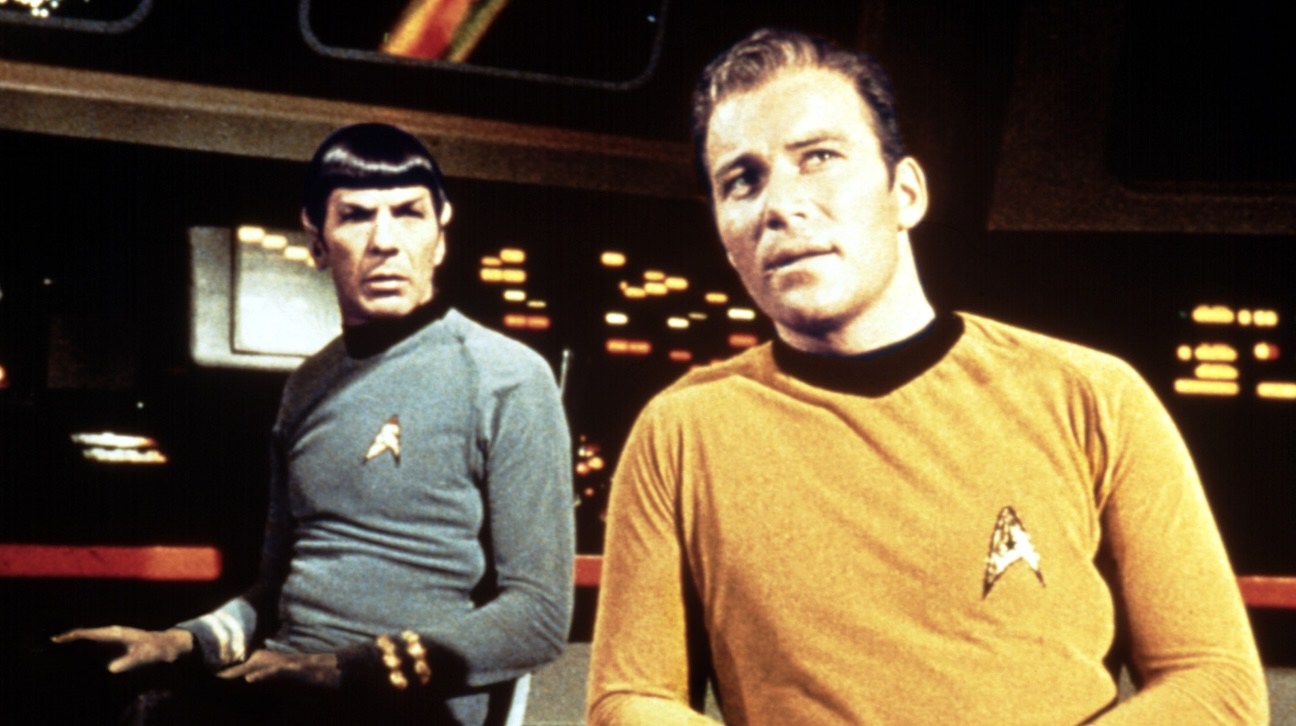
What “The Man Trap” does offer is an introduction to most of the characters who would become key parts of Star Trek in the years to come. James Doohan’s Scotty is absent, but Kirk (Shatner), Spock (Leonard Nimoy), McCoy, Uhura (Nichelle Nichols) and Sulu (George Takei) all have several key scenes, along with Grace Lee Whitney as Yeoman Janice Rand (who was written out partway through the first season). Walter Koenig’s Chekhov would join in the second season. Nichols is saddled with what’s closest to an exposition dump as Uhura tries to make small talk with Spock, only to hit a Vulcan wall, and then is shocked when he doesn’t react to the first crewman’s death (“My demonstration of concern will not change what has happened,” he replies).
The planet where Crater and the alien reside is very obviously a soundstage — something that’s probably more noticeable watching on a big high-definition set now than it was on a tube TV then — but episode takes viewers to a number of locations onboard the Enterprise, not just the bridge and transporter room. There’s even a tracking shot as Kirk walks down a corridor and into an elevator; it’s not a consequential scene, but it jumped out at me considering how static the camera is in the rest of the show (and in most other series of that era).
The Hollywood Reporter’s perfunctory (and somewhat condescending) review of the Star Trek premiere notes that the show features “quite a bit of suspense and tricks with gadgets that will please the sci-fi buffs no end” and concludes that it “should be a winner.” Ratings-wise, that didn’t turn out to be the case: Star Trek was what we’d now call a bubble show for all three of its seasons, and NBC canceled it in 1969. That was nowhere near the end of the story, obviously.
“The Man Trap” was a sturdy enough first episode, but it didn’t really hint at the creative leaps Star Trek would take in the course of its original run — ranging from “The Trouble with Tribbles” to “The City on the Edge of Forever.” Nor did anyone know at the time how deep a connection Trek fans would forge with the series. That as much as anything helped keep Star Trek alive through the 1970s. Star Trek: The Motion Picture‘s release in 1979 charted a new course for the franchise, which has continued through more than 20 series and films. Roddenberry’s optimistic vision of the future hasn’t necessarily played out in our present, but the appeal of that idea is still awfully strong six decades later.
Read the full article here