



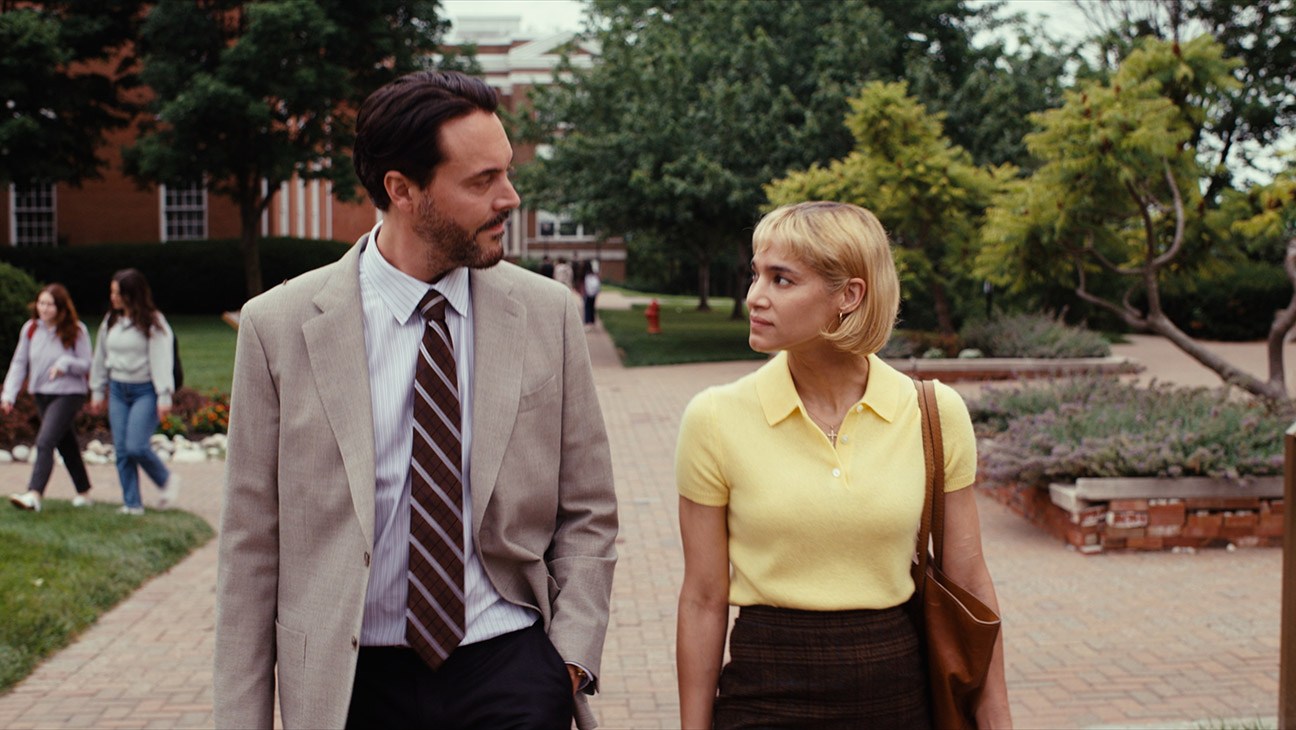


When Paul Schrader’s new moral drama The Basics of Philosophy begins, we are on a fictional college campus where John (Jack Huston), a professor of philosophy, gives an introductory lecture about the meaning of his course. Soon after, we see him in his office with a female student, who is begging for a grade change. She makes a clumsy attempt at seduction that he rebuffs, but the charged moment lingers in the air for several scenes afterward. I braced myself, concerned that we might be in store for a version of After the Hunt from a male perspective, or an attempt to yoke the older attitudes of, say, David Mamet’s Oleanna to the more modern cultural and sexual wars of academia that have roiled for over a decade now. When an 80-year-old man sets a film at a college in 2026, there might be reason to worry.
But Schrader is not just any 80-year-old man. He’s a deep thinker, something of a philosopher and theologian himself, forever trying to reconcile his deeply religious upbringing with all the challenges that worldview has faced in his many years of life. Schrader’s recent films, beginning with 2017’s First Reformed, have been pensive, offbeat mullings-over of the sociopolitical turned personal. First Reformed is (among other things) about a man grappling with climate change dread. In 2021’s The Card Counter, a man contends with a gnarly history of military torture. And in 2022’s Master Gardener, yet another of Schrader’s “men in a room” works to shed the white supremacist ideology he once held. Schrader, it seems, has been trying to process the world as it’s become, just as he is on his way out of it.
The Basics of Philosophy
The Bottom Line
Another clumsy but compelling entry from a filmmaker like no other.
Venue: Venice Film Festival (Venice Open — Out of Competition)
Cast: Jack Huston, Sofia Boutella, Bill Pullman, Daniel Zavatto, Shiloh Fernandez, Karl Glusman
Director and writer: Paul Schrader
1 hour 34 minutes
There is slightly less newsy topicality to The Basics of Philosophy. Instead, it turns even more inward, staging a struggle for John’s soul as a past sin comes to bear on his present life. (It’s impossible to write about this movie without giving away some pretty major plot details, so stop here if you are spoiler-averse.) When his father (Bill Pullman) dies, John spots a lone man at the funeral, someone he seems to recognize but can’t quite place. We eventually learn that when John was younger — but still an adult — he committed a sexual assault on an underage boy, the son of his family’s gardener who was essentially paid off in exchange for his silence. Seeing this figure years later sparks a sudden, intense need to get something like closure from the now grown man, Miguel (Daniel Zovatto), partly as an act of contrition, but quite possibly driven by desire, too.
John is in the long, agonizing process of writing a book about Baruch Spinoza, the 17th-century Jewish apostate and stoic who was one of the pioneers of rationalism, and who mightily influenced the entire course of philosophical thinking for centuries. Spinoza’s work is famously difficult to grasp, which is perhaps why John seems so stymied in his writing. Here he is, trying to rationalize that which maybe can’t be, both in his wrestling with Spinoza’s texts and with himself — his past predatory actions, his still conflicted sexuality, his relationships with his late father and with a fellow professor (Sofia Boutella) and her 14-year-old son.
Schrader approaches some pretty tetchy, third-rail territory, doing some debating about whether one act of child abuse means that John is, inherently, a child abuser by nature. One gets the discomfiting sense that Schrader is conflating that kind of illicit sexual activity with that of consenting, adult gay men, a line blurred as John finds himself drawn to a local gay bar and engaging in a seemingly satisfying one-night stand with a local hustler (Shiloh Fernandez). But I think Schrader is using homosexuality as a stand-in for broader societal transgression, rather than attempting to examine gay identity specifically.
At least, I hope that’s the case, as his writing in the film’s gay interludes is clunky and dated, in terms of both basic mechanicals like cruising and the more ineffable modes of queer behavior. Schrader is not exactly treating the subject matter as lurid, though, yes, he could probably draw a finer distinction between the act of molesting a 14-year-old and picking up a stranger at a bar. But I suppose the point is that John is struggling to find that distinction for himself, that something darker than he will ever speak aloud — or, maybe, ever act on again — might churn within him as he tries to maintain the resolve to live a decent, upstanding and therefore nobly repressed life.
That sense of propriety was partly imposed upon him by his father, who, in covering up John’s misdeed, placed an albatross around his son’s neck, demanding his conformity to a narrow sort of principle. Now, with his father gone, John seems uncertain what to do with that weight, and with the weight of existence entirely — he’s been researching a painless method of suicide online, finding a potion that brings to mind Socrates’ hemlock.
So, yes, this is heavy stuff, and one is tempted to roll one’s eyes at the film’s starchy presentation of its conflicts and its ideas, its frequently stilted dialogue and deliberate pacing. But then again, Schrader’s brand of Big Thought earnestness is rare these days; he is one of the few remaining practitioners of a fading artistic tradition, which knows nothing of — or at least has no use for — irony and meta self-effacement. Schrader has matters of change and expiation on his mind, and so he has written a blunt, unflinching story of exactly those things, with an ending that is quite shocking in its refusal to let us look away from the film’s direst suggestions.
Some viewers might read something exonerating in the way Schrader humanizes John’s turmoil, particularly in how the film seems to empathize with John as he strains under the tight restrictions that he, and society, have put on his sexual nature. Others might see the film another way, as a reckless claim that many (if not all) men would molest children were all the reins of civilization cut loose. Neither of those interpretations would be entirely invalid, exactly, and yet The Basics of Philosophy — ironically enough, given its title — mostly evades any such moral didacticism. The film is instead, in its strange and sometimes plodding manner, a call to simply sit and think about the contradictions of human character. Which has maybe been the great project of Schrader’s fascinating and singular career.
Read the full article here