





South Park, one of the longest-running comedy series on television, returned to Comedy Central for its 29th season after making the unexpected move of changing the show’s name to “South America” — a gag that creators Trey Parker and Matt Stone announced as a possible marketing gimmick but is certainly also a jab at President Donald Trump. Wednesday night’s season premiere provided little explanation as to when and why the name change happened for the fictional Colorado town, but it does offer a vague metaphor for current U.S. politics around immigration.
Seasons 27 and 28 of South Park had shifted from the show’s traditional stand-alone episodes to a season-long arc centered on fictionalized happenings within the White House, including President Trump’s clandestine affair with Satan. With the premiere, the show appears to be returning to its traditional format — stand-alone episodes that may still carry overarching themes. It’s not entirely clear whether we’ve seen the last of South Park‘s satirical Trump character and the supporting cast of cabinet officials, hangers-on and vice-president-turned-lover J.D. Vance, but they’re absent from this one-off episode, which stays within the confines of the titular town.
“Inspired by the bravery and patriotism of Apple and Google, we are changing the name of ‘South Park’ to ‘SOUTH AMERICA,’” Parker and Stone said in a Sept. 8 statement announcing the name change. One might have expected the season premiere to show Trump signing an executive order renaming Lake Ontario “Lake America” before eventually getting to South Park. Instead, the season begins after the name change has already been accepted — essentially baking the joke into the show, as characters refer to their town as “South America” without question. Only once does a character allude to the name change itself, and it’s clear the moment was divisive for the town.
What the episode offers is a straightforward plot that, as usual, hides a metaphor for a social issue beneath dialogue soaked in double entendres. It begins with Eric Cartman faking being bullied at school to trick his mother into buying him an e-bike — a vehicle clearly designed for adults that has become the one thing every kid in town must have. Ever the earnest pushover, Liane Cartman complies, and soon the boy is terrorizing the town on his new, dangerous ride. Eventually, more of the town’s children are wreaking havoc around South America, crashing through diner windows and scaring pedestrians — a clear metaphor for groups of immigrants moving into American towns.
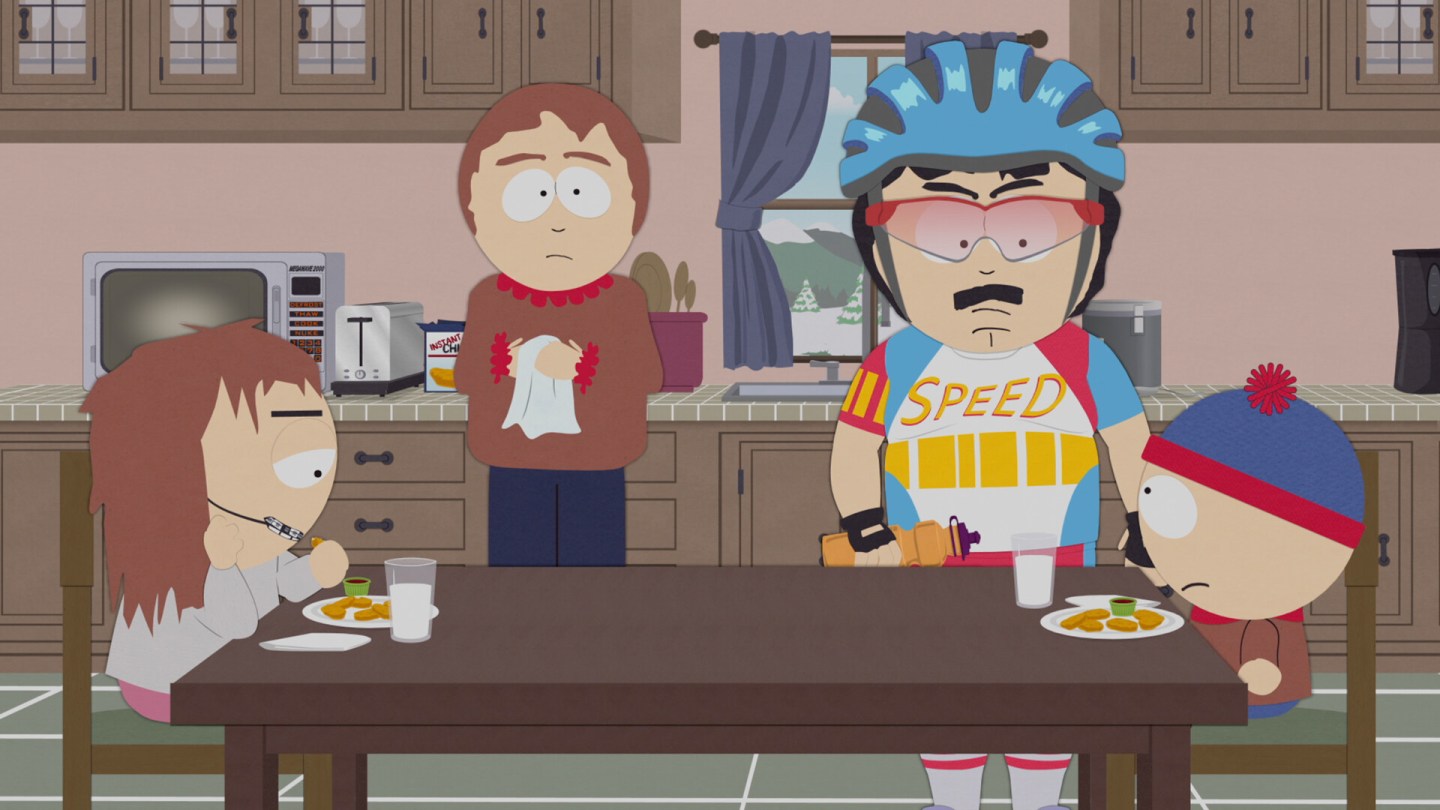
Early in the episode, Kyle tries his own version of Cartman’s ploy on his mother, but he has to go through his father, Randy, who arrives home in flashy spandex and sneakers, now a 10-speed cyclist commuting in the bike lane that’s being overtaken by kids on e-bikes. Randy soon forms a gang of 10-speed riders that begins roughing up anyone in their way. They’re not especially fast, though — one motorist bemoans the “old farts” blocking the road. Still, the gang feels like a stand-in for Immigration and Customs Enforcement as they comb the town trying to eradicate the e-bike kids.
As the kids’ South American youth biker gang is hunted by Randy’s gang of adults, the episode piles on satire aimed at the companies and public figures who have fallen in line as Trump took a marker to traditional maps. Google is repeatedly used to search things like “how to get the laws changed in South America?” (the answer: bribing government officials) and “how can police respond to gang violence in South America?” (the answer: extreme violence).
The episode also spoofs the massive cultural anticipation ahead of the release of Grand Theft Auto VI, the video game sequel slated to arrive in stores in November — making it a natural stand-in for the upcoming midterm elections, which “the libs” of Trump’s America are looking to for drastic change. “Hopefully, things will get better in November. That’s when Grand Theft Auto Six comes out,” one character says. Someone has to do something — we need to get these kids off the streets and back inside on their phones.
Parker and Stone have packed these metaphors into the premiere, a style that marks a clear departure from last season’s grotesque White House storylines. The question now is whether they plan to run this metaphor across the season and carry on with the e-bikes plot or if they will bring a new issue into the foreground and subject it to their now more subtle satire.
Read the full article here