





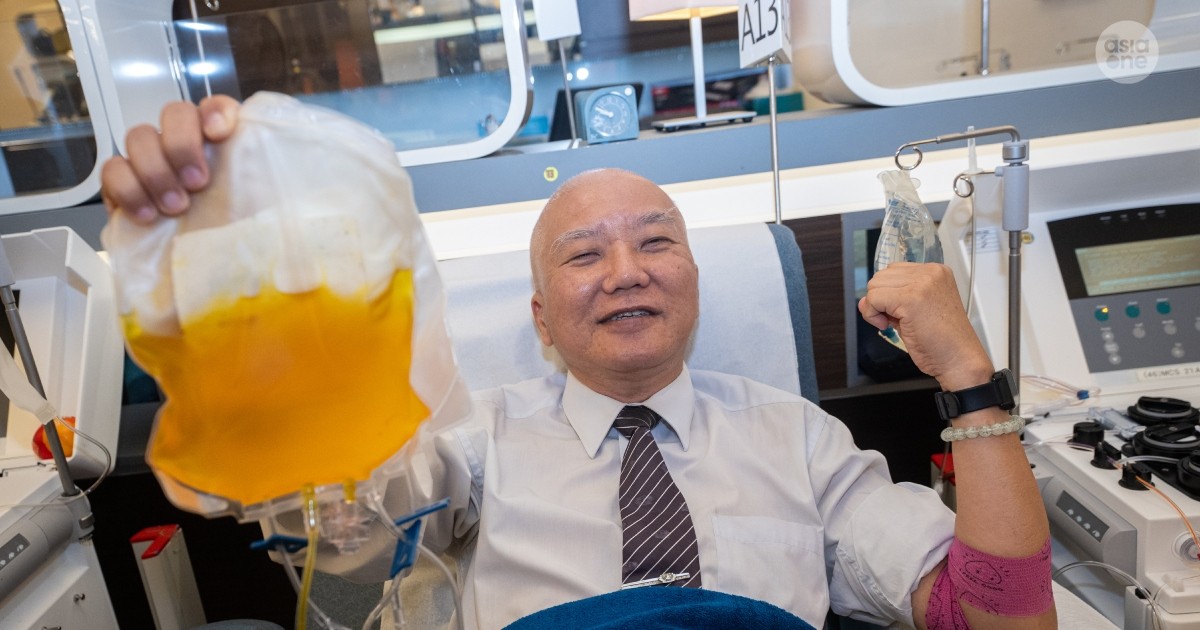


How many times have you donated blood?
For 62-year-old Lim Kim Koon, his blood donation count runs over hundreds — 368, to be exact.
A blood donation campaign in 1983 prompted an 18-year-old Kim Koon to donate blood for the first time.
Although it’s second nature to him now, there was a time when he was hesitant to donate blood.
“I heard some myths… such as when you first donate, you might feel giddy, or that you might put on weight,” he told AsiaOne in an interview on Tuesday (April 14).
But with the encouragement of his work supervisor, Kim Koon went ahead with the blood donation.
His fears eased when he realised that everything was fine after giving blood.
The insurance agent has been an avid blood donor ever since, and he has even adopted a strict lifestyle to ensure every blood donation is successful.
Kim Koon runs 10km daily and controls his diet, omitting barbecued, grilled and deep-fried foods. He also gave up his beloved durians.
For the past decade, he has also been on a vegetarian diet.
“It’s for the sake of the patients [who need blood],” Kim Koon shared.
Likening himself to the orange juice vending machines around Singapore, he said: “I’m just a blood machine. I live for the sake of donating blood.”
Kim Koon is also a strong advocate for blood donation. He encourages those around him to become donors through his actions, such as showing up at the blood bank to give blood every 28 days.
“I show by example, because you can’t use words to express this. You have to see [the process] for yourself to understand,” he said.
This inspired his elder sister and his daughter to become blood donors.
Benefits of blood donation
Another long-time blood donor is Philip Tan, 65, who works in the healthcare sector.
He first took part in a blood donation initiative during National Service (NS) in 1979 as it allowed him to enjoy a half-day off.
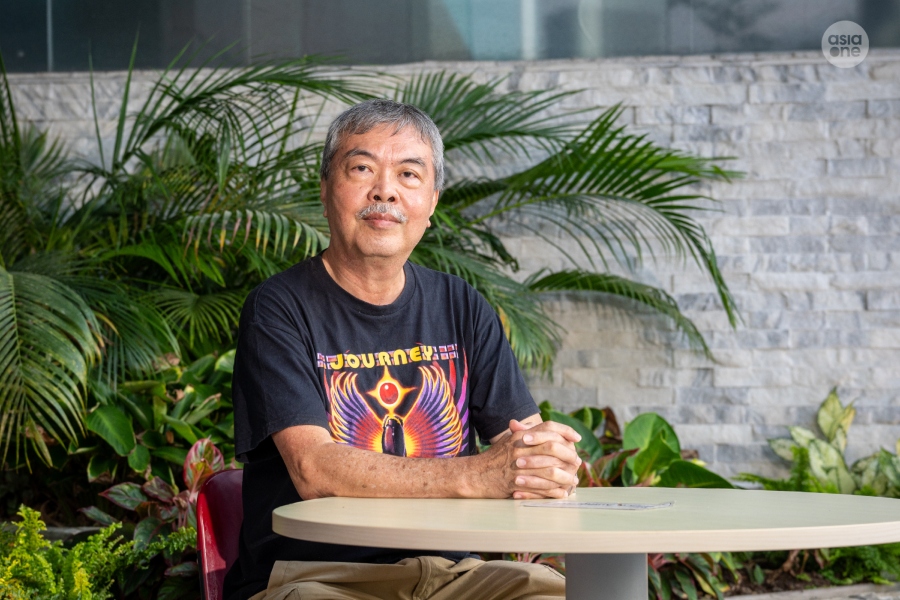

It soon became a lifelong commitment for Philip.
“The incentive was very attractive, so it started out that way. But as I grew into the journey, I began to realise the benefits of donating blood,” he said.
“I’m able to contribute to society in my own small way. It doesn’t require a lot of effort. All you need to do is show up, and it takes about 20 minutes. Sit down, get started, and you’re already helping the community,” he explained.
Like Kim Koon, Philip also maintains a healthy lifestyle to stay eligible for blood donation. He goes for walks and follows a healthy diet with enough nutrients and minerals such as iron, which is crucial for blood donors.
“You tend to look after yourself better in order to donate blood,” he said, pointing out that blood donations are not only beneficial to the recipient, but also the donor.
The importance of donating blood came into sharp focus for the 65-year-old when friends undergoing surgery had to appeal for blood donors.
A strong advocate for blood donation, Philip often informs his friends whenever he is “reporting” for blood donation.
“Every time you come for blood donation, they do a check-up for you,” he said. “If you’re able to continue giving, then you don’t have to worry about your health.”
Addressing those who are hesitant to donate blood due to a fear of needles or pain, Philip asked: “Imagine that somebody in your family requires blood, are you going to let the fear of needles stop you from helping them?”
Philip’s wife, 62-year-old Sally, was also an avid blood donor.
“It became a joint effort,” he shared, adding that they would go on blood bank “dates” every three months.
While Sally is unable to give blood now due to health reasons, she continues to support Philip by tagging along on his monthly blood donations. Between the couple, she has made at least 150 donations, and he has made 343 donations so far.
Giving blood despite fear
Dr Sadali Rasban, 67, is also a staunch advocate for blood donation.
His journey started at 21 after a friend brought him along on one of his trips to the blood bank.
“I’ve always believed in helping other people. If you can help, why not? There’s no cost at all,” the consultant in Muslim law and estate planning said.
Having made 302 donations and counting, Dr Sadali’s passion for blood donation inspired his three sons to become donors as well — one has donated 30 times, one 27 times, and his youngest son, who is still in polytechnic, has donated three times.
Despite his long history of donating blood, he still has a fear of needles.
“Every time the nurse puts the needle into my arm, I look away and close my eyes,” Dr Sadali admitted, adding that he eases his anxiety by using the television as a distraction or thinking about something else.

Even so, his passion for helping others keeps him going.
“The best thing you can do as a human being is to give,” said Dr Sadali. “Everybody has some fear, but just look at the good side of it. You’re going to help somebody.”
A call for young blood
To those who are thinking about donating blood, Dr Sadali said that there’s no better time than now.
“You’ve got to do it now. Do not procrastinate, because you never know what could happen. You may not have the chance to donate if you keep delaying it, because health may be an issue by then,” he said.
Philip echoes Dr Sadali’s call for blood donors to step up, especially youths, as it’s time to pass the baton.
“The younger generations need to step up and respond to the call to contribute.”
For their dedication to the cause, Kim Koon, Philip and Dr Sadali are some of the award recipients at the 80 Years of Gifting Blood event on Wednesday.
Organised by Health Sciences Authority (HSA) and Singapore Red Cross (SRC), the event celebrates 80 years of the National Blood Programme, and honours those who have donated blood at least 250 times.
Speaking at the event, Minister for Health Ong Ye Kung addressed the award recipients, saying: “Thank you for sustaining our blood supply all these years”.
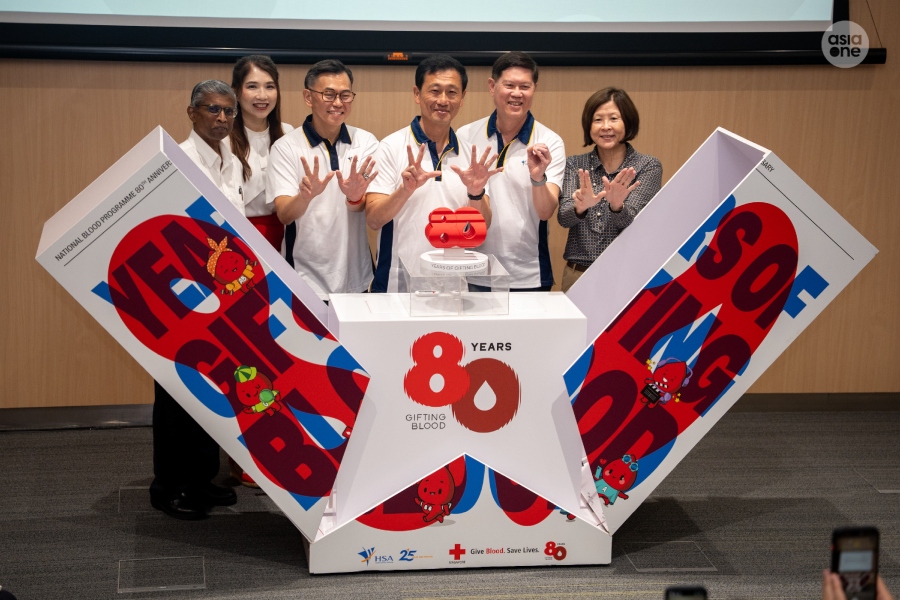
Noting the challenge in blood donation, the health minister said: “We can be more inclusive in recruiting donors. We will do this through a rigorous, evidence-based approach to widen donor eligibility.”
Since 2023, those who have lived in countries with known instances of the variant Creutzfeldt-Jakob disease can donate blood again. “This will be done via apheresis blood donation, where only certain components of their blood need to be taken, thereby eliminating any risks to the recipients,” he explained.
According to HSA, apheresis donations can be done every four weeks for platelets and plasma, and every 16 weeks for double red cells.
The automated process takes longer than the usual whole blood donation — from 60 to 90 minutes for platelets and 45 minutes for plasma and double red cells.
“We will step up efforts to reach out to younger donors,” Minister Ong added, noting that young working adults are very active blood donors.
He also announced new initiatives for blood donors in the second half of 2026.
These include a new Healthpoints programme by HSA, SRC and the Health Promotion Board, where donors will receive points for every successful blood donation.
In the Healthy 365 app, these points can be used to redeem MediShield Life premium discounts, e-vouchers at participating lifestyle retailers and food outlets, as well as donations to community causes. More details will be announced in June.
Another initiative is the 80 for 80 Blood Donation Marathon, a nationwide movement to get more organisations to support the National Blood Programme by gathering 80 people to donate blood together.
The initiative seeks to catalyse a sustained culture of care and community commitment, marking the beginning of a long-term effort to strengthen Singapore’s blood donation ecosystem.
HSA will be the first organisation to participate in this initiative, followed by ITE College Central. The marathon will conclude with SRC at year’s end.
[[nid:727451]]
No part of this article can be reproduced without permission from AsiaOne.
carol.ong@asiaone.com
Read the full article here