






[This story contains MAJOR spoilers for season one of Netflix’s Man on Fire, including the season finale.]
As John Creasy, the bedeviled main character in Netflix’s new series Man on Fire, says, he’s a solo act.
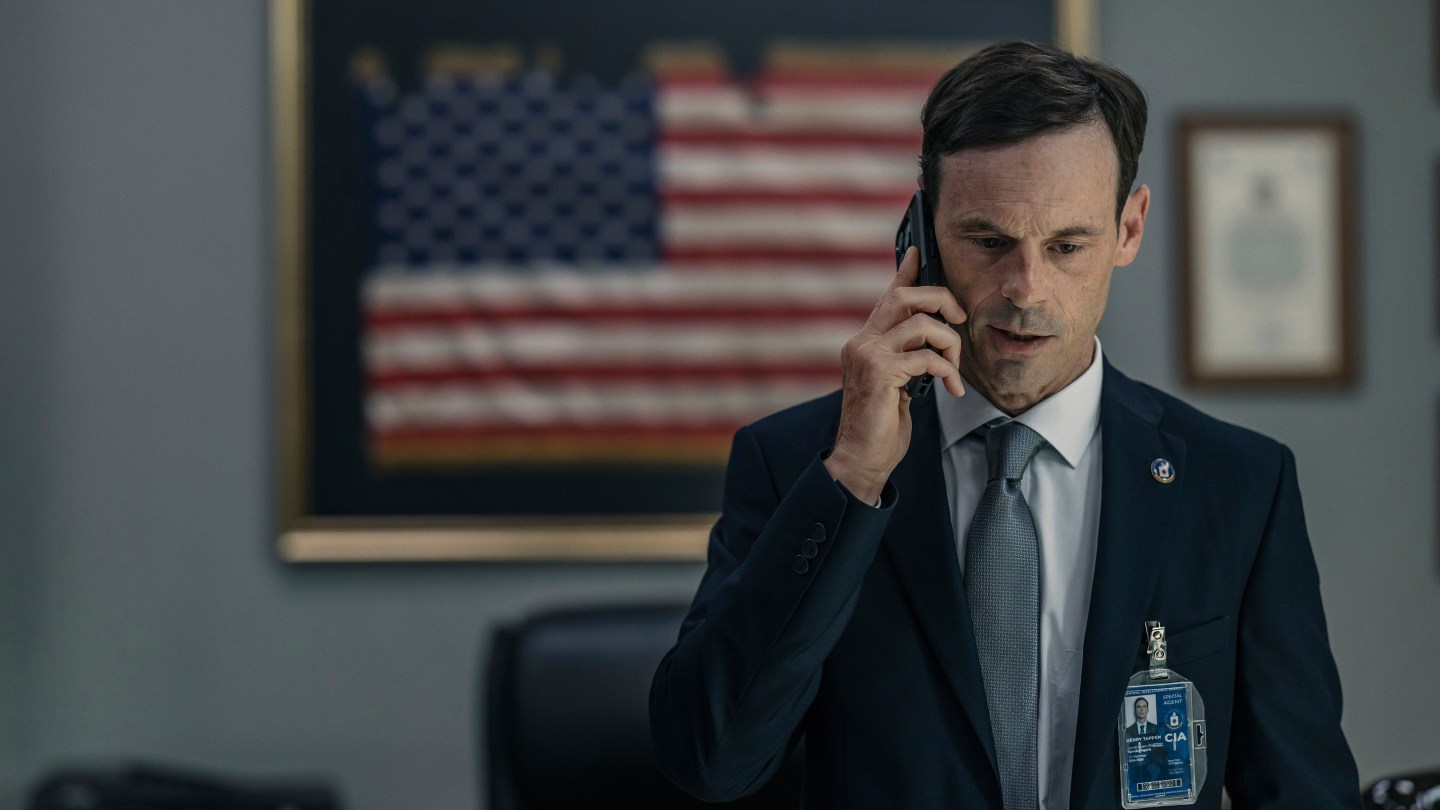
The former Special Forces operative, played by Yahya Abdul-Mateen II, trusts no one until he can be certain they aren’t involved in the terrorist explosion that occurs at the end of the first episode — and that means no one. It’s a strategy that ensures the safety of Poe Rayburn (Billie Boullet), the surviving daughter of his colleague Paul Rayburn (Bobby Cannavale) who died in an explosion. But it’s bad news for Creasy’s contact in the CIA, Henry Tappan (Scoot McNairy), who, in a plot twist, turns out to have been a driving force behind the murders of the Rayburns and everyone living in their high-rise condominium building.
After Creasy uncovers all the layers of the international conspiracy, while combating Tappan’s accomplices’ efforts to kill the girl, a lethal confrontation occurs in episode seven, when Tappan hunts down Creasy. A bone-wrenching fight occurs before Creasy snatches a scalpel and severs Tappan’s femoral artery in the season’s biggest “hoorah moment,” as McNairy puts it. The Hollywood Reporter recently chatted with McNairy over Zoom to learn about what drew him to the role, the highlights of filming in South America and what occurred behind the scenes as they filmed that epic showdown.
***
I last saw you in A Complete Unknown, in which you played Woody Guthrie. Of course, that’s an entirely different type of project than Man on Fire.
Absolutely it was, completely different ends of the spectrum. Look, any time you head down to Brazil or Mexico to go to work, it’s always a pleasure to be in the environment with those different communities of people. There’s just something fun about making movies down in South America.
One of the things I love about the show is how they go into the favela and you get to know the people there. Did you feel like you really got to experience that?
That’s really what they were going after. There was a lot of talk before the show to really get that culture and the music and really thrust you into that, as well as the action and all those things. Absolutely, when we were down in Brazil, Alice Braga [who plays Melo], that’s her world, you know? There were so many interesting things that we did outside of work to see that culture, but the filmmakers did an incredible job at capturing it on the screen, as well.
Your character, Henry Tappan, is not what he initially seems to be. What drew you to that part?
Initially, I didn’t really know where his character went toward the end. They had said that they wanted it to be a surprise, that you don’t see this coming. Part of it was they had written a really great pilot, as well as I had worked with [executive producer and director] Steven Caple Jr. before and I’m just such a big fan of his. He’s so great at storytelling and action, and also just a lovely person to work with, as well as Stacy Perskie who was [executive] producing it, and who I had worked with on Narcos down in Mexico. Part of it was just the team, and Netflix, I love working with them. And after working on Narcos — you just don’t know what to expect when you get down there, and I think that’s probably the most exciting thing about it.
Was it fun to play that character with that kind of twist? It sounds like you didn’t even know what to expect until you really got into it.
I kind of knew, but [the surprise came more from] the filmmakers and the process that really leads you into that, so it wasn’t necessarily something I was doing. But as a viewer, I do like a surprise. I do like when there’s a twist at the end and so yes, it was fun to lean into that. And the character as a whole, playing a CIA guy, all of it was interesting based on all the factors involved.
The battle of wits between Tappan and Creasy is one of the big dynamics in the show. Early on, there doesn’t seem to be any reason for Creasy not to trust him, but he doesn’t show up for the extraction that Tappan planned to get him and Poe back to the U.S. Why do you think that is?
I think it’s sort of foreshadowing the tension of these two and how they left off with each other. Creasy’s in a place where he doesn’t trust anyone, with the PTSD and the trauma that he’s going through, and he’s still an incredibly skilled soldier and a really intelligent human being. And working with Yahya, he’s a lot of fun. He cracks a lot of jokes — he’s a really, really hard worker, but he was a lot of fun to work with.
The biggest hurdle that was coming down the pipeline for me was the fight sequence [in the hospital in the finale]. We’re very different in size, so I think the stunt crew put together a really great sequence that made it believable, [to show] what would happen if these two individuals matched up. That was on my mind a lot for this shoot, making sure that looked realistic. But thinking of Yahya, I’m remembering more of playing around on set than I am of shooting. (Chuckles.)
Can you talk a little bit more about shooting that fight sequence? It seems like that could be really challenging or a lot of fun, depending on how you look at it.
Yeah, and I give full credit to the stunt coordinators because I wasn’t a part of [the planning], but the idea was that I’m smaller than him, so we tried to make [Tappan] quicker. That’s where they landed with sort of a Krav Maga background. He’s much quicker, but he’s not stronger. We trained for a good two, three weeks for this fight sequence. I had a great stuntman, Brett Sheerin, who I’ve worked with before. He came in and obviously did a lot of the bigger things. All in all, looking at it now, I thought the directors and editors did a great job of piecing that together and making it look authentic and real.
When Creasy stabs your character with the scalpel and gets the kill, did you feel like that was a good sendoff for your character?
Yeah, I think so. I hope it’s a hoorah moment for the audience. That’s what it’s designed to do. I’ve died in a couple projects. (Laughs.) You’re always trying to come up with a different way to not repeat yourself in dying.
Up until the hospital scene, it had been more of a mental battle of wits between your characters. Both of them are very smart. What do you think it was that made Creasy come out on top?
That’s a great question. I just think that he was always one step ahead. Tappan overplayed his hand by thinking he was smarter than him and he could get ahead of him, and I think that was his own demise, is thinking that the training he had given Creasy or that they had together, meant that he knew how [Creasy] thought. He fell into that trap, and at the end of the day, Creasy’s smarter than him and more well thought-out, more planned, more methodical, and what Tappan was doing was a crime and it was a scandal, so eventually you’re going to get caught. As we see today, there’s a lot of crimes happening and yes they go through them, but it’s almost impossible to pull off a caper these days.
Creasy thinks that isolating himself and distancing himself mentally from the problems he’s trying to solve will help him succeed. But in the end, he gets a lot of help from the friends he makes along the way, like Alice Braga’s character.
I can’t speak too freely on it, but I know that Kyle [Killen, the showrunner] researched a lot on people with military backgrounds who had PTSD, and they found out that people had a sense of resistance to returning to a similar situation, and it was more therapeutic to not resist but to live within the experience, versus returning to the [traumatic] event. I feel like those relationships that you see Creasy have throughout his journey are mirroring that, in a way. He’s living through the experiences versus returning to an experience. I don’t know if that clocks, but I took away that this sort of therapy that he gets through these other characters is part of his journey of getting better.
Although your character is dead at the end of the season, he has a long history with Creasy. Do you think Tappan might potentially figure into another season?
I love return projects, especially when you’ve set the stage for it. Absolutely, who knows, there could be a prequel. They can come up with anything, so absolutely I’d be open to it. I love working with that crew down there in Mexico City and so yeah, I would gladly go back.
Was there anything else you wanted to mention about the show?
It was a feat. There were big action sequences, and the stunt team and the VFX guys, they did a great job on this. There’s a great storyline in there, but it’s also incredibly exciting, incredibly thrilling, with great car chases, fight sequences, shootouts. [The name] Man on Fire hat-tips it. It’s a different story from the book [source material], sort of a sidebar. But it does a great job staying in that world. I’m excited for everyone to see it.
All episodes of Man on Fire season one are currently available on Netflix. Read THR‘s interview with Yahya Abdul-Mateen II and Steven Caple Jr. here.
Read the full article here