



The scene is intimate, haunting: Salman Rushdie, just a few days after being brutally attacked on a stage at an upstate New York retreat, is lying in a hospital bed. He is barely able to talk, the wounds in his neck archeologically deep, an eye bulging out grotesquely like in a horror movie. He asks if he’ll ever get out of the room.
The footage from Alex Gibney’s new documentary Knife: The Attempted Murder of Salman Rushdie, shot as part of a video diary by Rushdie’s wife, the novelist and poet Rachel Eliza Griffiths, opens a window painted shut. We remember the viral video of an attack, when a young man that August morning in 2022 came at Rushdie and the author tried to fight him off in front of a shocked audience. What we hadn’t seen is the aftermath — the closeness to death, the sheer psychic terror.
“We really didn’t know if we’d come out of it,” Rushdie says, reflecting on those harrowing days.
“I came into the room with all these machines,” Griffiths says. “It was freezing, and there was a huge blue ventilator. I thought, ‘People like this don’t get up out of the bed.’”
The couple is sitting in Gibney’s downtown Manhattan office a few days before Christmas, very much out of the bed, very much here. As he has so many times over the years — as, perhaps, literature and free expression itself has so many times over the years — Rushdie has beaten back the bloody designs on his life. Knife will premiere at Sundance on Jan. 25, and the venue couldn’t be more fitting: The last Utah edition of a festival birthed to fight suppression, synonymous with a longtime leader who embodied that mission. Yet Robert Redford is gone, but somehow Salman Rushdie — who by his own admission should have been dead decades ago — is still here, carrying the mantle, a lonely liberal voice in an increasingly illiberal time.
“I don’t think of myself as a symbol,” Rushdie says, with characteristic literary rumpliness. But how could he be anything else?
**
Even to those who recall the global Islamist anger over The Satanic Verses, Rushdie’s past might be startling. The Booker Prize winner wasn’t just under the death order of a desperate Ayatollah Khomeini (seeking to distract from problems in his own country) after publishing a book that imagined an alternate story of the prophet Muhammad — he was facing a long-term existential fragility. At the time of the fatwa, Gibney’s movie shows, Rushdie went into a kind of itinerant hiding in England, ferried by intelligence services from location to location. At one point, he estimates, he slept in 15 different bedrooms in a span of 20 days. This went on for 10 years. So did a litany of threats and thwarted attacks.
Finally, Rushdie — against the advice of intelligence officials — had enough. He emerged despite the threats and eventually moved to New York, where around 2000 he began to lead a nonchalantly public life — showing up at restaurants, house parties (this reporter met him at one such gathering on New Year’s Eve 2020), the set of Curb Your Enthusiasm, even dance clubs. He traveled the world, giving lectures — hundreds of places, cities, settings. Though hit lists and other plots would occasionally surface, the threat seemed over. Rushdie and free expression had won.
Until they didn’t. Until he was attacked at a retreat he’d been to before, by a person who hadn’t even been alive when The Satanic Verses came out and who hadn’t read even three pages of his work. “It felt like something out of the past, like a time traveler,” Rushdie says. (His attacker is currently serving a multi-decade prison sentence.)
How does one spend 20 years training themselves not to be afraid, only to be reminded that they should have been scared all along? How does one return to normalcy after all that?
High-minded principles, sure – “If you retreat, they win,” etc. But to meet with Salman Rushdie is to be struck by how ordinary he is, by how regular moments trump idealism. And, how it wasn’t principle that got him through this latest crucible. It was a relationship.
Rushdie and Griffiths met a few years before the attack. Despite a 30-year age difference, they hit it off immediately. “A lot of my friends called me up and said, ‘Finally,’” says Rushdie, who was married four times before, including to Padma Lakshmi for several years in the 2000s. “Everyone saw she was right for me.”
Says Griffiths: “It felt pretty immediate; it made sense in a way other relationships never made sense to me or required a different kind of compromise.” They wed in September 2021, in the ebbing months of the pandemic. Ten months later, he was attacked. “And I wouldn’t be here if not for her,” he says. The way she cared for him. The way she gave him something to live for.
Such a story may not fit as easily with the narrative imposed from without — with the scores of fans and free-speech advocates who see in Rushdie a kind of aspirational stare-down of danger. A “say what you want to say, even if it could literally get you killed, then keep doing it until it almost does, then come back again,” way of thinking. In a time when speech seems so dangerous, threatened by bullies on social media and in government, he couldn’t be anything less than a legend.
But Rushdie struggles with that self-concept. “I think of myself as a private person — lover of my beloved people, father of my children. I know there’s this other me that’s out there, and that’s OK. I know there are parts of the world in which Other Me has been turned into a kind of bogeyman. And I know there are parts of the world in which that other me is thought of more positively. Both of them feel OK. But to me, I’m just this guy in a room thinking of something to write.”
Griffiths adds: “Salman and Salman Rushdie both live in my house.”
(Incidentally, the thinking about what to write has bore fruit, considering he’s written 15 novels, three essay collections, two memoirs — including the book on which Knife is based — and one short-story collection, as well as a work of reportage. Midnight’s Children gets the most acclaim, but 1996’s The Moor’s Last Sigh may be he slept-on masterpiece, epic storytelling and magical realism colliding in that uniquely Rushdian way.)
He actually thought he was done with this story, having published Knife in 2024. But Gibney approached the couple with the suggestion there was more to tell — that people needed to see what he went through to understand the stakes. That Griffiths had all this cellphone footage helped (she is credited as a cinematographer). The pair agreed.
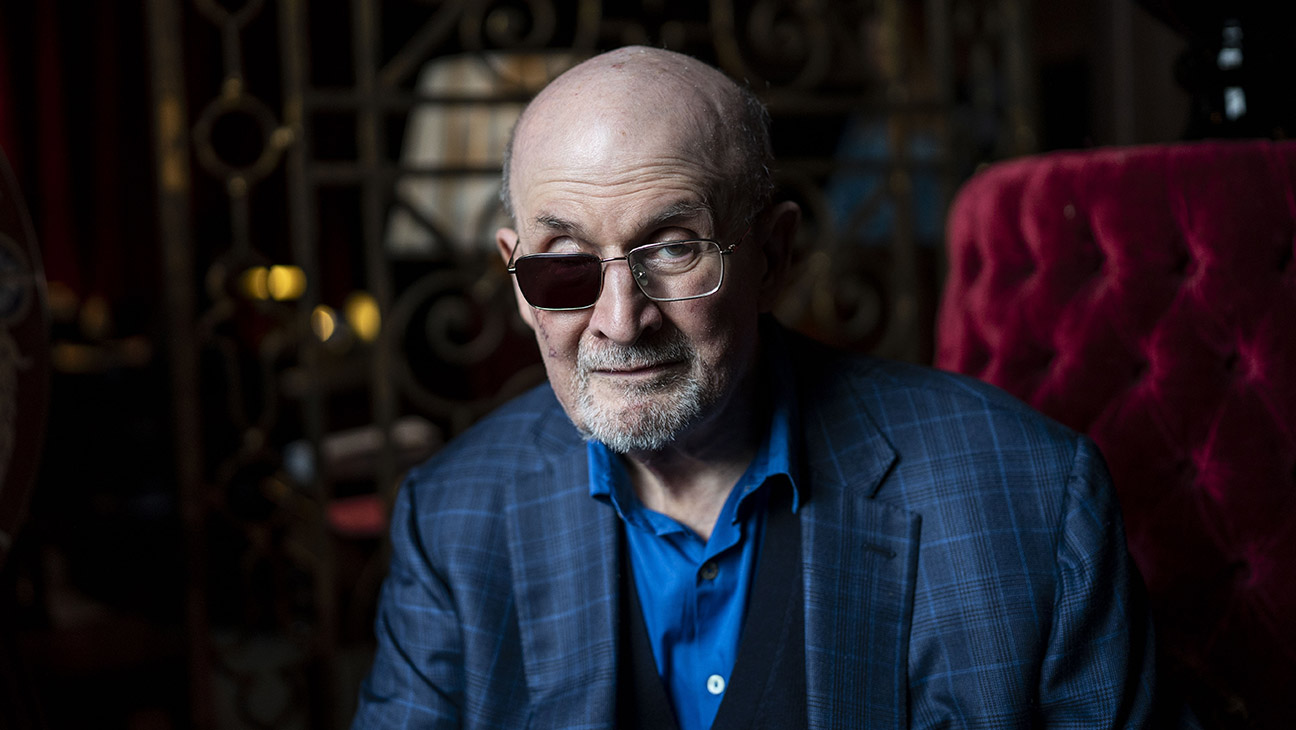
Rushdie seems like he should walk around in fear, or at least under the weight of what it all means, the one dark lens in his glasses covering the eye he lost a reminder of how much he carries with him. Yet there the man is, arguably the modern world’s most famous living writer and certainly its most heroic, standing in lower Manhattan in an unassuming cap and coat, waiting for an Uber, making a dad joke about the Wall Street bull statue, planning trips to Sundance. (There is more security than before, he says.)
He truly comes alive when talking about his beloved Yankees. “If Cole isn’t coming back from Tommy John surgery for a while, then Brian [Cashman] is going to need to make some moves. Fried is good and Schlittler showed promise last season, but we need another starter,” he says, more Sal from the Bronx than Salman from Manhattan.
In some ways Rushdie was ahead of the curve, both in anticipating the violence against unpopular opinion-holders (he of course pre-dated social media by decades) and in revealing the dangers of jihadism. For those who would use his example to make anti-Islamic points, though, Rushdie says he sees a much broader epidemic.
“What’s happened is that ideology has become a more powerful motivating factor. Karl Marx said economics is primary. But it turns out ideology is primary. And the Islamic thing is just one manifestation of that.” He adds thoughtfully, “There’s stuff closer to home.”
**
When Rushdie was sufficiently healed, the couple decided to go back to the scene of the crime. The visit can be viewed in the film. They stand on the Chautauqua stage, they walk around the lush grounds, they even stood outside the facility where the assailant (Rushdie just calls him “The A”) is imprisoned. Rushdie briefly thought of trying to go in to talk to him, to try to understand, then realized little would come of it.
Griffiths was shocked by how lovely Chautauqua looked, by all the cookouts and magic shows it holds around the literary events. “That made it much more horrible.” The trauma was heavy for her, too. Far removed from Chautauqua when the attack happened, she couldn’t get any information. She had to use a personal credit card to book a private flight to get to the hospital immediately. When she landed, security somberly awaited her at the plane; she thought they were going to tell her that her husband was dead. When she got to the hospital, she learned he was many hours into surgery and may not survive. It took until the third day before the doctors said that at least he would not die.
Rushdie says the return gave him something else. “For me, it was something different. More of a release. I’m standing up in the place where I fell down.” The author says the trauma is largely gone. “We have really good therapists,” he says when asked how the couple got through it, joking but not joking.
For all the desire to play down the symbolism, the occasion of Rushdie’s film debut has evoked something more…reflective.
“I don’t like to use the word victory, but I doubted I would get to 78.” He stops to take account. “I almost didn’t get through it and then I did, and then I almost didn’t get through it and then I did.” When told that was going to be inspiring whether he liked it or not, he says, “I hope that’s true.” He offered a thought on writing under threat. “People ask my advice and I say, ‘Just do it. Fuck ‘em. Do it.’ Because the worst thing in the world is self-censorship. If you’re going to write like that, then just spare the world that book.”
But he says he also understands why some might feel daunted. “The pressures on young writers are great, and they don’t always come from the traditional sources of censorship. They come from all around,” he said, not elaborating but seeming to refer to political correctness. “And it’s very hard to find the courage to just say what you have to say. Me? I’m too old to give a damn.”
The defiance runs through the couple’s attitude. They are here and talking publicly despite the attack — here and talking publicly despite the fact that it could happen again. The interview is happening just days after an apparently ISIS-inspired attack at a Hanukkah event at Bondi Beach, Australia, and if events like that are unnerving for us all, they are especially unnerving to the man who faced the threat of global rage. Imagine millions of zealots wanting you dead.
What has sustained Griffiths, she says, is an attempt to counter the meaning of that awful day. “The violence of the attacker is there, but also the perspective of love, of me holding the camera to show that love.”
Rushdie says he also felt that. Then he takes a moment and thinks about why he’s telling the story, what purpose there might be, after all this, in re-living everything with a film.
“When I first started thinking about the movie, I thought it was a true-crime story,” he says. “But really it’s a love story.”
A version of this story appeared in the Jan. 15 issue of The Hollywood Reporter magazine. Click here to subscribe.
Read the full article here