


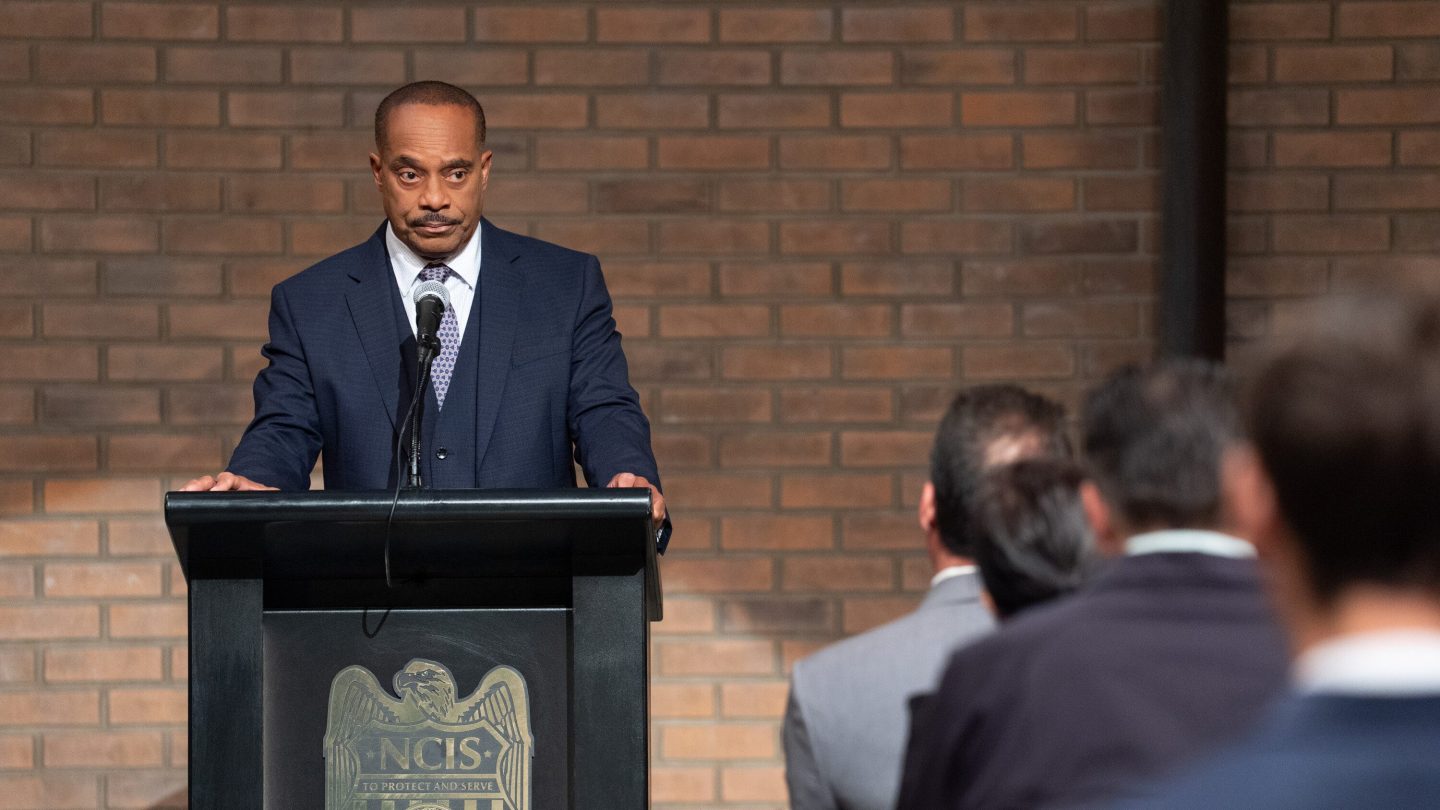

Rocky Carroll didn’t see his last episode of NCIS until it aired. But Carroll — who has played NCIS Director Leon Vance on the CBS series since 2008 — didn’t watch the March 24 episode alone. “I was at a Screen Actors Guild screening in New York City with 150 total strangers. I’m sitting there watching it on screen and my biggest concern, more than anything, was [for it not to be] a boring episode,” he tells The Hollywood Reporter. “I’m watching it just like the other people and I’m like, ‘Man, that was a damn good episode.’”
That “damn good episode” was bittersweet for longtime NCIS fans. Killing off a fan favorite who anchored the series for as many years as Carroll — especially after original star Mark Harmon stepped back as Leroy Jethro Gibbs, better known as Gibbs, on NCIS back in 2019 — was not just risky; it was highly emotional.
Carroll didn’t know Director Vance would die when the 23rd season of the veteran series began. When he first learned about his fare, he was caught off guard. But as he thought about Vance dying to save the agency, he saw the brilliance in it.
“Once we started filming, once I read the script, I was like: This is actually a really great idea, because for a 500th episode, for 23 years, if you’re not going make a move like this now, you may not ever get the chance. And it’s a really well-written episode,” he says of the “All Good Things” hour ending his 18-year NCIS tenure.
In the episode, NCIS is being shut down by the Department of Defense and handed over to the Army CID. Even though things are tense and unsure, there’s no indication that Vance or anyone else will lose more than their job. Vance has been arrested, however, and is being interrogated. As the episode continues, it seems slightly odd, but nothing super alarming. The team is solving a case that could save their agency.
Vance, who makes peace with Supervisory Special Agent Alden Parker (Gary Cole), is at the center recapping a series of events to his unnamed interrogator (Adhir Kalyan) that explains where some team members have gone, as well as details Vance’s own heroic actions, including defusing a bomb in the NCIS evidence locker and discovering that CID Agent Dolan Thompson (Matt Cook) is a dirty agent. Sadly, that discovery cost Vance his life — as Thompson shoots him three times in his chest as agents Parker and McGee (Sean Murray) arrive too late to save him. Suddenly, it becomes apparent to everyone watching that Director Vance is dead.
As Vance is taking his final bow, his long-gone friend Ducky appears as his younger self in the form of current NCIS: Origins star Adam Campbell, who plays that character to guide the way. Before Vance exits towards the white light, a montage of past NCIS moments plays before we hear the voice of his beloved wife Jackie (Paula Newsome), who was killed in season six, saying, “Hey, baby” to welcome him to the other side. After his death, NCIS reopens with Parker returning from retirement.
Because Vance was only intended as a recurring role, Carroll feels especially fortunate to have played him for so long. “I’ve been in 80 percent of the episodes. Of the 500 episodes, I’ve been in close to 400 of them,” he reports. Since 2015, he’s also been behind the screen directing. “They call me Director Director when I’m directing an episode.”
The Hollywood Reporter caught up with Carroll to discuss his reaction to the response Vance’s death has generated, some key details regarding his departure and what his future now holds.
***
Are you surprised by the outpouring of love for you and Vance?
I am very surprised, because when I joined the cast at the end of season five, it was not a big love fest. My character was this character everybody was a little wary of. I was kind of that stepdad that your mother said, “‘This is going to be your new daddy, and everybody says ‘He ain’t my daddy.’ That’s kind of how I felt. I felt like I had come into a family, and everybody was looking at me like, ‘when is he leaving?’”
When did you start feeling that Vance was part of the family?
It kind of happened organically as the episodes progressed. We could have just stuck to the script and written Vance as this perpetual boss from hell who comes in and makes everybody’s life miserable. But [that changed] over time [as] the actors, and even the writers, realized that [we didn’t have to make] this a one-dimensional character who’s adversarial for the sake of being adversarial.
Mark Harmon and I had a prior relationship; we’d worked together in Chicago Hope and we just started finding the character. They thought about writing off this character 10 years ago. The thought of killing Leon Vance is not something new. They were thinking about doing this as a plot twist years ago, but because of what was taking place on screen, and because of the chemistry between Vance and Gibbs, every time they talked about it as a plot twist, everybody would go, “No, we can’t do that. He’s good now. He’s too firmly established.” As the character and stories developed, and we got to see him outside of his office — especially the episode when Director Vance loses his wife, who’s tragically killed — he noe shares the same tragic experience as the main character Gibbs [and] they’re bonded in tragedy. I think that was the beginning of when our die-hard fans were like, “He’s one of us now, he’s a part of the NCIS family.”
Would Vance have normally been wearing a vest?
No! I used to always joke [that] Vance probably doesn’t even know where his gun is right now. If there was an emergency, he’d have to rifle through all the drawers in his office, because he’d be like, “Where the hell did I put this? I hadn’t used it in a while.” So no, and that was why that actually made sense. When you see the scene, you go, “Thank God he’s wearing a vest.” And it’s like, “Why would a bureaucrat who sits in his office where you’d have to get through such a chain of security to even knock on his door be sitting in his office wearing a vest?” So he doesn’t wear a vest. In his mind’s eye, he thought he was wearing a vest.
It was just so hard to believe that Vance was dead. It was shocking!
That is exactly what the objective was. After 23 years and 500 episodes, the executives, producers and writers could have easily done [an] episode with a whole bunch of flashbacks and retrospectives about scenes that have happened in the past, and maybe bring out a couple of surprise guest stars, and the audience would have been like, “Oh, that was nice.” We could have easily gone down that road. Your personal response is, “My character is being killed off. I’m not going to be in the last scene on the last day of the final season of NCIS. I’m not going to be there when they board up the windows and say, ‘Okay, that’s it. Everybody go home.’”
But the one thing I do have that maybe the other characters won’t get is that my character had a very specific ending. Real closure. A friend of mine called and said “a lot of people probably forget what happened to Gibbs in his very last scene, but nobody will forget what happened to Director Vance in his last episode.”
Usually when you get to the end of a series like NCIS, which is in season 23, who knows how much longer it’s going to go. In that final episode, where you try to tie up all the loose ends and put a button on everybody’s story, somebody’s going to get left out. The audience is going to watch and go, “Well, what happened to so and so? What happened to Agent Knight [Katrina Law]? What happened to Torres [Wilmer Valderrama]? I know I’ll be the one character, regardless of how the series ends, where people will remember what happened.
Vance is going to shoot up as the most shocking death, for sure. It was a lovely sendoff and you are right, so many characters never get that acknowledgment. And then there’s been ongoing complaints that Black characters don’t often get proper sendoffs on TV shows.
The thing I’m most proud of is that I knew all those things were in play when I started playing the character. Because I had such a great working relationship with Mark Harmon, we didn’t have to hang a sign on it. All of a sudden, this is one of the most popular shows in the world, and the main character has a boss who’s a person of color. Every time we were on screen together, you didn’t have to say, “There’s a Black bureaucrat and the white agent.” You’re going to look [at the show] through whatever lens you’ve been developing. If you are a person where the dynamic of race is important, that’s the lens you’re going to look through. And I’m okay with that. So we didn’t have to write toward it [because] people are going to see it. And the people who say, “I don’t see color,” it’s like, “I’s okay to see color because this is what it is.”
When Wilmer Valderrama joined the cast of NCIS, the first thing he said to me was, “I remember when you joined the show, and I thought, ‘wow, he broke the color barrier. You were the Jackie Robinson of this series, because you were the first person of color as a [main character] series regular.” And now you look at the racial, ethnic landscape of NCIS [and] it’s pretty amazing. We’ve come a long way.
I always auditioned for roles that I knew weren’t traditionally written for a Black man or a person of color. And the roles that I’m most proud of are the ones where I know that the executives and the producers said we never really looked at it in that capacity. But this works, and I kind of feel like that’s sort of been my calling card for the last 30 years.
You first started directing on NCIS in 2015. How did that come about? Did you know you wanted to direct?
I didn’t know I wanted to direct. Everybody around me said I should. I had been at the show for about eight seasons. And this is pre-COVID, so it was like a college campus. We had visitors on set all day. People brought their dogs. People had family visiting. It was a tour every day. My managers and agents and all the people connected to me would always say, “Look at the rapport you have with the cast, the way you get along with the crew, you’d make a great director.”
So every year, whenever it was time to renegotiate a contract, my representatives would go, “Should we put in; you want to direct?” I was like, “No. Stop pushing this thing on me.” And finally, I said, “You know what? In order to nip this in the bud, I’m going to go into the executive producer’s office and tell them that I’m interested in directing. They’re going to give me 30 reasons why it’s not possible, and then we can put this to bed.”
I walked into the producer’s office, and I said, “I’m interested if it would be possible for me to someday direct episodes of NCIS.” And the executive producer looked at me and said, “How about eight weeks from today?” It was almost like they were waiting for me to come in and ask.
You directed some episodes this season.
I did “Gone Girls” and “Her,” the episode where Eleanor Bishop comes back that just aired [March 3], the first new episode of 2026, I directed. I didn’t direct the episode where Vance loses his life — because I was a little busy in that one. But I directed three episodes this season. I told everybody this never really felt that final to me because when we shot “All Good Things” where Vance loses his life, a month later, I came back and directed another episode of NCIS that hasn’t aired yet. But that’s how it came about, and literally, on a dare, I went in, asked if I could direct, and the rest is history.
What does life after NCIS look like?
That’s a good question. I think it’s going to look a lot like life before NCIS, with more money in the bank. It’s like Charles Barkley said, “I haven’t worked a day in my adult life.” The last job I’ve had I was 25; I’m 62 now. I haven’t worked most of my adult life. So there’s life after NCIS. The beautiful thing about what we do also is that 62 as an actor is not like being 62 as a professional baseball player. I can still do what I do as long as I keep taking [my] memory supplement. I could probably do this for another 25 years. So it’s beautiful; the landscape is kind of wide open.
Mark Harmon texted me: “You’re a director, you’re an actor. The field is pretty wide open. You can choose to do it, or, because you’ve had 18 years of consecutive work and you haven’t been stupid about your money, you can choose not to do anything for about a year. Or you can just be the Black Anthony Bourdain and travel around the world and eat and drink.” That’s actually my dream job. …. Honestly, I’m in no hurry to jump back into a series where I’m working 12 hours a day on the set. If somebody would pay me to travel around the world and immerse myself in their culture, eat and drink and then produce it on CNN, something like Stanley Tucci, I would do that in a heartbeat.
Do you have any favorite episodes?
When you’ve got 392 under your belt, it’s hard to pick a favorite. That flashback in the very last scene when Vance is about to go to the other side and walk toward the light, we do a video, sort of retrospective. Just snippets of all those scenes. And that was my first time watching the episode. That was the one time where I got choked up watching it as an audience member, because I realized, “Wow, look at all the years, all the time and all the people.” That’s how I remember my time on NCIS. Like a series of just little moments.
Will you still watch the show? And how do you think the show will deal with Vance’s departure?
Oh, that remains to be seen. Not only will I still watch the show; I’ll still be part of it. I’ve been asked to come back and direct next season, even though my character is dead. But we also have coined the term “ghost stars.” We have more characters who have been killed off who come back as apparitions and spirits. And we do flashbacks, where people have died long ago are very significant. So I wouldn’t be surprised [if] Vance might be more prevalent dead than he was when he was alive.
Interesting.
I just thought I’d tease that a little bit.
NCIS airs Tuesday nights at 8 pm ET/PT and streams on Paramount+.
Read the full article here