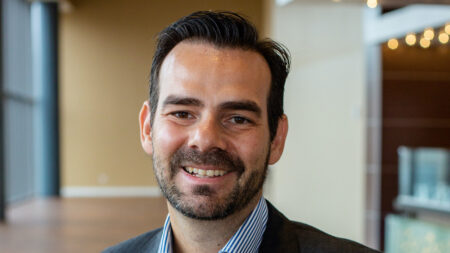



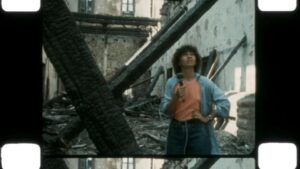

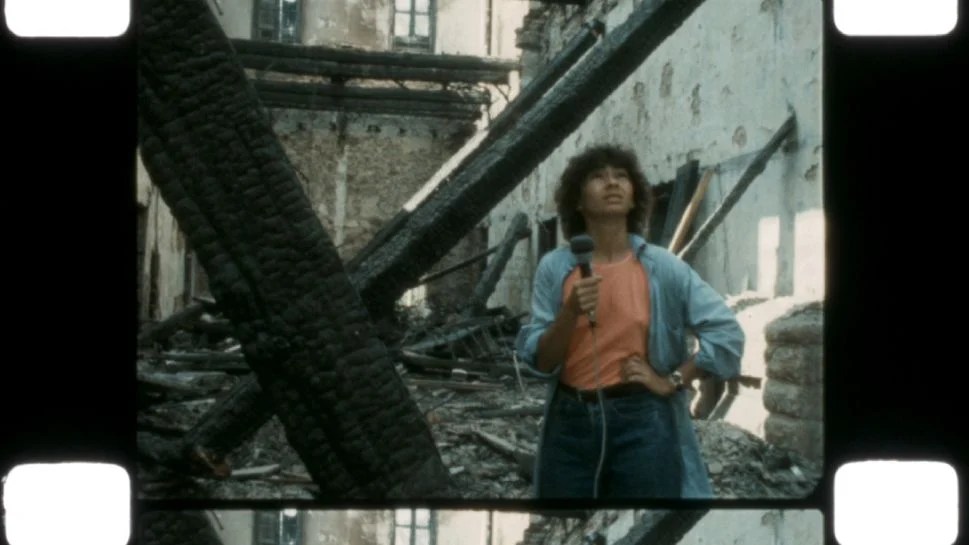


In late Lebanese filmmaker and war reporter Jocelyne Saab’s 1982 film Beirut My City, she can be seen standing in front of her house after it was bombed and destroyed. Belgium-based Palestinian filmmaker Mohanad Yaqubi (R21 AKA Restoring Solidarity, Off Frame AKA Revolution Until Victory) can relate — his family’s house in Gaza was bombed in April 2024. It is just one connection between the two. Another is an invitation that Yaqubi received from the female pioneer to collaborate just two months before she died, which he didn’t answer at the time.
So it’s perhaps fitting that Yaqubi decided to explore the work of Saab during her first decade of filmmaking, from 1973 to 1983. And he does so in his new film Revolutionaries Never Die, which will premiere in the Filmmakers of the Present competition program of the 79th edition of the Locarno Film Festival on Aug. 9.
Yaqubi, who is also the Palestine Film Institute’s public programmer and whose company Idioms Film produced Revolutionaries Never Die, describes the film, a cinematic letter to Saab, this way: “Jocelyne Saab’s film archive from 1973 to 1983 brought forward several questions about the striking resonance between her historical depictions and our contemporary realities five decades later, when no answers can ever be given.” Square Eyes is handling international sales.
Locarno artistic director Giona A. Nazzaro, in an interview with THR, lauded the film as paying homage to “the legacy of the magnificent Lebanese filmmaker,” and Saab for documenting “with an uncanny eye for the future the onset of the Iranian revolution” and more. “She was this living memory of what was going on, and the film is basically about the work and the life of Jocelyne Saab as a living archive,” he concluded.
Yaqubi never met Saab. Before diving into his new archive film, he wasn’t even too familiar with much of her work. “I knew a bit about her work, some of the famous films, like Letter From Beirut and others, before she passed away,” Yaqubi tells THR. “My work is really focused on this militant cinema period in the ‘60s and ‘70s. Her name always comes up, but I was more focused on what is considered Palestinian and on the topic of militant cinema itself. There was nothing much written about her. So, I really didn’t know much about her until we did a film program with the collective I work with and with the Courtisane Film Festival. The program was called ‘Out of the Shadows,’ and it was about five female filmmakers from the Arab world, with the others [being] Heiny Srour, Atteyat Al-Abnoudy, Selma Baccar and Assia Djebar. These are filmmakers from the Arab world, pioneers, politically committed, making films beside their male colleagues.”
Yaqubi recalls wondering why Saab and her work, as well as others, weren’t more widely known and recognized. “The question is always: Why don’t we know about these things and these people?” he shares. “It’s also related to this society that is based on the male gaze at the end of the day, even when it comes to topics of liberation.”
At first, his dive into Saab’s archive was “a restoration project,” he explains. “Mathilde Rouxel, who was her assistant in the last seven, eight years before she passed away, approached me, and because I had a film scanner in my office, we said, let’s do the scanning,” Yaqubi shares. “This is how I got to know her work.”
And then, shared experiences became obvious. “The parallels started to show up after my house in Gaza was destroyed,” Yaqubi tells THR. “And I was invited by the Cinematek in Brussels to present this film, and it was three or four days after our house was destroyed in Gaza. And I saw this on the screen, and suddenly I couldn’t take it. And I thought, let me check out these parallels.”
The filmmaker also felt he had to think about how to continue Saab’s work. “She made all these films and then somehow condensed all of her experience in one film, so for me the question was how do I continue that?” Yaqubi says. “It’s still only my third film. I’m working on cinema, but at the same time, I’m carrying this heavy feeling. What does it mean to be a committed filmmaker? It’s as if a decision has been made that I can’t make anything unless I’m committed to films for liberation, in a sense. But how do you do that? Where do you learn that? If you go to any film schools, they will not teach you these things. This is something that you have to explore and research. I feel that this film, even though it’s my third feature, is really my first film.”
The question of whether he wanted to or could even continue making films weighed on Yaqubi amid the latest escalations in the Middle East. “I made a decision on how I’m going to continue making films,” he tells THR. “But after October 7 and these whole atrocities that happened, why do we make films? I teach my students about the Frankfurt School, [the group of philosophers, sociologists and other thinkers who created Critical Theory and analyzed Nazism and more]. They all talked about the genocide, the Holocaust, violence and all of those things and Western ideologies. It is the same ideologies that enable these atrocities. So how are we going to move on from here?”
Concludes the filmmaker: “So there was a real need to reconstruct and re-deal with everything in a way that makes sense somehow. And this film is my answer for this beginning.”
Revolutionaries Never Die indeed sees Yaqubi call his cinematic letter to Saab his attempt to “cut through the repetition and disrupt it,” while not losing the belief that you can make films.
“It’s this idea of time as a loop, and everything is looping,” he explains to THR. “The same images keep coming again, even inside the same film. So, in my film, I felt that these repeating images, such as some scenes of Jocelyne writing, capture this feeling. Time and space collapse. This is our feeling as filmmakers today. So a chronology of shot after shot doesn’t work anymore.”
Revolutionaries Never Die highlights how there was always a positive outlook in Saab’s work. “What is very special about her is that hope she always has,” Yaqubi says. “Even with her house destroyed, she’s like, ‘It’s okay. At least nobody has died. We can continue. We can rebuild. And I think this is the feeling and the sense that I wanted to get across, and I want to project that hope to audiences.”
The filmmaker had the title Revolutionaries Never Die from the first minute. “I never changed it,” says Yaqubi. “It comes from [an autobiographical] book of conversations between Palestinian political leader George Habash and French journalist Georges Malbrunot about the revolutionary practices in the Palestinian struggle. My idea was that we always have to keep on making or thinking of revolution, even in the darkest times, because that’s the only way for us not to disappear.”
Concludes the filmmaker: “Jocelyne Saab was a revolutionary not only in the classical sense, but she’s also a revolutionary on a social level. And she is also a revolutionary for being a woman film pioneer. She was a revolutionary in many senses. That makes her — I don’t want to say eternal — but it makes her somebody who never dies. I heard this Arab proverb: You die three times. You die when you die. You die when you’re buried. And the third time you die when nobody remembers you.”
Read the full article here