






At the peak of its mania back in 2017, Rick and Morty cultivated a fanbase that, to put it kindly, was a bit much. At its fringes. No, not you, sensible reader. Obviously. But you know this to be true.
Sometimes a show with fans that extreme — seriously, need I remind you of the Szechuan sauce situation? — can alienate more moderate viewers, but Rick and Morty had something important going for it, something that made it hard to be entirely scared off: It was really good. There were stretches when it could easily have been argued that Rick and Morty was the loopiest and most creatively unhinged (in a good way) show on television.
President Curtis
The Bottom Line
Gets better after a shaky start.
Airdate: 11:30 p.m. Sunday, July 26 (Adult Swim)
Cast: Keith David, Jim Rash, Stephanie Beatriz
Creators: Dan Harmon and James Siciliano
It has been a while since that was the case. These days, Rick and Morty is so qualitatively erratic that if I miss an episode or two (or the second half of a season), nothing feels lost, and after watching screeners for the first few episodes of the current 10th season, I checked out entirely.
Recent autopilot Emmy nomination aside, this hardly feels like the best time for a Rick and Morty spinoff series, nor would I necessarily have thought that President Andre Curtis, a recurring character voiced by Keith David, was the most logical character around whom to build a spinoff.
The pilot of Adult Swim’s President Curtis, created by Dan Harmon and James Siciliano, seems to confirm the staleness and lack of utility for the new series. But patience is at least somewhat rewarded. Subsequent President Curtis episodes are funnier, wilder and better focused than the opener.
Through the full 10-episode first season, President Curtis never becomes sharp enough to create a fervent cult of its own, but as a quirky diversion, it offers a reasonable amount of amusement.
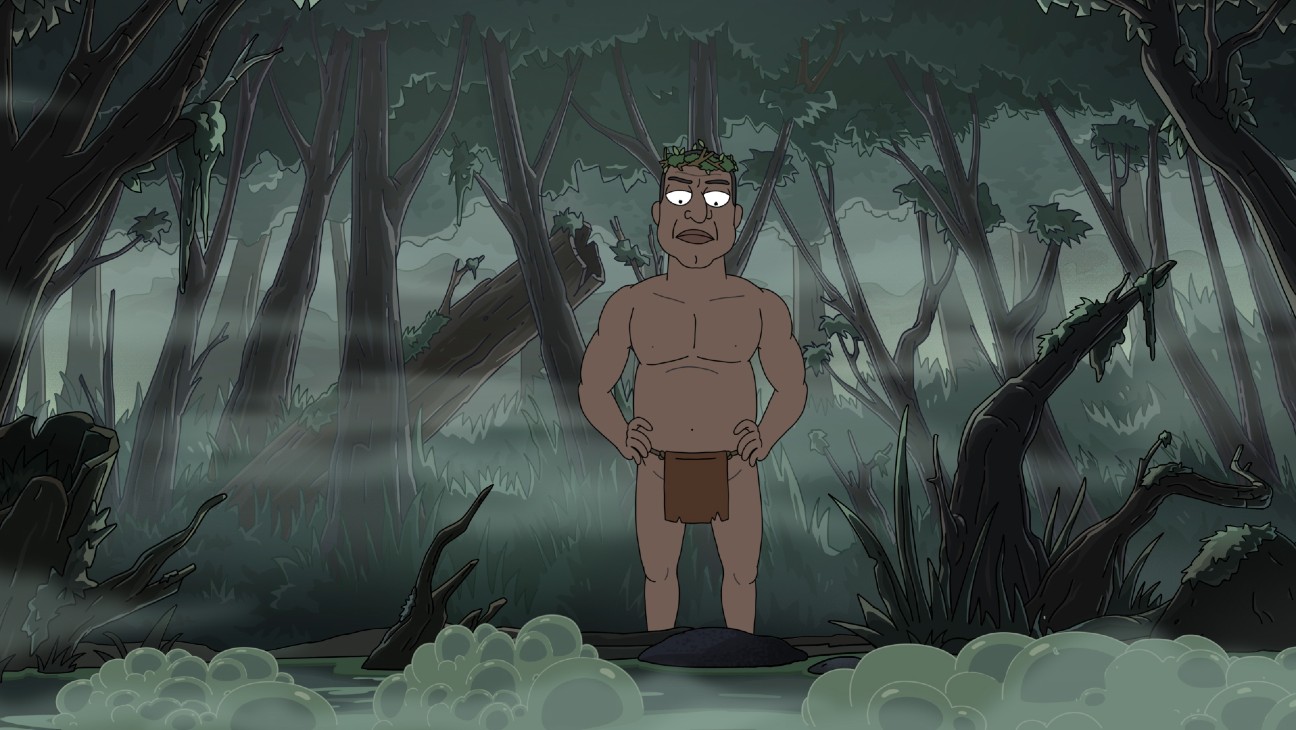
David returns as President Curtis, a divorced chief executive accurately praised by a reporter for having the best voice in presidential history. Curtis has no evident interest in his traditional accepted job — leading the country and whatnot — instead dedicating his time to vigilante side quests and playing networked video games with his constituents.
The series begins with an introductory press conference at which President Curtis proudly announces that he killed Paul Bunyan, who proved to be less an icon of American lumberjackery and more a vicious and gigantic cannibal. Though the Paul Bunyan joke becomes more substantive later in the season, it serves the initial purpose of quickly illustrating the sort of missions Curtis and the series will take an interest in, namely threats that would generally be too small for Rick and Morty to handle, threats tied to civics and/or American history and governance.
The description “National Treasure in the multiverse” is probably more enticing than what President Curtis actually delivers, as is the superior opening credits sequence blending ’80s sitcom-style theme music with action snapshots a la a broadcast adventure from that period. It’s at least a taste.
Curtis, who made multiple appearances on Rick and Morty over the years without really establishing a coherent voice or surrounding milieu of his own, is joined on his missions by O’Doyle (Jim Rash), a half-leprechaun secret service agent who aggressively resists the trickery and deceit of his species, and Banks (Stephanie Beatriz), Curtis’ newly appointed chief of staff, who isn’t quite a cyborg, but has been cybernetically “maximized for neural plasticity.”
The pilot, in which the CIA attempts to secure the real footage of the moon landing in order to protect a secret dating back to the Kennedy administration, is tasked with introducing the main characters and the structure of the show and it fails rather completely.
Not only is the pilot thoroughly unfunny — even an obligatory Rick and Morty cameo offers nothing — but I came away from it with no sense of O’Doyle’s voice and attributes and no understanding of Banks as a character, much less her robotically enhanced capabilities. And much less why the show wants or needs her to occupy the position of “chief of staff,” given that the staff is seemingly limited to a brassy old secretary and a tech guy who wants to be part of the team but isn’t. She’s the chief of nobody, which is probably for the best because since when is “chief of staff” a starter job for somebody who has never even met the president?
Realism shouldn’t be applied to a show like President Curtis, but the initial adventure isn’t funny enough to stanch the flow of parochial curiosities.
Even nine episodes later, I still hadn’t really warmed to O’Doyle or Banks as distinctive characters. Neither the leprechaun nor cybernetic thing is fully or consistently rendered, but there are highlight episodes that hint at potential for both.
O’Doyle gets to be at the center of one episode featuring his mother — the leprechaun half of his DNA — and built around the theft of gold from Fort Knox. A flashback episode somewhat explores the events that led to Banks’ enhancements. At this pace, by season six or seven, they might both be interesting characters, but so far it’s just Rash and Beatriz doing energetic, but nondescript voiceover work.
Curtis hasn’t really come close to reaching his potential as a character either. An episode featuring his ex-wife, the newly elected Governor of Illinois, underlines the loneliness that drives Curtis, who still sleeps pushed to one side of his presidential bed. It’s a faint undercurrent of melancholy, infused with the necessary regret and feigned bluster by the ever-impeccable David, that substitutes for a personality or, given that he’s the president, any sort of ideology at all.
The series delves mostly into details from the past — Abe Lincoln’s ghost and Amelia Earhart are among the better featured characters — in large part to avoid anything more than superficial similarities to 21st century political figures.
It’s hard to make a television show set in this chosen world that’s so completely toothless, but President Curtis is much more comfortable with meta-examinations of television tropes — jokes about spinoffs, A and B stories and Hallmark’s love of Christmas abound — than building satire around the ways Washington does or doesn’t work, much less the state of national affairs that might elevate a Curtis to power. On Rick and Morty, he occasionally resembled President Obama and later President Trump, but now he’s just there, representing and embodying nothing, tied to nothing tangible.
Of course, Rick and Morty is only sometimes a show with “meaning,” while the inconsistency of its supporting characters has always been a running gag, with more Ricks, Mortys, Beths and Jerrys than one could ever count. What Rick and Morty had going for it, at its best, was conceptual inspiration, the ability to take a kernel of an idea and stretch it to the creative limit and beyond.
President Curtis has, especially after the pilot, some very sturdy episodic concepts, from the top secret supermax prison in the Bermuda Triangle to a journey to the center of the Earth to the aforementioned appearance by Ghost Lincoln. Every once in a while, you might even convince yourself that you’ve learned just a wee bit about American history. The season does a decent job of seeding its few ongoing story arcs and some of its recurring jokes, especially the song and subsequent outtake accompanying each week’s closing credits, are sturdy.
There’s nothing here so far that I can imagine becoming a cultural talking point of the sort that Ricky and Morty delivered with semi-regularity in those early seasons. But if that prevents future riots at McDonald’s, no great loss.
After the rough start, President Curtis settles into a decent groove in which the plot-based things that work are a repeatable foundation and the character-based things that haven’t found a way to gel could easily improve with more episodes. When it comes to this week’s comedy spinoffs arriving long after the peak of the original series and focusing on characters who didn’t demand standalone stories, President Curtis at least tops Stuart Fails to Save the Universe.
Read the full article here