







“Power. People. Data.” That is a core theme of this year’s program of Locarno Pro, the industry strand of the Locarno Film Festival, whose 79th edition is currently taking place in the Swiss lakeside city. But in which order should we think about these key concepts and buzzwords? Is it maybe people, power, data?
You may have your own thoughts, and the opening day of the 15th edition of Locarno Pro, led by Markus Duffner in his sixth year, showed that there are very different ways to think about the order of and relationship between the three. After all, a three-person panel shared three different approaches and thoughts.
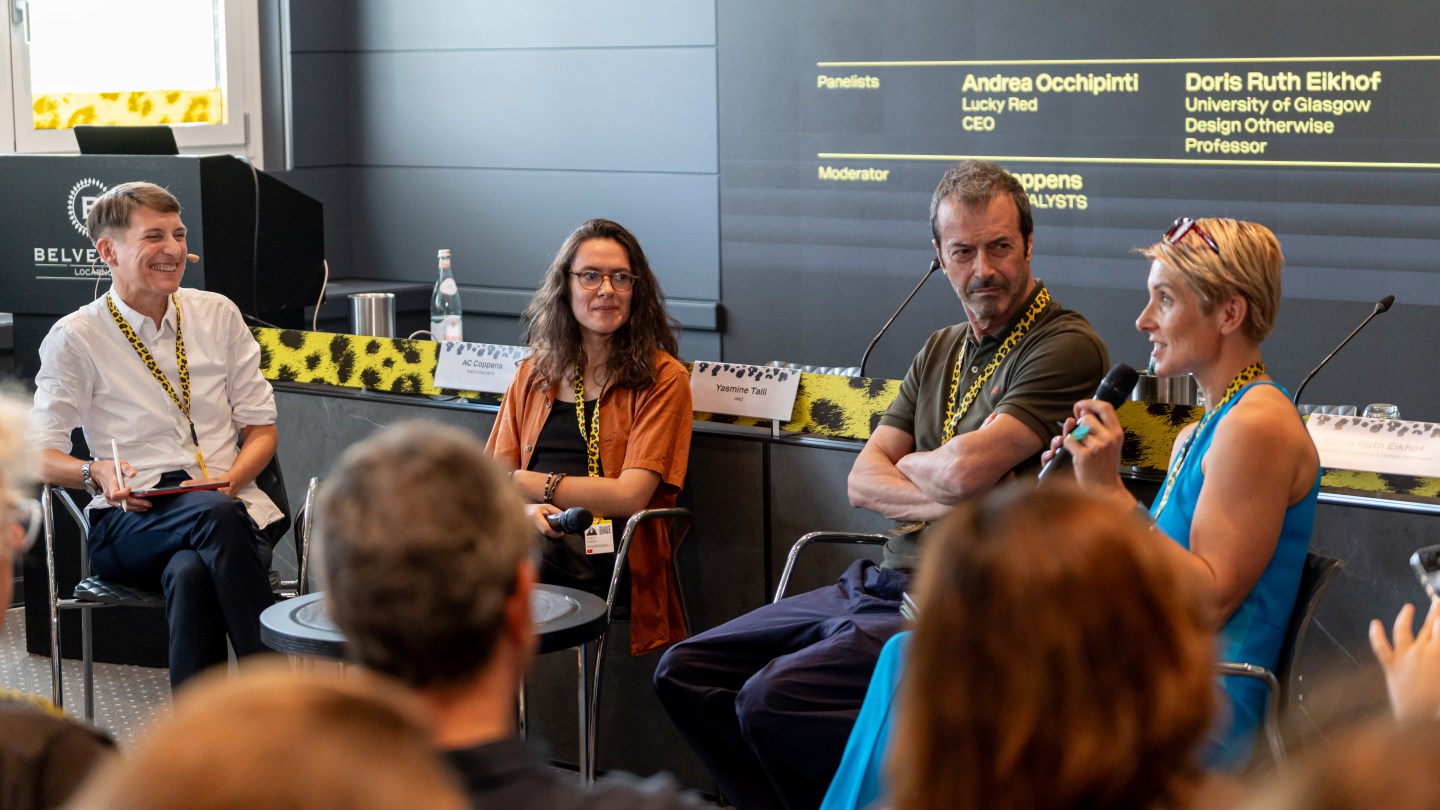
Moderated by AC Coppers of The Catalysts, the panel featured Yasmine Talli, acquisitions manager at sales agent, producer and distributor mk2 Films, Andrea Occhipinti, president and founder of Italian producer and distributor Lucky Red, in which StudioCanal recently acquired a majority stake, Doris Ruth Eikhof, CEO of the University of Glasgow spin-out company Design Otherwise, which focuses on helping organizations to improve inclusion and diversity in the cultural sector.
Asked about how she thinks about the order of and relationship between the three words in focus of the discussion, Eikhof offered her take: power, data, people. “People will be people. They’ll be more or less wise or more or less flawed,” she explains. “So, we sort out the power structures first and the stories that we tell about ourselves – that’s what data really is. Then we have the best chance at creating a space in which everyone can prosper.”
Occhipinti had a different approach. “I’ll go with people first,” he said. “Judgment, sensitivity and experiences come first. Then comes power. And data is a very important tool that we have to use.”
And Talli shared this thought: people, data, power. “It’s probably true that people need to gather some data in order to keep power,” she explained.
A key topic the industry players were asked about was how much they make decisions about films based on conviction versus data and algorithms. “We don’t use algorithms to choose a film that we want to distribute or produce,” shared Occhipinti. “We go very much on instinct, sensitivity and experience. If there’s something that clicks in that film, in that story, even if data or comparables or whatever says don’t do it, often we have proved the contrary” is true.
He mentioned examples, too. “We saw a film like Ida [by Pawel Pawlikowski] – a Polish film, black-and-white,” Occhipinti noted. “We saw it twice. This cannot work, but we still thought it’s a great movie. Or [Barry Jenkins’] Moonlight.”
His takeaway was that there are clearly “movies that on paper are not going to be successful,” but
conviction can trump data. Not that Lucky Red doesn’t look at data. As a distributor, the firm has a community that responds to films, which is a form of data, he told the panel audience. “We don’t know what they are looking for, but we test what they react to,” Occhipinti concluded.
How does mk2 make its decisions? Talli outlined a similar approach. “When we consider projects, …[we use] emotion, taste and the human aspects, but we also have what we want to believe gives us some more certainty that a film is going to work,” she said. “The things that we mostly pay attention to [include] the track record of a director, checking which festivals he or she attended with his or her previous work. The people around that director also matter. Who is the producer? The cast also gives a pretty big indication for us when we consider the potential in the international market,” mostly for English-language films.
Talli shared that mk2 is also looking at “comparables, films that have premiered in recent years that for some reason feel that they could be compared to the projects we are evaluating, not necessarily because the story is similar.” She explained that it is more of “a market comparison.”
All in all, at mk2, “it’s a process that actually involves a lot of people,” Talli concluded. “We have a pool of readers. If the readers are recommending something, then we go to the next level to people in the acquisitions team. So, it’s very much a group decision.”
The panel session was part of the 2026 StepIn kick-off event session, following a debate-inducing presentation by film industry data analyst Stephen Follows, who raised eyebrows with data points and hard truths in a presentation entitled “Fear, Lies, and the Illusion of Control.” Among the issues he covered were the likes of how many of this century’s 100 top-grossing films have a “nepo baby creative” and what low percentage of indie films generate a profit.
Read the full article here