




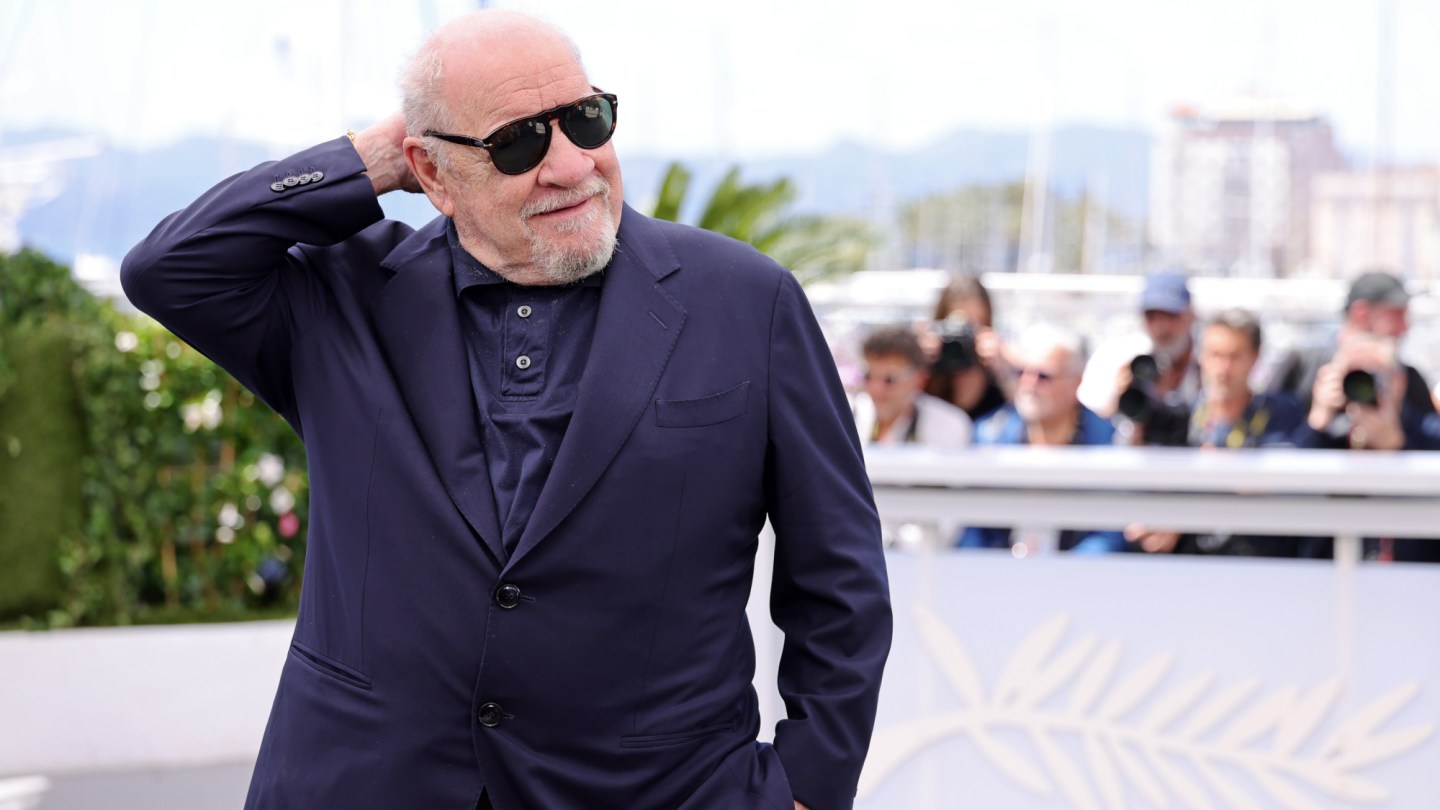


Audiences will eventually love Tilly Norwood, or a fully synthetic AI-generated performer like her, if you believe Paul Schrader.
The iconoclastic writer and director behind First Reformed, American Gigolo and The Card Counter has expressed interest in generative AI-assisted filmmaking for some time (and the tech in general — he recently claimed to have “procured an online AI girlfriend” who dumped him). And in a keynote speech at Amazon’s AI on the Lot event in Culver City on Thursday, the 79-year-old filmmaker expanded on his vision for how the technology could transform the film industry, even as at times he sounded a bit ambivalent about it.
“The real tip of the spear is when we can create an AI protagonist, not a hybrid. And that movie makes money,” he told the audience of conference attendees. He described a scenario where an AI tool is prompted to create a movie star that ends up looking like Clint Eastwood, even though the the person prompting the tool never uttered the Dirty Harry star’s name.
“The movie comes out and us carbon-based fools spend our money empathizing and caring about silicon-based creations,” Schrader continued. “And they want the next one. They want the follow-up one. Well, we know where that actor lives and he works for nothing and he works for 24 hours a day and he’s available right now.”
Schrader said that he had disagreed with Amazon MGM Studios’ head of AI studios, Albert Cheng, the previous day about whether audiences would wholeheartedly embrace a synthetic star. “I think he’s just afraid,” Schrader said. “I think it is going to happen. I think we are going to have a non-hybrid protagonist in the arts.”
Schrader is clearly not afraid. He was open about the fact that he may not live to see whether his predictions will come true or not: “I’m going to be able to ride into that cinematic sunset of that old broken horse we call movies,” he said. But he’s already working on an AI movie just because he finds it interesting, he says, using an old script. And he has plenty of ideas for how to use the technology, such as generating a new episode of I Love Lucy or Bonanza using AI, and having it write in a “‘50s style.”
On a more granular level, he cracked some jokes about areas of the business that could replace human work with AI. On the 2024 film Wicked, which he watched on the plane ride to the conference: “I’m looking at why are we paying extra $180 a day when they look so plastic and we not only pay them $180 a day, we have to close them and we have to feed them and we have to deal with their complaints when it gets too hot? Why don’t we just make them?” On scores for true-crime recreation documentaries: “Why is some poor guy sitting there on a synthesizer doing this pattern when all we have to do is feed it in [to an AI tool]?”
But Schrader was also clear that he thought at some point his own skills might be replaced by AI. He described asking ChatGPT to produce a script idea in his style and seeing it produce a story idea called The Collection Agency, about a former Catholic working as a medical debt collector who runs across a girl that brings up an old secret. (In another very Schrader-like touch, the man obsessively records diaristic entries in a cassette tape recorder while staying in cheap business hotels.)
“I could send it out. I know what response I would get: This is second-rate Schrader… but it’s going to be first-rate Schrader soon enough.” He joked, “And it’s already first-rate NCIS.”
Schrader isn’t the only one envisioning a future where studios could try minting synthetic stars. The performers’ union SAG-AFTRA has been concerned enough about that possibility that in its recent contract negotiations it extracted a commitment from the studios to not use synthetic over human performers unless it provides “significant additional value” to a project.
Read the full article here