




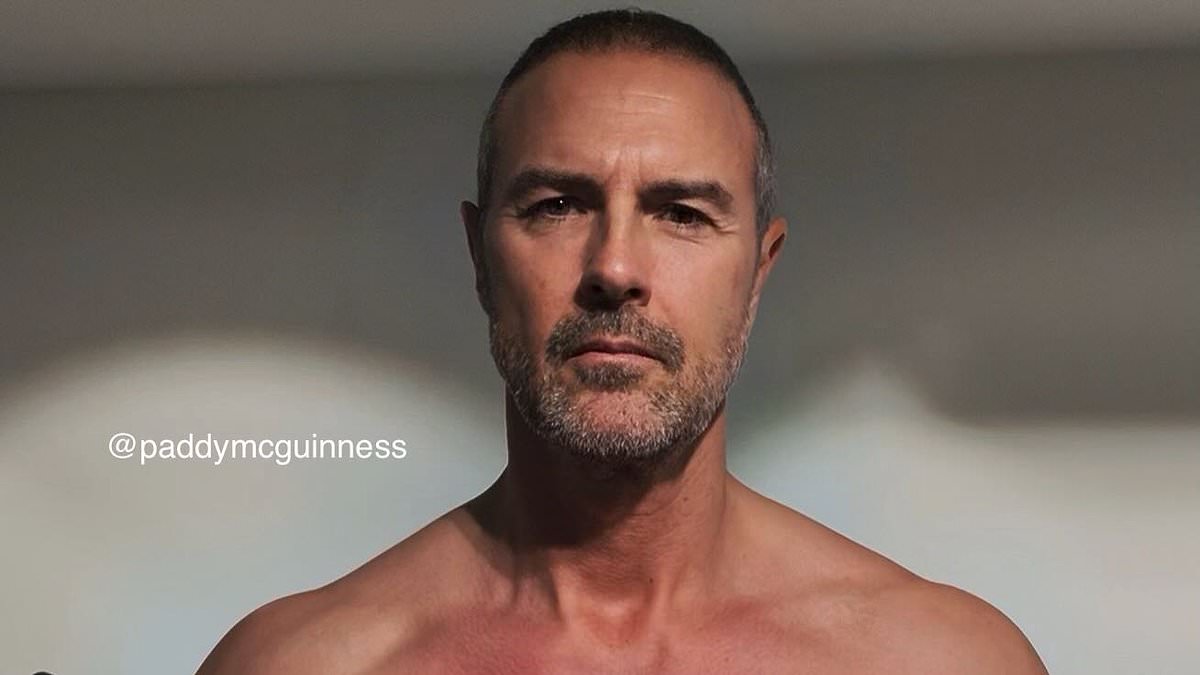

Paddy McGuinness says he ‘smashed himself to pieces’ after taking on a controversial viral fitness philosophy described by critics as a ‘recipe for burnout and injury.’
The TV presenter stunned social media followers by revealing his muscular physique after taking on the 75 Hard exercise method – a military-style programme combining exercise, diet and rigid self-discipline.
Experts warn that while some people may see impressive results, the programme is not suitable for everyone, requiring strict adherence to a set of seemingly arbitrary rules.
And McGuinness, 52, admits the rigorous programme shocked his body to such an extent that he struggled to get up in the morning.
Appearing on the Scott Mills Breakfast Show on Wednesday morning, he said: ‘The best advice if you’re doing a challenge like that is, don’t do too much straight away.
‘The 75 is two training sessions a day, 45 minutes each, one’s got to be outdoors, one’s got to be indoors. Indoors can be yoga, it doesn’t have to be a gym. Outdoors can be a nice hike or whatever, it’s just about getting yourself out and doing it.
Paddy McGuinness says he ‘smashed himself to pieces’ after taking on a controversial viral fitness philosophy described by critics as a ‘recipe for burnout and injury’
McGuinness admits the rigorous programme shocked his body to such an extent that he struggled to get up in the morning
‘I [smashed myself to pieces] for the first two weeks and I literally couldn’t get out of bed, my limbs were aching and everything else, so I just started training a bit different.’
McGuinness decided to take on the viral trend through boredom, and used his former Children In Need challenge – during which he raised £7.5million for charity by spending five days riding across the UK on a customised 1970s children’s bike – as motivation.
He said: ‘When I did the Children In Need challenge it was so physically exerting. I used to think, “how did I do that? How did I manage that challenge?” And I thought right, I’d love to do something again, really out of my comfort zone, and that’s what I did.
‘I had a bit of free time for a month and a half and I thought I’m gonna do it. I really enjoyed it. It’s so good for your mind and resilience. It was brilliant.’
Launched in 2019 by American entrepreneur – and self-styled ‘certified dominator’ – Andy Frisella, the 75-day high-intensity regime claims to offer a holistic approach to health and often results in significant weight loss.
There are five crucial elements to the programme: following a non-specified but ‘clean’ and challenging diet with no cheat days; drinking at least 3.79 litres of water a day; completing two 45-minute workouts daily – one of which must be outdoors; reading 10 pages of a non-fiction book; and taking daily progress pictures.
Crucially, if you compromise on any one of these rules – for example, by reading nine pages instead of 10 – you must start again from day one.
Alcohol is strictly prohibited, as are ‘cheat meals’, and participants are not supposed to modify the programme to make it easier – regardless of their baseline fitness.
Experts warn that while some people may see impressive results, the programme is not suitable for everyone, requiring strict adherence to a set of seemingly arbitrary rules
McGuinness decided to take on the viral trend through boredom, and used a former Children In Need challenge – during which he raised £7.5million for charity – as motivation
For the TV presenter, this meant kicking a two-month binge-eating habit that saw him gorging on cakes and biscuits, washed down with beer.
McGuinness proudly showed off his ripped abs on social media in a before-and-after photo, describing the results as ‘amazing’.
Looking back, he said: ‘It really is incredible what can be achieved in such a short period of time… if you’ve got the willpower.’
He admitted the challenge might not be for everyone, but added: ‘If you’ve got even an ounce of willpower, why not give something a whirl?’
That mindset closely mirrors Frisella’s own philosophy. ‘In life, conditions are never going to be perfect,’ he has said. ‘You are always going to have to do things you don’t want to do.’
McGuinness said that he couldn’t believe ‘how much he let himself go’ after over indulging on beer and sugary snacks (pictured in March)
Those who successfully complete the challenge are promised they will be in the best physical shape of their lives, alongside improved mental wellbeing.
However, despite building an army of health-conscious supporters who rave about the programme online, experts say there are several serious downsides when it comes to fitness, transformation and long-term self-improvement.
One issue is the relatively short duration of the challenge, which can be completed in less than two and a half months.
While most people will see some results if they adhere to all of the constraints, experts warn there is only so much the body can achieve in a fixed time frame – and results cannot always be ‘supercharged’.
There is also a strong risk that once the challenge ends, people revert to old habits as work, social and family life inevitably take over.
McGuinness himself admitted he ‘couldn’t believe how much he’d let himself go’ after over-indulging on beer and sugary snacks earlier this year.
75 Hard is all the rage among influencers, but experts have warned against the potential harms – and Ireland-based Aoife Clauson (pictured) said she ended up in hospital during the regime
According to Emma McCaffrey, a personal trainer and founder of Move With Emma, beginners and middle-aged women may be particularly vulnerable to the downsides of the 75 Hard.
‘While 75 Hard is marketed as a mental toughness challenge, for most women – especially those over 40 – it is a recipe for burnout and injury,’ she said.
‘True, sustainable transformation doesn’t come from a 75-day sprint. It comes from progressive overload on your own terms, in a way that is nourishing and realistic for your life.’
McCaffrey warns that the regime allows for zero recovery time, increasing the risk of physical breakdown.
‘Two 45-minute workouts a day with no rest leads to systemic inflammation and overuse injuries,’ she said.
‘For beginners, the musculoskeletal system hasn’t adapted to handle such high volume. Without recovery days, the body cannot repair the micro-tears in muscle tissue, leading to chronic fatigue, tendonitis or stress fractures rather than strength.’
She also highlighted the hormonal impact. ‘For women over 40, our physiology is more sensitive to stress. Extreme caloric restriction combined with overtraining can spike cortisol.
‘High cortisol levels are counterproductive – they lead to muscle wastage, sleep disruption and creeping weight gain, particularly around the midsection. We should be training to lower our stress response, not heighten it.’
Read the full article here