




“Oasis” feels like a bit of a theme at Venice this year, with at least two movies featuring that word in their titles. One is Will Lovelace and Dylan Southern’s Oasis: Don’t Look Back in Anger, a documentary about the reunion tour of the famous English rock band. But it is the other film that could leave audiences truly rocked.
Is a safe place simply a location or something we can create – a state of mind, even? German writer-director Jannis Lenz explores that and the various forms that exclusion and violence take in his feature debut Oasis (Oase).
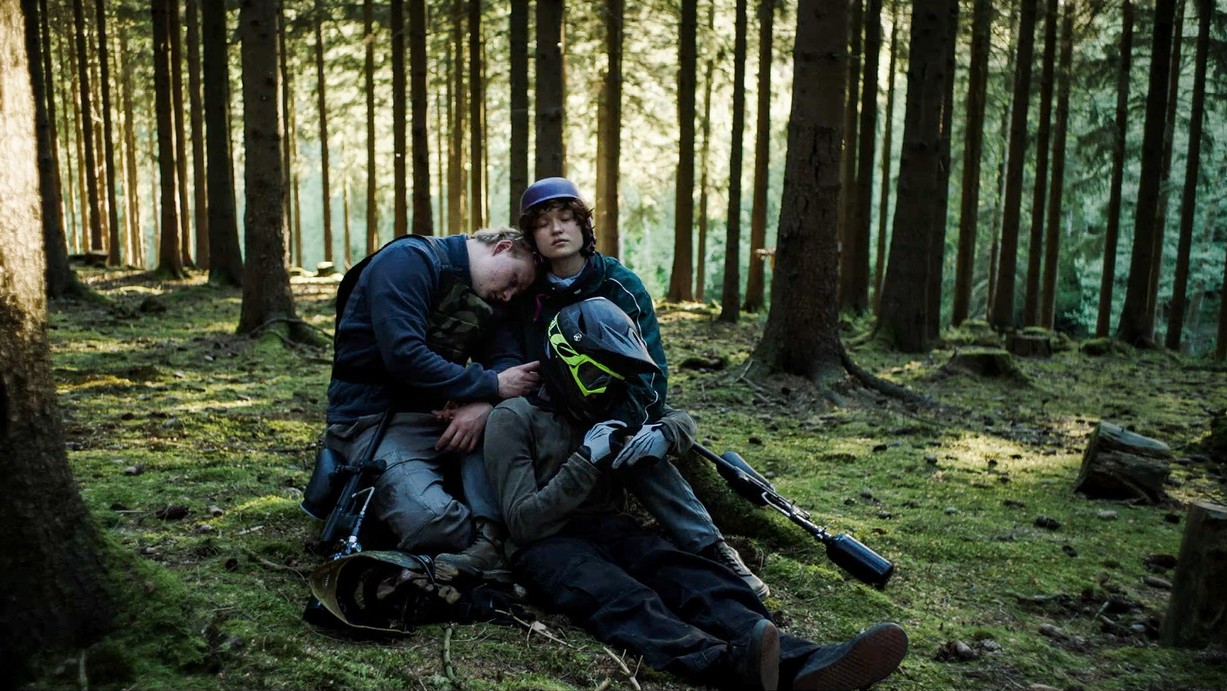
In the film, world-premiering on Sept. 6 in the Horizons section of the 83rd edition of the Venice Film Festival, a viral video of a student threatening his classmates surfaces online, causing concern among school staff, parents and kids. The student shown in the video and two other outcasts end up seeking refuge in a nearby forest. Their play turns into ritual, with pain becoming an escape. But then old wounds surface and, as notes on the film highlight, the boundaries between them are redrawn.
Boundaries were fluid behind the scenes of the production. For example, Lenz directed Oasis based on a screenplay that he wrote with Alexander Dirninger, who also served as director of photography. Lenz also collaborated with Melisa Krasniqi in the editing process.
The cast of Oasis is a showcase of established stars and up-and-coming German actors. Florian Geißelmann (Sound of Falling, Home Stories) as Lukas, Anton Petzold (Home Stories, Ouija) as Andrew and Mathilda Smidt (Almania, Chabos) as Maja feature as the young trio of outcasts, while veteran Godehard Giese plays one of their father’s and teacher (Rose, Transit, Babylon Berlin), with Britta Hammelstein (Murder Mindfully, Woman of the Dead, The Sparrow in the Chimney) potraying the school principal and Ioana Iacob (Do Not Expect Too Much From the End of the World) a school staff member.
Oasis is produced by Germany’s Zeitgeist Filmproduktion and co-produced by Austria’s Wega Film and Germany’s Third Picture in collaboration with We Fade to Grey, Ocean Pictures Filmproduktion and Totem Films. The German theatrical release is planned for February 2027 via Mindjazz Pictures. Totem Films is handling international sales on the German-Austrian co-production.
Lenz has also previously explored themes of the body and identity, as well as violence in his shorts, such as Shadowboxer (2015), Wannabe (2017), which was nominated for the European Film Award, and Soldat Ahmet (2021), which won several awards after its world premiere at the Visions du Réel festival in Switzerland.
Ahead of the Venice world premiere of Oasis, Lenz talked to THR about the timely themes that his first feature, and his first film made after his return to Germany from Austria, dives into, exploring adolescent rage and pain in the digital age without providing easy answers, ensuring true collaboration with cast and crew, and casting Ahmet Simsek, who featured in two of his shorts.
Thank you for the emotional, and at times difficult, film. Why did you want to make a film about the violent sides of adolescent and school life and beyond?
I think that the stories that are probably the most uncomfortable to us are the ones that should be told. In this case, I moved back to Germany from Vienna, where I spent a third of my whole life. For family reasons, I moved back to the area where I grew up. And after so many years in the big city, I spent a lot of time in nature again, including in the woods where I played as a child – and now with my own children. The older one already goes to school, and so, through direct contact with the surroundings, so many memories came up again, and I felt I had to deal with them. In the end, we even ended up shooting in the same elementary school that I went to and that my son is now going to.
When I grew up, there were school pressures, and there was the fear of ostracism. It seems like that is happening on a different level in our age of digital and social media. How do you think about how much has changed or stayed the same?
When I was a teenager, it already started to go in this direction, but, of course, it was very different from what it is today. For example, my nephews and people in my very close surroundings and family [give me a chance] to talk and discuss these themes. I felt that it was something for kids that is always present in everything they do, in the way they think, in the way they behave. This feeling of always being watched is something that changes life. That was very important for me to explore because it will get more and more serious as my children are growing up, and so it will become a problem of mine too.
Also, the thing about violence is, I think, that it just changes its form, but the problems remain the same. Now, it’s just on a digital level, and when I was young, it came in a more direct way. But it wasn’t better or worse. I think it’s just a different way that violence or pressure is coming to young people.
Looking at the Netflix series Adolescence, it feels like adolescent rage and violence are particularly timely and universal topics…
My aim was to get to the core of something, and in this case, it was how hierarchies are built in very early stages and the role models that shape us and that remain or stay with us for probably the rest of our lives. I think that happens very often in school. And I always try to make something as specific as possible, so that it becomes universal in the end. If you really get to the core of something, then many people can relate to it, and that was something I was aiming for. So, yes, violence and the things we describe is something that’s not specific to Austria or Germany – you find it in the whole world, because violence doesn’t stop at borders and it doesn’t make a difference between social classes and the like. It’s more like a virus that just changes its form and spreads.
Oasis shows and touches on various types of violence, not just physical, but also verbal, non-verbal, social, etc. How early did you know you wanted to cover a range of violence? And violence is a theme that I have noticed you dive into throughout your shorts as well…
Different views on violence are something that I’ve worked on in different films, especially in the films that I have worked on with Ahmet Simsek. In Shadowboxer, he was a young boxer forced into anti-violence training. Then I portrayed him in Soldat Ahmet in his job as a soldier in the barracks in the Austrian Federal Army and as a professional boxer. And now in Oasis, he’s holding an anti-violence training at the school.
Your cast is such a great mix of established names and young up-and-comers. How was the casting process?
I actually started from scratch because all my movies were made in Vienna up to this point, and so I didn’t know anybody in the German film scene. So I took a lot of time casting them. And because I come from the documentary side, this is something that shaped my work. So, I didn’t go into rehearsing scenes. It was more about coming together, talking, and getting to know each other, and trying to find out what we expect from the film and what the actors see in these characters, and then bringing the [core] three together and testing their chemistry.
We brought together and mixed many young people in Berlin in a casting room, and things became absolutely clear. The chemistry between the three of them was so intense, and they felt it, and I felt it, and our casting director felt it. It was just clear that they must be this group that carries the film.
The way you describe your process and your doc influence, I wonder how flexible the script was…
I have a very concrete vision of how the film should be – what it should transport, and how it should feel. But the process to get there is open, and I am always in contact and in exchange, especially with my actors and what they bring in, because they are the ones who have to bring these characters from paper to life. My experience is that it is much better to give them space to bring in their own experiences than to push them to a point where they maybe don’t want to go.
We were talking a lot for us to build trust. I felt that it needed this trust, and we had to build up the same safe place that the characters in the film are building for themselves.
There is a scene that I won’t spoil with the three protagonists touching each other’s hands. In that and other scenes, Oasis felt very much like an all-around sensory experience to me. Does that make sense?
Especially in this scene but also overall, we worked a lot with the sound design to make it a real experience for the audience. The changes are very subtle. But if you really dive into it, I think it’s a very special experience to let go like they let go.

I saw that Benedikt Palier was in charge of the sound for Oasis, and I have come across his name repeatedly over the past year, for example, because he was also on the sound team of Sandra Wollner’s Everytime, among other films.
I have worked with Benedikt for a long time. He also did the sound design for Soldat Ahmet, which was also very special. We both have the same way of working. We try to work with what is already in the film, rather than trying to invent things. We are working from the core of the storyline. Most of the sounds you actually hear are the starting point for the sound design, like a scene with a choir or guitar sounds, because there are guitars standing in Lukas’ room, and we have this one scene where [two characters are] playing Guitar Hero. So every sound is a starting point for the sound design, and then from the sound design, we build up to music. It’s a very organic process.
Since we are talking about creative collaborators, I noticed that Alexander Dirninger is not only the cinematographer, but he also co-wrote the script with you, which seems rare. How did that come about?
Well, Alexander and I studied together. We were in the same class at the Filmakademie Wien, and we knew that we wanted to make a project together. We were talking a lot about this project in a very early stage. And at a certain point, I felt it would be best just to write the script together because we already, from the very beginning, shared some visual ideas. I thought it would be uncommon but very fruitful to work with the DOP during the writing process because later on we also have to translate the written word into a film. It was a very, very inspiring collaboration. I can only recommend it.
Did you feel that also helped the film feel like a really cohesive whole experience?
Yeah, absolutely. In the end, the film should be bigger than the parts it’s built from. That develops out of people not only looking after their own department, but trying to build something together. And this is what filmmaking is for me. We tried to push this as far as possible in the system we’re working in to give several people more than just one position in the film, so that everything can merge together into something that’s bigger than the parts.
The body is something that seems to fascinate you. Do you know where that interest comes from?
Well, I started filmmaking with Parkour and Freerunning, filming my friends and myself during our training sessions, which was a very intuitive process. So nobody told me how to handle the camera or how to move or something like that. It was just filming and then editing it, before I even knew that I wanted to become a filmmaker. So my starting point was showing bodies in urban space, confronted with architecture and weightlessness and stuff like that. And so I think that definitely left traces.
Given the heavy themes and difficult scenes that Oasis features, how did you guys deal with this on set and beyond?
I was already in exchange with a psychologist during the process of writing, just because it’s a very sensitive subject, and I wanted to treat it seriously from the very beginning. And even before we started casting, we got in contact with an intimacy coordinator, and she was in dialogue with us during the casting process, and, of course, the rehearsals, and then on set. So we had rehearsals all together, where the young actors were building their choreographies together with the intimacy coordinator, and on set she was there every time there was a demanding scene.
Of course, we were talking a lot about what this all means also on a psychological level because when we finish shooting, it’s not over. These are themes and topics that you have to deal with even after the camera is off, and we wanted to build the best safe space for them.
How early did you find the title, Oasis?
Actually, it came very late. It was more like the conclusion of what we see in the film. This oasis in the film is not a place the three go to. It’s not a place in the landscape of the film. It’s something that exists in their mind, something they create for themselves, and that’s non-material.
It was also very important for me to show the woods in the film. It’s not an idyllic place. It’s logged. There are wind turbines, which are louder than the birds, even in the last pockets where they hide. And so I didn’t want to romanticize this place, especially because in the German history context, the woods were used by the Nazis for propaganda issues – a sense of creating an image of belonging and identity, and I didn’t want to reproduce that in any way, not even unconsciously. So, the oasis is something they created for themselves.
I won’t spoil the ending of the film, but you don’t let us off the hook easily…
I knew from the very beginning that I didn’t want to end it with an easy answer that only pretends to be an answer. It’s such a complex topic, and it would have felt absolutely wrong. So what I felt what I had to do is to hand over the questions that stayed with me from my age as a teenager, to ask these questions as precisely as possible, and to leave the audience with these questions, not exactly knowing how to feel or what to think, but just to cope with them afterwards – and maybe feel “I have to talk about this with somebody else.”
It’s also very important that the adults and the teachers were once also pupils going to school, and so that’s why I didn’t want to show them as the antagonists who do everything wrong, but just wanted to observe them with the same attentiveness with which I watch the teenagers and try to find out their motivations. In their case, their motivation is fear, and fear is never a good starting point for anything.
Read the full article here