




[The following story contains spoilers from the The Pitt season two, episode four, “10:00 a.m.”]
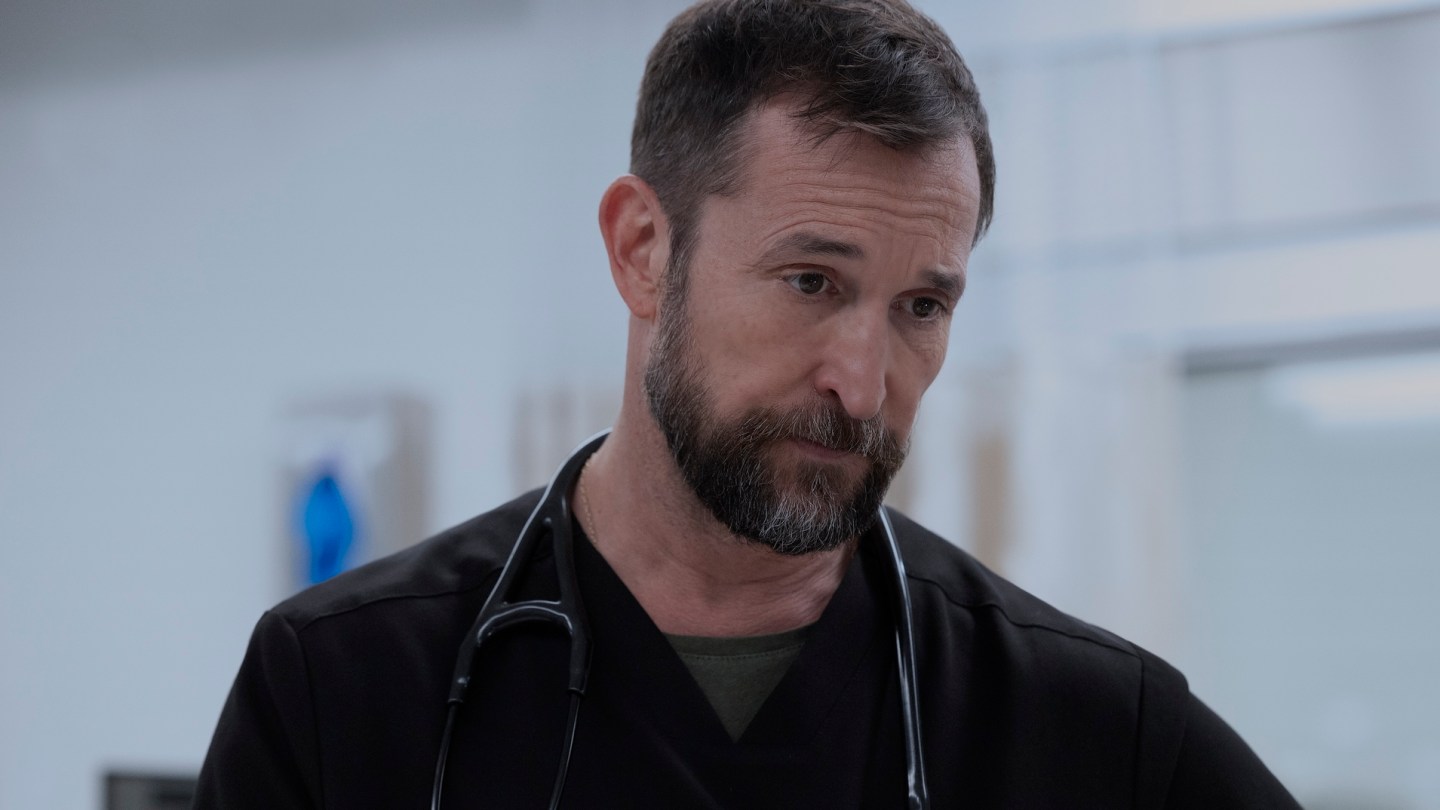
When Noah Wyle‘s Dr. Michael “Robby” Robinavitch ended the first season of The Pitt with an emotional meltdown followed by a heart-to-heart with Shawn Hatosy’s Dr. Abbot on the roof and Abbot offering to connect Robby with his therapist, some sort of mental health treatment seemed like it would be on the horizon for season two.
But, in an exchange with Christopher Thornton’s Dr. Caleb Jefferson in episode four, viewers learn that conventional therapy hasn’t really been working for Robby, as he says the last two people he saw weren’t his “speed” and that his upcoming motorcycle-trip sabbatical is the only sort of “zoom therapy” he’s interested in.
“He’s coming up against what a lot of physicians face, which is it’s really hard for a doctor to be a patient,” Wyle told The Hollywood Reporter ahead of the season two premiere. “It’s really hard to suddenly shift that vocational focus that’s been so directed outward, out of necessity for self preservation and for compartmentalization and for accuracy, to suddenly turn inward and open up a Pandora’s box of things that you’ve not been able to look at for a very long time, and have it not seem overwhelming [or] counterproductive to the job you still have to do, the relationships you still have to maintain and, maybe more significantly, to the example you need to set to your staff and to your patients that you are competent and confident in what you’re doing. So it’s that admission that you’re increasingly projecting an imposter syndrome, as you prescribe a treatment plan that you’re not willing to adhere to yourself, that I found really interesting and really topical. We’ve been inundated with a lot of anecdotal evidence that this is becoming a significant issue with people in these positions, and that leadership becoming an isolating factor in their ability to seek help.”
Indeed Robby’s motorcycle trip is greeted with various forms of skepticism from the other doctors and nurses at the hospital and even, as seen in last week’s episode, a patient who likened it to a “mid-life crisis,” as Robby put it.
“He’s not really practicing what he preaches. He’s advocating that his staff make full use of all the mental health resources available. But he’s not buying in completely himself,” Wyle says. “He’s kind of curated a whole other kind of plan for himself and the restoration of this whole motorcycle and this romantic, slightly literary, slightly utopian trip that he’s planning to go on and get his head clear. And as the season progresses, we begin to call into question the motivations for this trip, the details of this trip and begin to realize that it’s more of an escapist voyage than it is a voyage of self discovery.”
As Robby’s confronting his own demons, he’s also forced to reckon with the return of his onetime protegé, Patrick Ball‘s Dr. Langdon, after Langdon’s stint in rehab for an addiction to benzos, which Robby discovered, kicking him out of the hospital and lamenting how he’d failed to see what was happening.
Robby has spent the early episodes in season two mostly shutting out Langdon, banishing him to triage, and, in episode four, confessing to Katherine LaNasa‘s charge nurse Dana that he’d hoped he’d be gone when Langdon came back. She suggests that perhaps both of them working on the Fourth of July was a sign that they should “clear the air.”
Wyle says “there’s an evolution” to his feelings about Langdon’s return.
“You know, initially you believe it’s because the student has betrayed the teacher and the friend has lied,” Wyle explains to THR. “Then poke that a little bit more, and you can see where the teacher feels a degree of guilt over having had this happen under his auspices, and he didn’t notice it and wasn’t there to save it from happening. You poke it a little farther, and Langdon represents somebody who’s just come back from the therapeutic road, somebody who’s had the courage to face his demons and to humble himself into admitting that he needed help and that he was in over his head and needs to rebuild his life in a more honest way. So to the unexamined person, that’s kryptonite.”
Dana, however, seems to be more accepting of Langdon’s return.
“In my mind. Dana has a child, a middle child that has an addiction problem. I’ve always had that in the back of my mind that has just been a kid that’s had a rougher go at life,” LaNasa tells THR. “There’s a fair amount of addiction in my own family, and I’ve had a lot of experience with alcoholics. And I’m very aware that it’s a disease, so I think it was really easy for me to channel that perspective into being part of Dana. And I think Dana is a person that has seen all walks of life and very much believes and hopes for redemption for everyone. So I think she’s more than willing to extend that. But I do think that honestly, on this particular day, she also wants Langdon to keep his head down and just do his freaking job and let Robby, who’s on his last legs, get out of town. So in a way, it’s like, ‘We don’t need to talk about this now. I forgive you. Go do your job.’ That’s all she wants, you know, like a mom that’s just had it up to here and needs crazy pants to get out of town, needs this guy to just cool his jets, just let everything be.”
Meanwhile, Isa Briones’ Dr. Santos is having a rough day. Her instincts about a young girl who came in with bruises turn out to be incorrect, and she’s struggling to stay on top of her charts. And Briones says Langdon’s return has contributed to Santos feeling “thrown off.”
“The last time she saw him, he told her she didn’t belong in the ER, and I think that really affected her,” Briones says of Santos. “And even though she leads with a facade of confidence, she still doesn’t really feel that underneath, and that’s why she puts that forward: She wants to feel that way.”
Langdon’s return, after she reported that she suspected he was stealing medication, is forcing her to confront “a lot of stuff that she’s tried to push down.”
“She has, I think, not been a great figure in the [emergency department.] A lot of people, I think, are very skeptical of her, because she blew the whistle on Langdon when no one really knows what happened, only a few people, only Robby and I think [Dr.] Whitaker (Gerran Howell), really know what happened and know that he was in the wrong,” Briones says. “So a lot of people have kind of painted her with this scarlet letter and they avoid her, and I think that’s been kind of hard for her but is also a place where she’s comfortable. I think she’s like, ‘Fine, I’ll be alone, I am the lone wolf. I’m the villain, sure.’ And now she actually has to address it and face it instead of just shrinking into it. And that’s very destabilizing for the new normal that she had created in this environment of uncomfortability. Now she has to find a whole new normal when he’s back, because he’s there to stay, like she’s gonna be working with him every day again.”
As for her character’s season two struggles, Briones says viewers are seeing “a much more tired, run-down Santos.”
“She started season one being very ready to take on all these challenges and ready to prove herself. And now I think it’s all catching up. And second year residency is a really tough year, because you’re kind of right in the middle, and you are taking care of those who are under you, and you’re also catching all the things that that the seniors are passing on to you, so you’re carrying all of it. And she used to be up for the challenge, and now she kind of just wants to, like, put her head down and work, which is I think growth in a way, but also I think is a bit of a coping mechanism of Langdon coming back too.”
Though Langdon is back, fellow senior resident Dr. Heather Collins (Tracy Ifeachor) is not, as news broke over the summer that her character would not be in the second season of The Pitt.
And viewers who were wondering what happened to Dr. Collins get an answer in episode four as Whitaker reveals that she moved back to Portland to be closer to her family and is adopting a baby.
When asked about the motivation for including that update, showrunner R. Scott Gemmill cites the “natural rhythm” of the emergency department.
“When someone’s not there, someone inquires about them and where are they? And we thought it would be nice to hear that she was in the process of adopting a baby, because that was the one thing that seemed to be missing from her life,” Gemmill says. “So it would just seem like a nice tribute to the character and to the actor who played it, that they hear that they had moved on and are in a good place and are happy and are fulfilling their life. There was no need to do it, but it felt like it was a nice nod to the character from the previous season.”
While Collins is getting settled with her family, Shabana Azeez‘s student doctor Victoria Javadi has found a new home, and persona as “Dr. J,” on TikTok.
“I think that’s something that emerged after the mass casualty incident of season one,” Azeez says of her character’s TikTok videos. “Everybody deals with the trauma of the mass casualty in really different ways. And I think that with Javadi, she’s a really lonely character. She is really isolated from her peers, like in this season she’s turning 21, and she still can’t legally drink. She’s still a child in so many ways, and she’s in med school with people that are at least half a decade or more older than her. And so she’s really lonely and really isolated and poorly socialized, which I think we can all see with how she asked Matteo out like twice in a day last season. And so I think that finding online community is a really, actually, adaptive way for her to respond to those events. She grew up with technology. I think that she deals with technology in a way that’s really different to how older people deal with it. I think that she tries to make the internet a better place, but I think society has a lot of biases against young women on social media, where they see it as something that’s anti-intellectual and silly or vapid, but I think with Javadi, that’s not the story we’re telling. I think we’re playing with people’s expectations around what that TikTok is going to look like, which I’m excited about.”
New episodes of The Pitt drop Thursdays at 9 p.m. ET/6 p.m. PT on HBO Max ahead of the season finale on April 16.
Read the full article here